Event submissions
Published
This submission belongs to the session S6. Novel and Sustainable approaches in Medicinal Chemistry of the event 9th International Electronic Conference on Medicinal Chemistry
Published date
01 Nov, 2023
Academic Editor
'%3e%3cpath%20d='M12.6657%2010.9104C12.4185%2010.325%2012.0599%209.79327%2011.6097%209.34482C11.1609%208.89508%2010.6293%208.5365%2010.0442%208.28888C10.0389%208.28626%2010.0337%208.28495%2010.0285%208.28233C10.8446%207.69279%2011.3752%206.73249%2011.3752%205.64904C11.3752%203.8542%209.92103%202.39999%208.1262%202.39999C6.33136%202.39999%204.87715%203.8542%204.87715%205.64904C4.87715%206.73249%205.40774%207.69279%206.22393%208.28364C6.21869%208.28626%206.21345%208.28757%206.20821%208.29019C5.62129%208.5378%205.09463%208.89284%204.64265%209.34613C4.1929%209.79493%203.83432%2010.3266%203.58671%2010.9117C3.34345%2011.4845%203.21226%2012.0987%203.20023%2012.7209C3.19988%2012.7349%203.20233%2012.7488%203.20744%2012.7619C3.21255%2012.7749%203.22022%2012.7867%203.22998%2012.7968C3.23975%2012.8068%203.25142%2012.8147%203.26431%2012.8202C3.2772%2012.8256%203.29105%2012.8284%203.30504%2012.8284H4.09109C4.14874%2012.8284%204.19459%2012.7825%204.1959%2012.7262C4.2221%2011.7148%204.62823%2010.7676%205.34617%2010.0497C6.08899%209.30683%207.0755%208.89808%208.1262%208.89808C9.17689%208.89808%2010.1634%209.30683%2010.9062%2010.0497C11.6242%2010.7676%2012.0303%2011.7148%2012.0565%2012.7262C12.0578%2012.7838%2012.1037%2012.8284%2012.1613%2012.8284H12.9474C12.9613%2012.8284%2012.9752%2012.8256%2012.9881%2012.8202C13.001%2012.8147%2013.0126%2012.8068%2013.0224%2012.7968C13.0322%2012.7867%2013.0398%2012.7749%2013.0449%2012.7619C13.0501%2012.7488%2013.0525%2012.7349%2013.0522%2012.7209C13.0391%2012.0947%2012.9094%2011.4855%2012.6657%2010.9104ZM8.1262%207.9024C7.52486%207.9024%206.9589%207.6679%206.53312%207.24211C6.10733%206.81633%205.87283%206.25037%205.87283%205.64904C5.87283%205.0477%206.10733%204.48174%206.53312%204.05596C6.9589%203.63018%207.52486%203.39567%208.1262%203.39567C8.72753%203.39567%209.29349%203.63018%209.71927%204.05596C10.1451%204.48174%2010.3796%205.0477%2010.3796%205.64904C10.3796%206.25037%2010.1451%206.81633%209.71927%207.24211C9.29349%207.6679%208.72753%207.9024%208.1262%207.9024Z'%20fill='%235D1EE1'/%3e%3c/g%3e%3c/svg%3e) Duke Wang
Duke WangCitation
Catarina S. Miranda, Elina Marinho, Susana P. G. Costa, Natália C. Homem, Helena P. Felgueiras, Coaxial wet-spun fibers loaded with essential oils for the treatment of chronic wounds, in Proceedings of 9th International Electronic Conference on Medicinal Chemistry, 1 November–30 November 2023, MDPI: Basel, Switzerland
Share
Email
Facebook
Twitter
LinkedIn
Coaxial wet-spun fibers loaded with essential oils for the treatment of chronic wounds
'%3e%3cpath%20d='M12.6647%2010.9104C12.4176%2010.325%2012.0589%209.7933%2011.6088%209.34485C11.16%208.89511%2010.6283%208.53653%2010.0432%208.28891C10.038%208.28629%2010.0327%208.28498%2010.0275%208.28236C10.8437%207.69282%2011.3743%206.73252%2011.3743%205.64907C11.3743%203.85423%209.92005%202.40002%208.12522%202.40002C6.33038%202.40002%204.87618%203.85423%204.87618%205.64907C4.87618%206.73252%205.40677%207.69282%206.22296%208.28367C6.21772%208.28629%206.21248%208.2876%206.20724%208.29022C5.62031%208.53783%205.09365%208.89287%204.64167%209.34616C4.19192%209.79496%203.83334%2010.3266%203.58573%2010.9117C3.34247%2011.4846%203.21128%2012.0987%203.19925%2012.721C3.1989%2012.735%203.20135%2012.7489%203.20646%2012.7619C3.21157%2012.7749%203.21924%2012.7868%203.22901%2012.7968C3.23877%2012.8068%203.25045%2012.8148%203.26334%2012.8202C3.27623%2012.8256%203.29007%2012.8284%203.30406%2012.8284H4.09012C4.14776%2012.8284%204.19362%2012.7825%204.19493%2012.7262C4.22113%2011.7148%204.62726%2010.7676%205.34519%2010.0497C6.08802%209.30686%207.07452%208.89811%208.12522%208.89811C9.17592%208.89811%2010.1624%209.30686%2010.9052%2010.0497C11.6232%2010.7676%2012.0293%2011.7148%2012.0555%2012.7262C12.0568%2012.7839%2012.1027%2012.8284%2012.1603%2012.8284H12.9464C12.9604%2012.8284%2012.9742%2012.8256%2012.9871%2012.8202C13%2012.8148%2013.0117%2012.8068%2013.0214%2012.7968C13.0312%2012.7868%2013.0389%2012.7749%2013.044%2012.7619C13.0491%2012.7489%2013.0515%2012.735%2013.0512%2012.721C13.0381%2012.0947%2012.9084%2011.4856%2012.6647%2010.9104ZM8.12522%207.90243C7.52388%207.90243%206.95792%207.66793%206.53214%207.24215C6.10636%206.81636%205.87185%206.2504%205.87185%205.64907C5.87185%205.04773%206.10636%204.48177%206.53214%204.05599C6.95792%203.63021%207.52388%203.3957%208.12522%203.3957C8.72655%203.3957%209.29252%203.63021%209.7183%204.05599C10.1441%204.48177%2010.3786%205.04773%2010.3786%205.64907C10.3786%206.2504%2010.1441%206.81636%209.7183%207.24215C9.29252%207.66793%208.72655%207.90243%208.12522%207.90243Z'%20fill='%235D1EE1'/%3e%3c/g%3e%3c/svg%3e)
Catarina S. Miranda 1
Elina Marinho 1
Susana P. G. Costa 2

Natália C. Homem 3

Helena P. Felgueiras 1
1. Centre for Textile Science and Technology (2C2T), University of Minho
2. Center of Chemistry, University of Minho, Campus of Gualtar, Braga, Portugal
3. Simoldes Plastics S.A, Oliveira de Azeméis, Portugal
Abstract
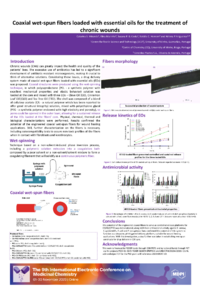
Chronic wounds (CWs) are frequently associated with bacterial infections. The development of antibiotic-resistant microorganisms makes it crucial to think of alternative solutions. Considering these issues, a drug delivery system made of coaxial wet-spun fibers loaded with essential oils (EOs) was proposed. Coaxial structures were produced using the wet-spinning technique, in which 10% w/v polycaprolactone (PCL, a synthetic polymer with excellent mechanical properties and elastic behavior) was used to produce the core and loaded with three EOs, Clove Oil (CO), Cinnamon Leaf Oil (CLO) and Tea Tree Oil (TTO) at 2×Minimum Bactericidal Concentration (MBC). The shell was made of a blend of 10% w/v cellulose acetate (CA, a natural polymer which has been reported to offer good structural integrity) and 10% w/v polyethylene glycol (PEG, a synthetic polymer often used as a plasticizer), mixed at a ratio of 90/10 v/v, respectively, so pores could be opened in the outer layer, allowing for a sustained release of the EOs loaded at the fibers’ core overtime. The formation of coaxial structures was confirmed by Brightfield Microscopy. Coaxial fibers exhibited high maximum elongations at break (≈350%). EO-loaded fibers were effective against S. aureus, S. epidermidis, E. coli and P. aeruginosa, the most common bacteria present in CWs. Results confirmed the potential of the engineered coaxial wet-spun fibers for wound healing applications. Still, further characterization on the fibers is necessary, including cytocompatibility tests to assure non-toxic profiles of the fibers when in contact with fibroblasts and keratinocytes.
Keywords
core-shell fibers
therapeutic natural extracts
antimicrobial effectiveness
Manuscript
Abstract ECMC Catarina Miranda.pdf
Poster
9th-ECMC_poster Catarina Miranda.pdf
EVALUATION OF THE HEPATOPROTECTOR ACTIVITY OF NEW THIENO[2,3-B]QUINOLINE AND 1,4-DIHYDROPYRIDINE DERIVATIVES
Deciphering Phosphodiesterase-5 Inhibitors from Aframemum melegueta: Computational Models against Erectile dysfunction