Event submissions
Published
This submission belongs to the session S4. New Small molecules as drug candidates of the event 9th International Electronic Conference on Medicinal Chemistry
Published date
01 Nov, 2023
Academic Editor
'%3e%3cpath%20d='M12.6657%2010.9104C12.4185%2010.325%2012.0599%209.79327%2011.6097%209.34482C11.1609%208.89508%2010.6293%208.5365%2010.0442%208.28888C10.0389%208.28626%2010.0337%208.28495%2010.0285%208.28233C10.8446%207.69279%2011.3752%206.73249%2011.3752%205.64904C11.3752%203.8542%209.92103%202.39999%208.1262%202.39999C6.33136%202.39999%204.87715%203.8542%204.87715%205.64904C4.87715%206.73249%205.40774%207.69279%206.22393%208.28364C6.21869%208.28626%206.21345%208.28757%206.20821%208.29019C5.62129%208.5378%205.09463%208.89284%204.64265%209.34613C4.1929%209.79493%203.83432%2010.3266%203.58671%2010.9117C3.34345%2011.4845%203.21226%2012.0987%203.20023%2012.7209C3.19988%2012.7349%203.20233%2012.7488%203.20744%2012.7619C3.21255%2012.7749%203.22022%2012.7867%203.22998%2012.7968C3.23975%2012.8068%203.25142%2012.8147%203.26431%2012.8202C3.2772%2012.8256%203.29105%2012.8284%203.30504%2012.8284H4.09109C4.14874%2012.8284%204.19459%2012.7825%204.1959%2012.7262C4.2221%2011.7148%204.62823%2010.7676%205.34617%2010.0497C6.08899%209.30683%207.0755%208.89808%208.1262%208.89808C9.17689%208.89808%2010.1634%209.30683%2010.9062%2010.0497C11.6242%2010.7676%2012.0303%2011.7148%2012.0565%2012.7262C12.0578%2012.7838%2012.1037%2012.8284%2012.1613%2012.8284H12.9474C12.9613%2012.8284%2012.9752%2012.8256%2012.9881%2012.8202C13.001%2012.8147%2013.0126%2012.8068%2013.0224%2012.7968C13.0322%2012.7867%2013.0398%2012.7749%2013.0449%2012.7619C13.0501%2012.7488%2013.0525%2012.7349%2013.0522%2012.7209C13.0391%2012.0947%2012.9094%2011.4855%2012.6657%2010.9104ZM8.1262%207.9024C7.52486%207.9024%206.9589%207.6679%206.53312%207.24211C6.10733%206.81633%205.87283%206.25037%205.87283%205.64904C5.87283%205.0477%206.10733%204.48174%206.53312%204.05596C6.9589%203.63018%207.52486%203.39567%208.1262%203.39567C8.72753%203.39567%209.29349%203.63018%209.71927%204.05596C10.1451%204.48174%2010.3796%205.0477%2010.3796%205.64904C10.3796%206.25037%2010.1451%206.81633%209.71927%207.24211C9.29349%207.6679%208.72753%207.9024%208.1262%207.9024Z'%20fill='%235D1EE1'/%3e%3c/g%3e%3c/svg%3e) Duke Wang
Duke WangCitation
Azizah Malebari, Brendan Twamley, Darren Fayne, Mary Meegan, Synthesis and biological evaluation of 2-azetidinone derivatives with antiproliferative activity in breast cancer and chemoresistant colon cancer, in Proceedings of 9th International Electronic Conference on Medicinal Chemistry, 1 November–30 November 2023, MDPI: Basel, Switzerland
Share
Email
Facebook
Twitter
LinkedIn
Synthesis and biological evaluation of 2-azetidinone derivatives with antiproliferative activity in breast cancer and chemoresistant colon cancer
'%3e%3cpath%20d='M12.6647%2010.9104C12.4176%2010.325%2012.0589%209.7933%2011.6088%209.34485C11.16%208.89511%2010.6283%208.53653%2010.0432%208.28891C10.038%208.28629%2010.0327%208.28498%2010.0275%208.28236C10.8437%207.69282%2011.3743%206.73252%2011.3743%205.64907C11.3743%203.85423%209.92005%202.40002%208.12522%202.40002C6.33038%202.40002%204.87618%203.85423%204.87618%205.64907C4.87618%206.73252%205.40677%207.69282%206.22296%208.28367C6.21772%208.28629%206.21248%208.2876%206.20724%208.29022C5.62031%208.53783%205.09365%208.89287%204.64167%209.34616C4.19192%209.79496%203.83334%2010.3266%203.58573%2010.9117C3.34247%2011.4846%203.21128%2012.0987%203.19925%2012.721C3.1989%2012.735%203.20135%2012.7489%203.20646%2012.7619C3.21157%2012.7749%203.21924%2012.7868%203.22901%2012.7968C3.23877%2012.8068%203.25045%2012.8148%203.26334%2012.8202C3.27623%2012.8256%203.29007%2012.8284%203.30406%2012.8284H4.09012C4.14776%2012.8284%204.19362%2012.7825%204.19493%2012.7262C4.22113%2011.7148%204.62726%2010.7676%205.34519%2010.0497C6.08802%209.30686%207.07452%208.89811%208.12522%208.89811C9.17592%208.89811%2010.1624%209.30686%2010.9052%2010.0497C11.6232%2010.7676%2012.0293%2011.7148%2012.0555%2012.7262C12.0568%2012.7839%2012.1027%2012.8284%2012.1603%2012.8284H12.9464C12.9604%2012.8284%2012.9742%2012.8256%2012.9871%2012.8202C13%2012.8148%2013.0117%2012.8068%2013.0214%2012.7968C13.0312%2012.7868%2013.0389%2012.7749%2013.044%2012.7619C13.0491%2012.7489%2013.0515%2012.735%2013.0512%2012.721C13.0381%2012.0947%2012.9084%2011.4856%2012.6647%2010.9104ZM8.12522%207.90243C7.52388%207.90243%206.95792%207.66793%206.53214%207.24215C6.10636%206.81636%205.87185%206.2504%205.87185%205.64907C5.87185%205.04773%206.10636%204.48177%206.53214%204.05599C6.95792%203.63021%207.52388%203.3957%208.12522%203.3957C8.72655%203.3957%209.29252%203.63021%209.7183%204.05599C10.1441%204.48177%2010.3786%205.04773%2010.3786%205.64907C10.3786%206.2504%2010.1441%206.81636%209.7183%207.24215C9.29252%207.66793%208.72655%207.90243%208.12522%207.90243Z'%20fill='%235D1EE1'/%3e%3c/g%3e%3c/svg%3e)
Azizah Malebari 1
Brendan Twamley 2
Darren Fayne 3

Mary Meegan 4
1. Department of Pharmaceutical Chemistry, College of Pharmacy, King Abdulaziz University, Jeddah 21589, Saudi Arabia
2. School of Chemistry, Trinity College Dublin, Dublin 2 DO2R590, Ireland.
3. School of Biochemistry and Immunology, Trinity College Dublin, Trinity Biomedical Sciences Institute, 152-160 Pearse Street, Dublin 2 DO2R590, Ireland.
4. School of Pharmacy and Pharmaceutical Sciences, Trinity Biomedical Sciences Institute, 152-160 Pearse Street, Trinity College Dublin, Dublin 2, Ireland
Abstract
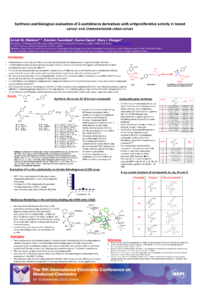
Small molecule compounds which interact with the tubulin-microtubule system are recognized as one of the major clinical options for cancer treatment such taxol and vincristine. The stilbene Combretastatin A-4 (CA-4) demonstrates potent anticancer activity in human cancer cells together with inhibition of tubulin polymerisation and antivascular effects. We report the synthesis of a panel of nineteen conformationally restricted 1,4-diaryl-2-azetidinones containing the 3,5-dimethoxyphenyl substituent at N-1 replacing the characteristic 3,4,5-trimethoxyphenyl Ring A of CA-4, together with phenyl, chloro, hydroxyl, phenoxy substituents at C-3. X-Ray crystallographic studies determined the specific structural features of selected compounds together with the role of the novel 3,5-dimethoxyphenyl Ring A interactions with the colchicine tubulin binding site residues.
The effect of these compounds on cancer cell proliferation was determined in vitro with the 3-hydroxyl, 3-phenoxy and 3-unsubstituted compounds identified as the most potent examples, having IC50 values of 3-25 nM in MCF-7 human breast cancer and 8-25 nM in chemoresistant HT-29 colon cancer cells which compare favourably with control CA-4. Low levels of in vitro cytotoxicity was confirmed for the novel β-lactams in MCF-7 cells using the lactate dehydrogenase (LDH) assay (< 3.5% cell death observed). The interactions of the methoxy groups at C-3 and C-5 of Ring A with key hydrophobic tubulin binding site residues Valβ318, Cysβ241, Alaβ354, Alaβ316, Alaβ317, Leuβ242, Valβ238 and Ileβ378 are explored to provide binding stabilisation. The structural study of these compounds will facilitate further design of more effective and diverse β-lactams for potential development in breast and chemoresistant colon cancer applications.
Keywords
Combretastatin A-4 (CA-4)
2-Azetidinone
Colchicine tubulin binding
breast cancer
chemo-resistant colon cancer
Manuscript
9th-ECMC_Poster.pdf
Poster
9th-ECMC_Poster.pdf
Multi-Targeting Potential of Flavonol Glycosides from Ginkgo biloba Leaves against Colorectal Cancer Mutations
Synthesis of N-(4-acryloylphenyl)-2,4-dichloro-5-sulfamoylbenzamides with anticancer activity