Event submissions
Published
This submission belongs to the session S3. General of the event 9th International Electronic Conference on Medicinal Chemistry
Published date
01 Nov, 2023
Academic Editor
'%3e%3cpath%20d='M12.6657%2010.9104C12.4185%2010.325%2012.0599%209.79327%2011.6097%209.34482C11.1609%208.89508%2010.6293%208.5365%2010.0442%208.28888C10.0389%208.28626%2010.0337%208.28495%2010.0285%208.28233C10.8446%207.69279%2011.3752%206.73249%2011.3752%205.64904C11.3752%203.8542%209.92103%202.39999%208.1262%202.39999C6.33136%202.39999%204.87715%203.8542%204.87715%205.64904C4.87715%206.73249%205.40774%207.69279%206.22393%208.28364C6.21869%208.28626%206.21345%208.28757%206.20821%208.29019C5.62129%208.5378%205.09463%208.89284%204.64265%209.34613C4.1929%209.79493%203.83432%2010.3266%203.58671%2010.9117C3.34345%2011.4845%203.21226%2012.0987%203.20023%2012.7209C3.19988%2012.7349%203.20233%2012.7488%203.20744%2012.7619C3.21255%2012.7749%203.22022%2012.7867%203.22998%2012.7968C3.23975%2012.8068%203.25142%2012.8147%203.26431%2012.8202C3.2772%2012.8256%203.29105%2012.8284%203.30504%2012.8284H4.09109C4.14874%2012.8284%204.19459%2012.7825%204.1959%2012.7262C4.2221%2011.7148%204.62823%2010.7676%205.34617%2010.0497C6.08899%209.30683%207.0755%208.89808%208.1262%208.89808C9.17689%208.89808%2010.1634%209.30683%2010.9062%2010.0497C11.6242%2010.7676%2012.0303%2011.7148%2012.0565%2012.7262C12.0578%2012.7838%2012.1037%2012.8284%2012.1613%2012.8284H12.9474C12.9613%2012.8284%2012.9752%2012.8256%2012.9881%2012.8202C13.001%2012.8147%2013.0126%2012.8068%2013.0224%2012.7968C13.0322%2012.7867%2013.0398%2012.7749%2013.0449%2012.7619C13.0501%2012.7488%2013.0525%2012.7349%2013.0522%2012.7209C13.0391%2012.0947%2012.9094%2011.4855%2012.6657%2010.9104ZM8.1262%207.9024C7.52486%207.9024%206.9589%207.6679%206.53312%207.24211C6.10733%206.81633%205.87283%206.25037%205.87283%205.64904C5.87283%205.0477%206.10733%204.48174%206.53312%204.05596C6.9589%203.63018%207.52486%203.39567%208.1262%203.39567C8.72753%203.39567%209.29349%203.63018%209.71927%204.05596C10.1451%204.48174%2010.3796%205.0477%2010.3796%205.64904C10.3796%206.25037%2010.1451%206.81633%209.71927%207.24211C9.29349%207.6679%208.72753%207.9024%208.1262%207.9024Z'%20fill='%235D1EE1'/%3e%3c/g%3e%3c/svg%3e) Duke Wang
Duke WangCitation
Jessica Silva, Tiago Azevedo, Abigaël Valada, Lara Anjos, Ana Isabel Faustino-Rocha, Paula Alexandra Oliveira, José Alberto Duarte, Studying humane endpoints in Wistar rats fed with a western diet during resistance training: data from a model of mammary cancer, in Proceedings of 9th International Electronic Conference on Medicinal Chemistry, 1 November–30 November 2023, MDPI: Basel, Switzerland
Share
Email
Facebook
Twitter
LinkedIn
Studying humane endpoints in Wistar rats fed with a western diet during resistance training: data from a model of mammary cancer
'%3e%3cpath%20d='M12.6647%2010.9104C12.4176%2010.325%2012.0589%209.7933%2011.6088%209.34485C11.16%208.89511%2010.6283%208.53653%2010.0432%208.28891C10.038%208.28629%2010.0327%208.28498%2010.0275%208.28236C10.8437%207.69282%2011.3743%206.73252%2011.3743%205.64907C11.3743%203.85423%209.92005%202.40002%208.12522%202.40002C6.33038%202.40002%204.87618%203.85423%204.87618%205.64907C4.87618%206.73252%205.40677%207.69282%206.22296%208.28367C6.21772%208.28629%206.21248%208.2876%206.20724%208.29022C5.62031%208.53783%205.09365%208.89287%204.64167%209.34616C4.19192%209.79496%203.83334%2010.3266%203.58573%2010.9117C3.34247%2011.4846%203.21128%2012.0987%203.19925%2012.721C3.1989%2012.735%203.20135%2012.7489%203.20646%2012.7619C3.21157%2012.7749%203.21924%2012.7868%203.22901%2012.7968C3.23877%2012.8068%203.25045%2012.8148%203.26334%2012.8202C3.27623%2012.8256%203.29007%2012.8284%203.30406%2012.8284H4.09012C4.14776%2012.8284%204.19362%2012.7825%204.19493%2012.7262C4.22113%2011.7148%204.62726%2010.7676%205.34519%2010.0497C6.08802%209.30686%207.07452%208.89811%208.12522%208.89811C9.17592%208.89811%2010.1624%209.30686%2010.9052%2010.0497C11.6232%2010.7676%2012.0293%2011.7148%2012.0555%2012.7262C12.0568%2012.7839%2012.1027%2012.8284%2012.1603%2012.8284H12.9464C12.9604%2012.8284%2012.9742%2012.8256%2012.9871%2012.8202C13%2012.8148%2013.0117%2012.8068%2013.0214%2012.7968C13.0312%2012.7868%2013.0389%2012.7749%2013.044%2012.7619C13.0491%2012.7489%2013.0515%2012.735%2013.0512%2012.721C13.0381%2012.0947%2012.9084%2011.4856%2012.6647%2010.9104ZM8.12522%207.90243C7.52388%207.90243%206.95792%207.66793%206.53214%207.24215C6.10636%206.81636%205.87185%206.2504%205.87185%205.64907C5.87185%205.04773%206.10636%204.48177%206.53214%204.05599C6.95792%203.63021%207.52388%203.3957%208.12522%203.3957C8.72655%203.3957%209.29252%203.63021%209.7183%204.05599C10.1441%204.48177%2010.3786%205.04773%2010.3786%205.64907C10.3786%206.2504%2010.1441%206.81636%209.7183%207.24215C9.29252%207.66793%208.72655%207.90243%208.12522%207.90243Z'%20fill='%235D1EE1'/%3e%3c/g%3e%3c/svg%3e)
Jessica Silva 1,2

Tiago Azevedo 3
Abigaël Valada 3
Lara Anjos 3

Ana Isabel Faustino-Rocha 2,4

Paula Alexandra Oliveira 1,2
José Alberto Duarte 5,6
1. Department of Veterinary Sciences, University of Trás-os-Montes and Alto Douro (UTAD), Vila Real, Portugal
2. CITAB, Inov4Agro, Vila Real, Portugal
3. Department of Veterinary Sciences, University of Trás-os-Montes and Alto Douro (UTAD), Vila Real, Portugal;
4. Department of Zootechnics, School of Sciences and Technology, CHRC, University of Évora, Évora, Portugal
5. CIAFEL, ITR Laboratory, Faculty of Sport, University of Porto, Porto, Portugal
6. TOXRUN–Toxicology Research Unit, CESPU, Gandra, Portugal
Abstract
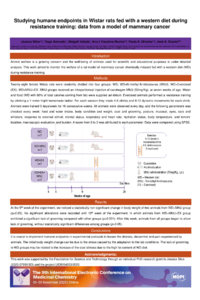
Objective: Animal welfare is a growing concern and the well-being of animals used for scientific and educational purposes is under detailed analysis. This work aimed to monitor the welfare of a rat model of mammary cancer chemically-induced fed with a western diet (WD) during resistance training.
Methods: Twenty-eight female Wistar rats were randomly divided into four groups: WD; WD+N-methyl-N-nitrosourea (MNU); WD+Exercised (EX); WD+MNU+EX. MNU groups received an intraperitoneal injection of carcinogen MNU (50mg/Kg), at seven weeks of age. Water and food (WD with 60% of total calories coming from fat) were supplied ad libitum. Exercised animals performed a resistance training by climbing a 1-meter-hight homemade ladder. For each session they made 4-8 climbs and 8-12 dynamic movements for each climb. Animals were trained 3 days/week for 18 consecutive weeks. All animals were observed every day and the following parameters was checked every week: food and water intake, body condition and weight, coat and grooming, posture, mucosal, eyes, ears and whiskers, response to external stimuli, mental status, respiratory and heart rate, hydration status, body temperature, and tumors’ location, macroscopic evaluation, and burden. A score from 0 to 3 was attributed to each parameter. Data were compared using SPSS.
Results: At the 5th week of the experiment, we noticed a statistically non-significant change in body weight on two animals from WD+MNU group (p>0.05). No significant alterations were recorded until 10th week of the experiment, in which animals from WD+MNU+EX group exhibited a significant lack of grooming compared with other groups (p=0.00). After this week, animals from all groups began to show lack of grooming, without statistically significant differences among groups (p>0.05).
Conclusions: It is crucial to implement humane endpoints in experimental protocols to lessen the distress, discomfort and pain experienced by animals. The initial body weight change can be due to the stress caused by the adaptation to the lab conditions. The lack of grooming in WD groups may be related to the increase of the coat oiliness due to the high fat content of WD diet.
Keywords
Mammary cancer
resistance training
Western diet
Manuscript
Abstract 9th IECMC.pdf
Poster
9th-ECMC_Poster_Jessica Silva.pdf
Synthesis of N-(4-acryloylphenyl)-2,4-dichloro-5-sulfamoylbenzamides with anticancer activity
Metabolomic profiling of Smilax zeylanica and in vitro and in silico screening for antilipidemic activity.