Event submissions
Published
This submission belongs to the session S7. Emerging technologies in drug discovery of the event 9th International Electronic Conference on Medicinal Chemistry
Published date
01 Nov, 2023
Academic Editor
'%3e%3cpath%20d='M12.6657%2010.9104C12.4185%2010.325%2012.0599%209.79327%2011.6097%209.34482C11.1609%208.89508%2010.6293%208.5365%2010.0442%208.28888C10.0389%208.28626%2010.0337%208.28495%2010.0285%208.28233C10.8446%207.69279%2011.3752%206.73249%2011.3752%205.64904C11.3752%203.8542%209.92103%202.39999%208.1262%202.39999C6.33136%202.39999%204.87715%203.8542%204.87715%205.64904C4.87715%206.73249%205.40774%207.69279%206.22393%208.28364C6.21869%208.28626%206.21345%208.28757%206.20821%208.29019C5.62129%208.5378%205.09463%208.89284%204.64265%209.34613C4.1929%209.79493%203.83432%2010.3266%203.58671%2010.9117C3.34345%2011.4845%203.21226%2012.0987%203.20023%2012.7209C3.19988%2012.7349%203.20233%2012.7488%203.20744%2012.7619C3.21255%2012.7749%203.22022%2012.7867%203.22998%2012.7968C3.23975%2012.8068%203.25142%2012.8147%203.26431%2012.8202C3.2772%2012.8256%203.29105%2012.8284%203.30504%2012.8284H4.09109C4.14874%2012.8284%204.19459%2012.7825%204.1959%2012.7262C4.2221%2011.7148%204.62823%2010.7676%205.34617%2010.0497C6.08899%209.30683%207.0755%208.89808%208.1262%208.89808C9.17689%208.89808%2010.1634%209.30683%2010.9062%2010.0497C11.6242%2010.7676%2012.0303%2011.7148%2012.0565%2012.7262C12.0578%2012.7838%2012.1037%2012.8284%2012.1613%2012.8284H12.9474C12.9613%2012.8284%2012.9752%2012.8256%2012.9881%2012.8202C13.001%2012.8147%2013.0126%2012.8068%2013.0224%2012.7968C13.0322%2012.7867%2013.0398%2012.7749%2013.0449%2012.7619C13.0501%2012.7488%2013.0525%2012.7349%2013.0522%2012.7209C13.0391%2012.0947%2012.9094%2011.4855%2012.6657%2010.9104ZM8.1262%207.9024C7.52486%207.9024%206.9589%207.6679%206.53312%207.24211C6.10733%206.81633%205.87283%206.25037%205.87283%205.64904C5.87283%205.0477%206.10733%204.48174%206.53312%204.05596C6.9589%203.63018%207.52486%203.39567%208.1262%203.39567C8.72753%203.39567%209.29349%203.63018%209.71927%204.05596C10.1451%204.48174%2010.3796%205.0477%2010.3796%205.64904C10.3796%206.25037%2010.1451%206.81633%209.71927%207.24211C9.29349%207.6679%208.72753%207.9024%208.1262%207.9024Z'%20fill='%235D1EE1'/%3e%3c/g%3e%3c/svg%3e) Maria Emília Sousa
Maria Emília SousaCitation
Philip Kohlmann, Pascal Marchand, Marc-Antoine Bazin, Patrice Le Pape, Joachim Jose, Towards new antifungal drugs: A FRET-based HTS assay to identify selective C. albicans HSP90 and HSP90 - Sba1 interaction inhibitors, in Proceedings of 9th International Electronic Conference on Medicinal Chemistry, 1 November–30 November 2023, MDPI: Basel, Switzerland
Share
Email
Facebook
Twitter
LinkedIn
Towards new antifungal drugs: A FRET-based HTS assay to identify selective C. albicans HSP90 and HSP90 - Sba1 interaction inhibitors
'%3e%3cpath%20d='M12.6647%2010.9104C12.4176%2010.325%2012.0589%209.7933%2011.6088%209.34485C11.16%208.89511%2010.6283%208.53653%2010.0432%208.28891C10.038%208.28629%2010.0327%208.28498%2010.0275%208.28236C10.8437%207.69282%2011.3743%206.73252%2011.3743%205.64907C11.3743%203.85423%209.92005%202.40002%208.12522%202.40002C6.33038%202.40002%204.87618%203.85423%204.87618%205.64907C4.87618%206.73252%205.40677%207.69282%206.22296%208.28367C6.21772%208.28629%206.21248%208.2876%206.20724%208.29022C5.62031%208.53783%205.09365%208.89287%204.64167%209.34616C4.19192%209.79496%203.83334%2010.3266%203.58573%2010.9117C3.34247%2011.4846%203.21128%2012.0987%203.19925%2012.721C3.1989%2012.735%203.20135%2012.7489%203.20646%2012.7619C3.21157%2012.7749%203.21924%2012.7868%203.22901%2012.7968C3.23877%2012.8068%203.25045%2012.8148%203.26334%2012.8202C3.27623%2012.8256%203.29007%2012.8284%203.30406%2012.8284H4.09012C4.14776%2012.8284%204.19362%2012.7825%204.19493%2012.7262C4.22113%2011.7148%204.62726%2010.7676%205.34519%2010.0497C6.08802%209.30686%207.07452%208.89811%208.12522%208.89811C9.17592%208.89811%2010.1624%209.30686%2010.9052%2010.0497C11.6232%2010.7676%2012.0293%2011.7148%2012.0555%2012.7262C12.0568%2012.7839%2012.1027%2012.8284%2012.1603%2012.8284H12.9464C12.9604%2012.8284%2012.9742%2012.8256%2012.9871%2012.8202C13%2012.8148%2013.0117%2012.8068%2013.0214%2012.7968C13.0312%2012.7868%2013.0389%2012.7749%2013.044%2012.7619C13.0491%2012.7489%2013.0515%2012.735%2013.0512%2012.721C13.0381%2012.0947%2012.9084%2011.4856%2012.6647%2010.9104ZM8.12522%207.90243C7.52388%207.90243%206.95792%207.66793%206.53214%207.24215C6.10636%206.81636%205.87185%206.2504%205.87185%205.64907C5.87185%205.04773%206.10636%204.48177%206.53214%204.05599C6.95792%203.63021%207.52388%203.3957%208.12522%203.3957C8.72655%203.3957%209.29252%203.63021%209.7183%204.05599C10.1441%204.48177%2010.3786%205.04773%2010.3786%205.64907C10.3786%206.2504%2010.1441%206.81636%209.7183%207.24215C9.29252%207.66793%208.72655%207.90243%208.12522%207.90243Z'%20fill='%235D1EE1'/%3e%3c/g%3e%3c/svg%3e)
Philip Kohlmann 1

Pascal Marchand 2

Marc-Antoine Bazin 2

Patrice Le Pape 2

Joachim Jose 1
1. University of Münster, Institute of Pharmaceutical and Medicinal Chemistry, PharmaCampus, Corrensstraße 48, 48149 Münster, Germany
2. Nantes Université, Cibles et médicaments des infections et de l’immunité, IICiMed, UR 1155, F-44000 Nantes, France
Abstract
Increase in drug resistance of pathogenic fungi as well as a growing immunocompromised patient population in risk of fungal infections create a need for novel anti-infective drugs [1].
HSP90 forms homodimers and is an essential chaperone involved in a plethora of protein-protein-interactions (PPI) [2]. The HSP90 conformational cycle is driven by the binding and hydrolysis of ATP by HSP90. Whereas HSP90 is highly conserved across species, co-chaperones of HSP90 like Sba1 are less conserved, providing a potential target structure for the development of selective antifungal drugs [3]. A prerequisite of HSP90 – Sba1 interaction is the prior binding of ATP to HSP90.
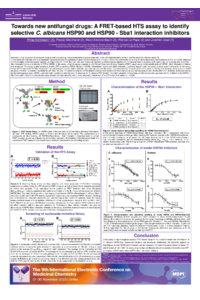
In this study, a high-throughput capable in vitro Förster Resonance Energy Transfer (FRET) based assay for the identification of HSP90 - Sba1 interaction inhibitors was developed. The assay is also suitable to identify ATP-competitive HSP90 inhibitors. HSP90-mNeonGreen (donor) and Sba1-mScarlet-I (acceptor) fusion protein constructs showed specific interaction in the assay. Known ATP-competitive HSP90 inhibitors such as geldanamycin can be reliably identified and characterized with the assay. This demonstrates the applicability of the assay to identify and characterize the activity of small molecule inhibitors. Competition experiments with Sba1 for Sba1-mScarlet-I binding to HSP90-mNeonGreen provide evidence for the suitability as a screening assay to also identify direct PPI inhibitors. Analogous setups for the homologous human HSP90 – p23 interaction enable the determination of selectivity for C. albicans PPI inhibition. A small nucleoside-mimetic library of 320 compounds was screened for inhibition of the HSP90 – Sba1 interaction. Overall, the developed assay showed low data variability and a robust separation, resulting in a Z-factor of consistently > 0.5 [4].
References
1. Aldholmi, M.; Marchand, P.; Ourliac-Garnier, I.; Le Pape, P.; Ganesan, A. A Decade of Antifungal Leads from Natural Products: 2010-2019. Pharmaceuticals (Basel) 2019, 12, doi:10.3390/ph12040182.
2. Schopf, F.H.; Biebl, M.M.; Buchner, J. The HSP90 chaperone machinery. Nat. Rev. Mol. Cell Biol. 2017, 18, 345–360, doi:10.1038/nrm.2017.20.
3. Gu, X.; Xue, W.; Yin, Y.; Liu, H.; Li, S.; Sun, X. The Hsp90 Co-chaperones Sti1, Aha1, and P23 Regulate Adaptive Responses to Antifungal Azoles. Front. Microbiol. 2016, 7, 1571, doi:10.3389/fmicb.2016.01571.
4. Ji-Hu Zhang, Thomas D. Y. Chung, and Kevin R. Oldenburg. A Simple Statistical Parameter for Use in Evaluation and Validation of High Throughput Screening Assays.
Keywords
drug discovery
HTS
High-Throughput Screening
antiinfectives
antifungals
HSP90
Sba1
p23
FRET
Manuscript
2023_10_11_PK_Poster ECMC2023.pdf
Poster
2023_10_11_PK_Poster ECMC2023.pdf
Со-encapsulation of doxorubicin and vorinostat in polymeric nanoparticles for the breast cancer therapy
Small-molecules isoxazole and isothiazole adjuvants in combination with first-line antitumor drugs in chemotherapy of neuroepithelial tumors