Event submissions
Published
This submission belongs to the session F. Energy, Environmental and Earth Science of the event The 4th International Electronic Conference on Applied Sciences
Published date
01 Nov, 2023
Academic Editor
'%3e%3cpath%20d='M12.6657%2010.9104C12.4185%2010.325%2012.0599%209.79327%2011.6097%209.34482C11.1609%208.89508%2010.6293%208.5365%2010.0442%208.28888C10.0389%208.28626%2010.0337%208.28495%2010.0285%208.28233C10.8446%207.69279%2011.3752%206.73249%2011.3752%205.64904C11.3752%203.8542%209.92103%202.39999%208.1262%202.39999C6.33136%202.39999%204.87715%203.8542%204.87715%205.64904C4.87715%206.73249%205.40774%207.69279%206.22393%208.28364C6.21869%208.28626%206.21345%208.28757%206.20821%208.29019C5.62129%208.5378%205.09463%208.89284%204.64265%209.34613C4.1929%209.79493%203.83432%2010.3266%203.58671%2010.9117C3.34345%2011.4845%203.21226%2012.0987%203.20023%2012.7209C3.19988%2012.7349%203.20233%2012.7488%203.20744%2012.7619C3.21255%2012.7749%203.22022%2012.7867%203.22998%2012.7968C3.23975%2012.8068%203.25142%2012.8147%203.26431%2012.8202C3.2772%2012.8256%203.29105%2012.8284%203.30504%2012.8284H4.09109C4.14874%2012.8284%204.19459%2012.7825%204.1959%2012.7262C4.2221%2011.7148%204.62823%2010.7676%205.34617%2010.0497C6.08899%209.30683%207.0755%208.89808%208.1262%208.89808C9.17689%208.89808%2010.1634%209.30683%2010.9062%2010.0497C11.6242%2010.7676%2012.0303%2011.7148%2012.0565%2012.7262C12.0578%2012.7838%2012.1037%2012.8284%2012.1613%2012.8284H12.9474C12.9613%2012.8284%2012.9752%2012.8256%2012.9881%2012.8202C13.001%2012.8147%2013.0126%2012.8068%2013.0224%2012.7968C13.0322%2012.7867%2013.0398%2012.7749%2013.0449%2012.7619C13.0501%2012.7488%2013.0525%2012.7349%2013.0522%2012.7209C13.0391%2012.0947%2012.9094%2011.4855%2012.6657%2010.9104ZM8.1262%207.9024C7.52486%207.9024%206.9589%207.6679%206.53312%207.24211C6.10733%206.81633%205.87283%206.25037%205.87283%205.64904C5.87283%205.0477%206.10733%204.48174%206.53312%204.05596C6.9589%203.63018%207.52486%203.39567%208.1262%203.39567C8.72753%203.39567%209.29349%203.63018%209.71927%204.05596C10.1451%204.48174%2010.3796%205.0477%2010.3796%205.64904C10.3796%206.25037%2010.1451%206.81633%209.71927%207.24211C9.29349%207.6679%208.72753%207.9024%208.1262%207.9024Z'%20fill='%235D1EE1'/%3e%3c/g%3e%3c/svg%3e) Simeone Chianese
Simeone ChianeseCitation
José Salvador Napoli, Adriano Silva, Fernanda Roman, Maria Eduarda Fuziki, Giane Lenzi, Helder Gomes, Efficiency of a Magnetic Multi-Core Shell Catalyst in the Degradation of Paracetamol and Sulfamethoxazole: A Catalytic Wet Peroxide Oxidation Approach, in Proceedings of The 4th International Electronic Conference on Applied Sciences, 27 October–10 November 2023, MDPI: Basel, Switzerland
Share
Email
Facebook
Twitter
LinkedIn
Efficiency of a Magnetic Multi-Core Shell Catalyst in the Degradation of Paracetamol and Sulfamethoxazole: A Catalytic Wet Peroxide Oxidation Approach
'%3e%3cpath%20d='M12.6647%2010.9104C12.4176%2010.325%2012.0589%209.7933%2011.6088%209.34485C11.16%208.89511%2010.6283%208.53653%2010.0432%208.28891C10.038%208.28629%2010.0327%208.28498%2010.0275%208.28236C10.8437%207.69282%2011.3743%206.73252%2011.3743%205.64907C11.3743%203.85423%209.92005%202.40002%208.12522%202.40002C6.33038%202.40002%204.87618%203.85423%204.87618%205.64907C4.87618%206.73252%205.40677%207.69282%206.22296%208.28367C6.21772%208.28629%206.21248%208.2876%206.20724%208.29022C5.62031%208.53783%205.09365%208.89287%204.64167%209.34616C4.19192%209.79496%203.83334%2010.3266%203.58573%2010.9117C3.34247%2011.4846%203.21128%2012.0987%203.19925%2012.721C3.1989%2012.735%203.20135%2012.7489%203.20646%2012.7619C3.21157%2012.7749%203.21924%2012.7868%203.22901%2012.7968C3.23877%2012.8068%203.25045%2012.8148%203.26334%2012.8202C3.27623%2012.8256%203.29007%2012.8284%203.30406%2012.8284H4.09012C4.14776%2012.8284%204.19362%2012.7825%204.19493%2012.7262C4.22113%2011.7148%204.62726%2010.7676%205.34519%2010.0497C6.08802%209.30686%207.07452%208.89811%208.12522%208.89811C9.17592%208.89811%2010.1624%209.30686%2010.9052%2010.0497C11.6232%2010.7676%2012.0293%2011.7148%2012.0555%2012.7262C12.0568%2012.7839%2012.1027%2012.8284%2012.1603%2012.8284H12.9464C12.9604%2012.8284%2012.9742%2012.8256%2012.9871%2012.8202C13%2012.8148%2013.0117%2012.8068%2013.0214%2012.7968C13.0312%2012.7868%2013.0389%2012.7749%2013.044%2012.7619C13.0491%2012.7489%2013.0515%2012.735%2013.0512%2012.721C13.0381%2012.0947%2012.9084%2011.4856%2012.6647%2010.9104ZM8.12522%207.90243C7.52388%207.90243%206.95792%207.66793%206.53214%207.24215C6.10636%206.81636%205.87185%206.2504%205.87185%205.64907C5.87185%205.04773%206.10636%204.48177%206.53214%204.05599C6.95792%203.63021%207.52388%203.3957%208.12522%203.3957C8.72655%203.3957%209.29252%203.63021%209.7183%204.05599C10.1441%204.48177%2010.3786%205.04773%2010.3786%205.64907C10.3786%206.2504%2010.1441%206.81636%209.7183%207.24215C9.29252%207.66793%208.72655%207.90243%208.12522%207.90243Z'%20fill='%235D1EE1'/%3e%3c/g%3e%3c/svg%3e)
José Salvador Napoli 1,2,3

Adriano Silva 1,2

Fernanda Roman 1,2
Maria Eduarda Fuziki 4

Giane Lenzi 3

Helder Gomes 1,2
1. Centro de Investigação de Montanha (CIMO), Instituto Politécnico de Bragança, 5300-253 Bragança, Portugal
2. Laboratório Associado para a Sustentabilidade e Tecnologia em Regiões de Montanha (SusTEC), Instituto Politécnico de Bragança, Campus de Santa Apolónia, 5300-253 Bragança, Portugal
3. Departamento de Engenharia Química, Universidade Tecnológica Federal Do Paraná, Rua Doutor Washington Subtil Chueire, 330, Ponta Grossa, PR 84017-220, Brazil
4. Departamento de Engenharia Química, Universidade Estadual de Maringá, 5790 Colombo Avenue, Maringá, Paraná, 87020-900, Brazil
Abstract
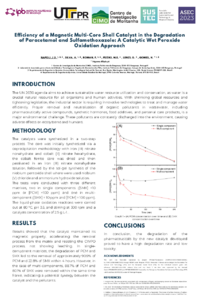
With the populational rise in the last decades, the potable water available has been a common concern. In this scenario, pharmaceuticals, mostly excreted in sewers, are not treated by conventional wastewater treatment plants. This study explores the synthesis of a magnetic multi-core shell catalyst and its efficiency in the degradation of paracetamol (PCM) and sulfamethoxazole (SMX) by catalytic wet peroxide oxidation (CWPO). The catalysts were synthesized in a two-step process. The core was initially synthesized via a coprecipitation methodology, followed by the sol-gel synthesis of the niobium pentoxide shell. The tests were conducted with three different matrixes, two in single components ([SMX] =10 ppm or [PCM] =100 ppm) and one in multi-component ([SMX] = 10 ppm and [PCM] = 100 ppm). The liquid-phase oxidation reactions were carried out at 80 °C, pH 3.5, and stirring at 300 rpm and a catalysts concentration of 2.5 g L-1. Results showed that the catalyst maintained its magnetic property, accelerating the removal process from the matrix and resisting the CWPO process, not showing leaching. The degradation of PCM and SMX in the single-component matrixes allowed removing about 90.9% of PCM and 22.8% of SMX in 4h. Still, the multi-component removed 88.7% of PCM and 80.1% of SMX in 4h, suggesting some synergy between the catalyst and the pharmaceuticals. In conclusion, the degradation of the pharmaceuticals by the new catalyst developed proved to have a high degradation rate and low toxicity.
Keywords
CWPO
pharmaceuticals
wastewater treatment
environmental catalysis.
Manuscript
ASEC2023 (MDPI)_conference abstract_v.2.pdf
Poster
ASEC2023 - Poster_v.2.pdf
The electronic structure and magnetic properties of full Heusler alloy Mn2CrAl
Investigation of the structural and optical properties of ACZTS solid solution