Event submissions
Published

This submission belongs to the session S1. Disease, pest and weed control in sustainable agriculture of the event The 3rd International Electronic Conference on Agronomy
Published date
03 Nov, 2023
Academic Editor
'%3e%3cpath%20d='M12.6657%2010.9104C12.4185%2010.325%2012.0599%209.79327%2011.6097%209.34482C11.1609%208.89508%2010.6293%208.5365%2010.0442%208.28888C10.0389%208.28626%2010.0337%208.28495%2010.0285%208.28233C10.8446%207.69279%2011.3752%206.73249%2011.3752%205.64904C11.3752%203.8542%209.92103%202.39999%208.1262%202.39999C6.33136%202.39999%204.87715%203.8542%204.87715%205.64904C4.87715%206.73249%205.40774%207.69279%206.22393%208.28364C6.21869%208.28626%206.21345%208.28757%206.20821%208.29019C5.62129%208.5378%205.09463%208.89284%204.64265%209.34613C4.1929%209.79493%203.83432%2010.3266%203.58671%2010.9117C3.34345%2011.4845%203.21226%2012.0987%203.20023%2012.7209C3.19988%2012.7349%203.20233%2012.7488%203.20744%2012.7619C3.21255%2012.7749%203.22022%2012.7867%203.22998%2012.7968C3.23975%2012.8068%203.25142%2012.8147%203.26431%2012.8202C3.2772%2012.8256%203.29105%2012.8284%203.30504%2012.8284H4.09109C4.14874%2012.8284%204.19459%2012.7825%204.1959%2012.7262C4.2221%2011.7148%204.62823%2010.7676%205.34617%2010.0497C6.08899%209.30683%207.0755%208.89808%208.1262%208.89808C9.17689%208.89808%2010.1634%209.30683%2010.9062%2010.0497C11.6242%2010.7676%2012.0303%2011.7148%2012.0565%2012.7262C12.0578%2012.7838%2012.1037%2012.8284%2012.1613%2012.8284H12.9474C12.9613%2012.8284%2012.9752%2012.8256%2012.9881%2012.8202C13.001%2012.8147%2013.0126%2012.8068%2013.0224%2012.7968C13.0322%2012.7867%2013.0398%2012.7749%2013.0449%2012.7619C13.0501%2012.7488%2013.0525%2012.7349%2013.0522%2012.7209C13.0391%2012.0947%2012.9094%2011.4855%2012.6657%2010.9104ZM8.1262%207.9024C7.52486%207.9024%206.9589%207.6679%206.53312%207.24211C6.10733%206.81633%205.87283%206.25037%205.87283%205.64904C5.87283%205.0477%206.10733%204.48174%206.53312%204.05596C6.9589%203.63018%207.52486%203.39567%208.1262%203.39567C8.72753%203.39567%209.29349%203.63018%209.71927%204.05596C10.1451%204.48174%2010.3796%205.0477%2010.3796%205.64904C10.3796%206.25037%2010.1451%206.81633%209.71927%207.24211C9.29349%207.6679%208.72753%207.9024%208.1262%207.9024Z'%20fill='%235D1EE1'/%3e%3c/g%3e%3c/svg%3e) Gianni Bellocchi
Gianni BellocchiCitation
Mohammed Mustafa, Joel Ayebeng Adjei, László Menyhártc, László Csambalik, Zita Szalai, Impact of Pests and Diseases on Three Tomato (Solanum lycopersicum L) Genotypes Productivity Under Hedgerow System, in Proceedings of The 3rd International Electronic Conference on Agronomy, 15 October–30 October 2023, MDPI: Basel, Switzerland, doi: 10.3390/IECAG2023-15819
Share
Email
Facebook
Twitter
LinkedIn
Impact of Pests and Diseases on Three Tomato (Solanum lycopersicum L) Genotypes Productivity Under Hedgerow System

Mohammed Mustafa 1,2
'%3e%3cpath%20d='M12.6647%2010.9104C12.4176%2010.325%2012.0589%209.7933%2011.6088%209.34485C11.16%208.89511%2010.6283%208.53653%2010.0432%208.28891C10.038%208.28629%2010.0327%208.28498%2010.0275%208.28236C10.8437%207.69282%2011.3743%206.73252%2011.3743%205.64907C11.3743%203.85423%209.92005%202.40002%208.12522%202.40002C6.33038%202.40002%204.87618%203.85423%204.87618%205.64907C4.87618%206.73252%205.40677%207.69282%206.22296%208.28367C6.21772%208.28629%206.21248%208.2876%206.20724%208.29022C5.62031%208.53783%205.09365%208.89287%204.64167%209.34616C4.19192%209.79496%203.83334%2010.3266%203.58573%2010.9117C3.34247%2011.4846%203.21128%2012.0987%203.19925%2012.721C3.1989%2012.735%203.20135%2012.7489%203.20646%2012.7619C3.21157%2012.7749%203.21924%2012.7868%203.22901%2012.7968C3.23877%2012.8068%203.25045%2012.8148%203.26334%2012.8202C3.27623%2012.8256%203.29007%2012.8284%203.30406%2012.8284H4.09012C4.14776%2012.8284%204.19362%2012.7825%204.19493%2012.7262C4.22113%2011.7148%204.62726%2010.7676%205.34519%2010.0497C6.08802%209.30686%207.07452%208.89811%208.12522%208.89811C9.17592%208.89811%2010.1624%209.30686%2010.9052%2010.0497C11.6232%2010.7676%2012.0293%2011.7148%2012.0555%2012.7262C12.0568%2012.7839%2012.1027%2012.8284%2012.1603%2012.8284H12.9464C12.9604%2012.8284%2012.9742%2012.8256%2012.9871%2012.8202C13%2012.8148%2013.0117%2012.8068%2013.0214%2012.7968C13.0312%2012.7868%2013.0389%2012.7749%2013.044%2012.7619C13.0491%2012.7489%2013.0515%2012.735%2013.0512%2012.721C13.0381%2012.0947%2012.9084%2011.4856%2012.6647%2010.9104ZM8.12522%207.90243C7.52388%207.90243%206.95792%207.66793%206.53214%207.24215C6.10636%206.81636%205.87185%206.2504%205.87185%205.64907C5.87185%205.04773%206.10636%204.48177%206.53214%204.05599C6.95792%203.63021%207.52388%203.3957%208.12522%203.3957C8.72655%203.3957%209.29252%203.63021%209.7183%204.05599C10.1441%204.48177%2010.3786%205.04773%2010.3786%205.64907C10.3786%206.2504%2010.1441%206.81636%209.7183%207.24215C9.29252%207.66793%208.72655%207.90243%208.12522%207.90243Z'%20fill='%235D1EE1'/%3e%3c/g%3e%3c/svg%3e)
Joel Ayebeng Adjei 3
László Menyhártc 4
László Csambalik 5
Zita Szalai 1
1. Department of Agroecology and Organic Farming, Institute of Rural Development and Sustainable Production, Hungarian University of Agriculture and Life Sciences (MATE)
2. Agriculture Research Corporation (ARC), Wad Madani 126, Horticultural Research Center, Khartoum, Sudan
3. Department of Agroecology and Organic Farming, Institute of Rural Development and Sustainable Production, Hungarian University of Agriculture and Life Sciences, (MATE).
4. Institute of Mathematics and Basic Science, Georgikon Campus, Hungarian University of Agriculture and Life Sciences (MATE)
5. Department of Agroecology and Organic Farming, Institute of Rural Development and Sustainable Production, Hungarian University of Agriculture and Life Sciences, (MATE)
Abstract
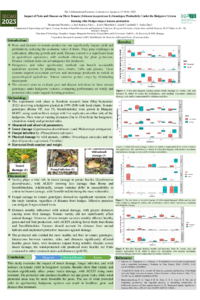
Tomato (Solanum lycopersicum L), popular vegetable grown in traditional and alternative farming systems, such as agroforestry. The study focuses to assess the impact of insect damage caused by (potato beetle (Leptinotarsa decemlineata), cotton bollworm (Helicoverpa armigera)), fungal infections by (Phytophthora infestans), and wildlife damage from (rabbits (Oryctolagus cuniculus), roe deer (Capreolus capreolus)) on three tomato genotypes, Szentlőrinckáta, ACE55, and Roma. Were grown in random block design with five replicates, on both sides of a hedgerow in Hungary MATE. The plots were situated at five different distances (3m, 6m, 9m, 12m, and 15m) from the hedgerow on both windy and protected sides.
The results indicate the choice of tomato variety had a significant effect on fruit production; ACE55 yielded less healthy green and red fruits compared to Roma and Szentlőrinckáta. Tomato variety, side, and distance significantly influenced insect damage and overall yield in tomato plants. Fungal damage was not serious in 2022 - and was not significantly affected by variety, side, and distance. Potato beetle damage was more prevalent on the protected side, ACE55 had significantly fewer damaged fruits compared to both Roma and Szentlőrinckáta. Wild animal damage was significantly affected by distance from the hedgerow.
Insect damage was higher on the protected side and lower on the windy side of the hedgerow, depending on insects and survey date. Despite higher insect damage, the protected side promoted healthy red and green fruit production, particularly Roma and Szentlőrinckáta.
Keywords
Insect damage
Fungal infection
Tomato
Hedgerow system
Manuscript
078896-final-11.3.pdf
Poster
The 3rd International Electronic Conference on Agronomy 15–30 Oct 2023 last.pdf
A GIS-BASED APPROACH FOR MANURE SPREADING MONITORING WITHIN THE DIGITAL AGRICULTURE FRAMEWORK
Comparative analysis of RuBisCO evolution and intrinsic differences: insights from in silico assessment in cyanobacteria, monocot and dicot plants