Event submissions
Published
 10.3390/ECMC2023-15896 (registering DOI)
 This submission belongs to the session S6. Novel and Sustainable approaches in Medicinal Chemistry of the event 9th International Electronic Conference on Medicinal Chemistry
Published date
07 Nov, 2023
Academic Editor
'%3e%3cpath%20d='M12.6657%2010.9104C12.4185%2010.325%2012.0599%209.79327%2011.6097%209.34482C11.1609%208.89508%2010.6293%208.5365%2010.0442%208.28888C10.0389%208.28626%2010.0337%208.28495%2010.0285%208.28233C10.8446%207.69279%2011.3752%206.73249%2011.3752%205.64904C11.3752%203.8542%209.92103%202.39999%208.1262%202.39999C6.33136%202.39999%204.87715%203.8542%204.87715%205.64904C4.87715%206.73249%205.40774%207.69279%206.22393%208.28364C6.21869%208.28626%206.21345%208.28757%206.20821%208.29019C5.62129%208.5378%205.09463%208.89284%204.64265%209.34613C4.1929%209.79493%203.83432%2010.3266%203.58671%2010.9117C3.34345%2011.4845%203.21226%2012.0987%203.20023%2012.7209C3.19988%2012.7349%203.20233%2012.7488%203.20744%2012.7619C3.21255%2012.7749%203.22022%2012.7867%203.22998%2012.7968C3.23975%2012.8068%203.25142%2012.8147%203.26431%2012.8202C3.2772%2012.8256%203.29105%2012.8284%203.30504%2012.8284H4.09109C4.14874%2012.8284%204.19459%2012.7825%204.1959%2012.7262C4.2221%2011.7148%204.62823%2010.7676%205.34617%2010.0497C6.08899%209.30683%207.0755%208.89808%208.1262%208.89808C9.17689%208.89808%2010.1634%209.30683%2010.9062%2010.0497C11.6242%2010.7676%2012.0303%2011.7148%2012.0565%2012.7262C12.0578%2012.7838%2012.1037%2012.8284%2012.1613%2012.8284H12.9474C12.9613%2012.8284%2012.9752%2012.8256%2012.9881%2012.8202C13.001%2012.8147%2013.0126%2012.8068%2013.0224%2012.7968C13.0322%2012.7867%2013.0398%2012.7749%2013.0449%2012.7619C13.0501%2012.7488%2013.0525%2012.7349%2013.0522%2012.7209C13.0391%2012.0947%2012.9094%2011.4855%2012.6657%2010.9104ZM8.1262%207.9024C7.52486%207.9024%206.9589%207.6679%206.53312%207.24211C6.10733%206.81633%205.87283%206.25037%205.87283%205.64904C5.87283%205.0477%206.10733%204.48174%206.53312%204.05596C6.9589%203.63018%207.52486%203.39567%208.1262%203.39567C8.72753%203.39567%209.29349%203.63018%209.71927%204.05596C10.1451%204.48174%2010.3796%205.0477%2010.3796%205.64904C10.3796%206.25037%2010.1451%206.81633%209.71927%207.24211C9.29349%207.6679%208.72753%207.9024%208.1262%207.9024Z'%20fill='%235D1EE1'/%3e%3c/g%3e%3c/svg%3e) Alfredo Berzal-Herranz
Alfredo Berzal-HerranzCitation
Kseniia Matveeva, Daniil Shevyrev, SA-β-galactosidase activity in effector and regulatory T cells., in Proceedings of 9th International Electronic Conference on Medicinal Chemistry, 1 November–30 November 2023, MDPI: Basel, Switzerland, doi: 10.3390/ECMC2023-15896
Share
Email
Facebook
Twitter
LinkedIn
SA-β-galactosidase activity in effector and regulatory T cells.
'%3e%3cpath%20d='M12.6647%2010.9104C12.4176%2010.325%2012.0589%209.7933%2011.6088%209.34485C11.16%208.89511%2010.6283%208.53653%2010.0432%208.28891C10.038%208.28629%2010.0327%208.28498%2010.0275%208.28236C10.8437%207.69282%2011.3743%206.73252%2011.3743%205.64907C11.3743%203.85423%209.92005%202.40002%208.12522%202.40002C6.33038%202.40002%204.87618%203.85423%204.87618%205.64907C4.87618%206.73252%205.40677%207.69282%206.22296%208.28367C6.21772%208.28629%206.21248%208.2876%206.20724%208.29022C5.62031%208.53783%205.09365%208.89287%204.64167%209.34616C4.19192%209.79496%203.83334%2010.3266%203.58573%2010.9117C3.34247%2011.4846%203.21128%2012.0987%203.19925%2012.721C3.1989%2012.735%203.20135%2012.7489%203.20646%2012.7619C3.21157%2012.7749%203.21924%2012.7868%203.22901%2012.7968C3.23877%2012.8068%203.25045%2012.8148%203.26334%2012.8202C3.27623%2012.8256%203.29007%2012.8284%203.30406%2012.8284H4.09012C4.14776%2012.8284%204.19362%2012.7825%204.19493%2012.7262C4.22113%2011.7148%204.62726%2010.7676%205.34519%2010.0497C6.08802%209.30686%207.07452%208.89811%208.12522%208.89811C9.17592%208.89811%2010.1624%209.30686%2010.9052%2010.0497C11.6232%2010.7676%2012.0293%2011.7148%2012.0555%2012.7262C12.0568%2012.7839%2012.1027%2012.8284%2012.1603%2012.8284H12.9464C12.9604%2012.8284%2012.9742%2012.8256%2012.9871%2012.8202C13%2012.8148%2013.0117%2012.8068%2013.0214%2012.7968C13.0312%2012.7868%2013.0389%2012.7749%2013.044%2012.7619C13.0491%2012.7489%2013.0515%2012.735%2013.0512%2012.721C13.0381%2012.0947%2012.9084%2011.4856%2012.6647%2010.9104ZM8.12522%207.90243C7.52388%207.90243%206.95792%207.66793%206.53214%207.24215C6.10636%206.81636%205.87185%206.2504%205.87185%205.64907C5.87185%205.04773%206.10636%204.48177%206.53214%204.05599C6.95792%203.63021%207.52388%203.3957%208.12522%203.3957C8.72655%203.3957%209.29252%203.63021%209.7183%204.05599C10.1441%204.48177%2010.3786%205.04773%2010.3786%205.64907C10.3786%206.2504%2010.1441%206.81636%209.7183%207.24215C9.29252%207.66793%208.72655%207.90243%208.12522%207.90243Z'%20fill='%235D1EE1'/%3e%3c/g%3e%3c/svg%3e)
Kseniia Matveeva 1

Daniil Shevyrev 1
1. Sirius University of Science and Technology, Sirius, 354340 Sochi, Russia
Abstract
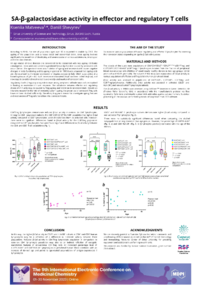
The aging of the immune system is accompanied by a significant increase in the risk of developing age-related pathologies, including inflammatory, autoimmune diseases and oncology. Age-dependent decline in immune function is accompanied by a gradual accumulation of senescent (aged) cells that are the source of chronic inflammation. The main producers of proinflammatory cytokines in the body are activated effector T cells. With age, along with an increase in chronic inflammation (InflamAging), the ability of the immune system to suppress and/or remove activated and senescent effector cells decreases. With age, there is also a decrease in the function of CD3+CD4+CD25hiCD127lo/- T-regulatory cells (Treg), which unbalances the immune system and increases the risk of autoimmune pathologies. In ex vivo analysis, senescence and effector function in CD4+ and CD8+, activated (CD25+ and HLA-DR+) and non-activated (CD25- and HLA-DR-) T cells, as well as the suppressor activity of senescent Tregs were assessed by functional tests and using SA-β-galactosidase assay. Additional analysis, p16INK4A, p21WAF1/CIP1, phospho-histone H2A.X and HMGB1 was applied to confirm the senescent status of these cells. PBMCs irradiated with UV or reaching the replication limit were used as a positive control of senescent cells. UV radiation increased SA-β-Gal activity and correlated with an increase in the level of phospho-histone H2A.X, confirming their senescent status and the relevance of SA-β-Gal as a marker of senescence. In middle-aged donors in activated (CD25+ and HLA-DR+) both CD4+ and CD8+ lymphocytes, SA-β-Gal activity was higher compared to non-activated lymphocytes. Whereas, SA-β-Gal activity was lowest in Tregs, suggesting their specific metabolic patterns. Among middle-aged donors, there were no significant differences between the populations of CD3+CD4+ and CD3+CD8+ lymphocytes in SA-β-Gal activity. Thus, the activity of SA-β-Gal marker of senescent and activated effector T cells can be used to analyze the aging of the immune system in further functional tests. Using this approach, the phenotypic features and functional activity of senescent T cells among young (<30 years old) and older (>60 years old) donors will be studied in detail. The development of this model in non-human primates of different age groups will facilitate future preclinical trials for senolytic and senomorphic drugs, and substances that enhance the repair of double-strand breaks.
This work was supported by the Russian Science Foundation, No. 23-15-00443.
Keywords
SA-β-Gal
senescence
lymphocytes
regulatory T cells
Treg
Manuscript
9th-ECMC_Abstract_template.pdf
Poster
9th-ECMC_POSTER.pdf
Non-equilibrium free energy calculations accurately predict the molecular mechanism of a disease conferring mutation in proliferating cell nuclear antigen (PCNA)
Profiling of Bioactive compounds, Antioxidant properties and Inhibitory potentials of Ethanolic Leaf Fraction of Sida linifolia L. (Malvaceae) on Enzymes Implicated in the pathology of Diabetes, Inflammation, and Neurological Disorders