Event submissions
Published
 10.3390/ECMC2023-15901 (registering DOI)
 This submission belongs to the session S3. General of the event 9th International Electronic Conference on Medicinal Chemistry
Published date
07 Nov, 2023
Academic Editor
'%3e%3cpath%20d='M12.6657%2010.9104C12.4185%2010.325%2012.0599%209.79327%2011.6097%209.34482C11.1609%208.89508%2010.6293%208.5365%2010.0442%208.28888C10.0389%208.28626%2010.0337%208.28495%2010.0285%208.28233C10.8446%207.69279%2011.3752%206.73249%2011.3752%205.64904C11.3752%203.8542%209.92103%202.39999%208.1262%202.39999C6.33136%202.39999%204.87715%203.8542%204.87715%205.64904C4.87715%206.73249%205.40774%207.69279%206.22393%208.28364C6.21869%208.28626%206.21345%208.28757%206.20821%208.29019C5.62129%208.5378%205.09463%208.89284%204.64265%209.34613C4.1929%209.79493%203.83432%2010.3266%203.58671%2010.9117C3.34345%2011.4845%203.21226%2012.0987%203.20023%2012.7209C3.19988%2012.7349%203.20233%2012.7488%203.20744%2012.7619C3.21255%2012.7749%203.22022%2012.7867%203.22998%2012.7968C3.23975%2012.8068%203.25142%2012.8147%203.26431%2012.8202C3.2772%2012.8256%203.29105%2012.8284%203.30504%2012.8284H4.09109C4.14874%2012.8284%204.19459%2012.7825%204.1959%2012.7262C4.2221%2011.7148%204.62823%2010.7676%205.34617%2010.0497C6.08899%209.30683%207.0755%208.89808%208.1262%208.89808C9.17689%208.89808%2010.1634%209.30683%2010.9062%2010.0497C11.6242%2010.7676%2012.0303%2011.7148%2012.0565%2012.7262C12.0578%2012.7838%2012.1037%2012.8284%2012.1613%2012.8284H12.9474C12.9613%2012.8284%2012.9752%2012.8256%2012.9881%2012.8202C13.001%2012.8147%2013.0126%2012.8068%2013.0224%2012.7968C13.0322%2012.7867%2013.0398%2012.7749%2013.0449%2012.7619C13.0501%2012.7488%2013.0525%2012.7349%2013.0522%2012.7209C13.0391%2012.0947%2012.9094%2011.4855%2012.6657%2010.9104ZM8.1262%207.9024C7.52486%207.9024%206.9589%207.6679%206.53312%207.24211C6.10733%206.81633%205.87283%206.25037%205.87283%205.64904C5.87283%205.0477%206.10733%204.48174%206.53312%204.05596C6.9589%203.63018%207.52486%203.39567%208.1262%203.39567C8.72753%203.39567%209.29349%203.63018%209.71927%204.05596C10.1451%204.48174%2010.3796%205.0477%2010.3796%205.64904C10.3796%206.25037%2010.1451%206.81633%209.71927%207.24211C9.29349%207.6679%208.72753%207.9024%208.1262%207.9024Z'%20fill='%235D1EE1'/%3e%3c/g%3e%3c/svg%3e) Maria Emília Sousa
Maria Emília SousaCitation
Magdalena Zyzak, Krzysztof Marycz, Sex hormone-binding globulin restores mitochondrial integrity in PPARγ-depleted mesenchymal stromal cells, in Proceedings of 9th International Electronic Conference on Medicinal Chemistry, 1 November–30 November 2023, MDPI: Basel, Switzerland, doi: 10.3390/ECMC2023-15901
Share
Email
Facebook
Twitter
LinkedIn
Sex hormone-binding globulin restores mitochondrial integrity in PPARγ-depleted mesenchymal stromal cells
'%3e%3cpath%20d='M12.6647%2010.9104C12.4176%2010.325%2012.0589%209.7933%2011.6088%209.34485C11.16%208.89511%2010.6283%208.53653%2010.0432%208.28891C10.038%208.28629%2010.0327%208.28498%2010.0275%208.28236C10.8437%207.69282%2011.3743%206.73252%2011.3743%205.64907C11.3743%203.85423%209.92005%202.40002%208.12522%202.40002C6.33038%202.40002%204.87618%203.85423%204.87618%205.64907C4.87618%206.73252%205.40677%207.69282%206.22296%208.28367C6.21772%208.28629%206.21248%208.2876%206.20724%208.29022C5.62031%208.53783%205.09365%208.89287%204.64167%209.34616C4.19192%209.79496%203.83334%2010.3266%203.58573%2010.9117C3.34247%2011.4846%203.21128%2012.0987%203.19925%2012.721C3.1989%2012.735%203.20135%2012.7489%203.20646%2012.7619C3.21157%2012.7749%203.21924%2012.7868%203.22901%2012.7968C3.23877%2012.8068%203.25045%2012.8148%203.26334%2012.8202C3.27623%2012.8256%203.29007%2012.8284%203.30406%2012.8284H4.09012C4.14776%2012.8284%204.19362%2012.7825%204.19493%2012.7262C4.22113%2011.7148%204.62726%2010.7676%205.34519%2010.0497C6.08802%209.30686%207.07452%208.89811%208.12522%208.89811C9.17592%208.89811%2010.1624%209.30686%2010.9052%2010.0497C11.6232%2010.7676%2012.0293%2011.7148%2012.0555%2012.7262C12.0568%2012.7839%2012.1027%2012.8284%2012.1603%2012.8284H12.9464C12.9604%2012.8284%2012.9742%2012.8256%2012.9871%2012.8202C13%2012.8148%2013.0117%2012.8068%2013.0214%2012.7968C13.0312%2012.7868%2013.0389%2012.7749%2013.044%2012.7619C13.0491%2012.7489%2013.0515%2012.735%2013.0512%2012.721C13.0381%2012.0947%2012.9084%2011.4856%2012.6647%2010.9104ZM8.12522%207.90243C7.52388%207.90243%206.95792%207.66793%206.53214%207.24215C6.10636%206.81636%205.87185%206.2504%205.87185%205.64907C5.87185%205.04773%206.10636%204.48177%206.53214%204.05599C6.95792%203.63021%207.52388%203.3957%208.12522%203.3957C8.72655%203.3957%209.29252%203.63021%209.7183%204.05599C10.1441%204.48177%2010.3786%205.04773%2010.3786%205.64907C10.3786%206.2504%2010.1441%206.81636%209.7183%207.24215C9.29252%207.66793%208.72655%207.90243%208.12522%207.90243Z'%20fill='%235D1EE1'/%3e%3c/g%3e%3c/svg%3e)
Magdalena Zyzak 1
Krzysztof Marycz 1
1. Department of Experimental Biology, Wrocław University of Environmental and Life Sciences
Abstract
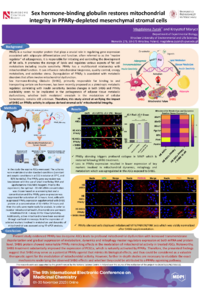
Equine Metabolic Syndrome (EMS) is a prevalent condition that primarily affects horses and ponies. It is characterized by a cluster of metabolic disturbances, including insulin resistance, obesity or abnormal fat distribution, and a heightened risk of laminitis (a painful hoof condition). Sex hormone binding globulin (SHBG) is a glycoprotein produced by the liver and released into the bloodstream. It plays a crucial role in the regulation of sex hormones in the body, primarily testosterone and estrogen. Recent findings have shown that SHBG is also produced by adipocytes and their precursors, thus playing an important role in the balance of adipose tissue metabolism. On the other hand, peroxisome proliferator-activated receptor gamma (PPARγ) is a transcription factor that promotes adipogenesis, lipid absorption and storage, insulin sensitivity, and glucose metabolism. Therefore, PPARγ defects are associated with the development of metabolic disorders, and as with SHBG, reduced PPARγ levels are associated with insulin resistance and related endocrine abnormalities.
The aim of our study was to evaluate for the first time the impact of SHBG protein on mitochondrial changes in ASCs isolated from horses and to verify whether SHBG can restore impaired PPARγ functions and therefore represents a new candidate PPARγ agonist for the treatment of EMS.
Our obtained data showed that PPARγ knockdown resulted in significant changes in mitochondrial membrane potential as well as the expression of metabolic and dynamics related markers. Interestingly, SHBG treatment improved the transmembrane potential, normalized the expression levels of key mitochondrial dynamics mediators as well as such as mitochondrial recycling machinery effectors including PINK protein.
The outcomes of this study suggest that SHBG can exert PPARγ-like effects and improve the mitochondrial function of ASC, and thus highlights the possible interaction between PPARγ and SHBG in the regulation of cellular metabolic processes.
Keywords
SHBG
PPARγ
EMS
ASC
MSC
silencing
Manuscript
9th-ECMC_Abstract_Zyzak_revision.pdf
Poster
9th-ECMC_Poster_Dr Magdalena Zyzak_revision.pdf
Environmental Impact of Ketoprofen on Key Freshwater Species: Insights on intra and inter-species response variability
Biological Network Analysis and Protein Kinase Inhibition in Breast Cancer Oncosystem