Event submissions
Published
 10.3390/ECMC2023-15902 (registering DOI)
 This submission belongs to the session S4. New Small molecules as drug candidates of the event 9th International Electronic Conference on Medicinal Chemistry
Published date
07 Nov, 2023
Academic Editor
'%3e%3cpath%20d='M12.6657%2010.9104C12.4185%2010.325%2012.0599%209.79327%2011.6097%209.34482C11.1609%208.89508%2010.6293%208.5365%2010.0442%208.28888C10.0389%208.28626%2010.0337%208.28495%2010.0285%208.28233C10.8446%207.69279%2011.3752%206.73249%2011.3752%205.64904C11.3752%203.8542%209.92103%202.39999%208.1262%202.39999C6.33136%202.39999%204.87715%203.8542%204.87715%205.64904C4.87715%206.73249%205.40774%207.69279%206.22393%208.28364C6.21869%208.28626%206.21345%208.28757%206.20821%208.29019C5.62129%208.5378%205.09463%208.89284%204.64265%209.34613C4.1929%209.79493%203.83432%2010.3266%203.58671%2010.9117C3.34345%2011.4845%203.21226%2012.0987%203.20023%2012.7209C3.19988%2012.7349%203.20233%2012.7488%203.20744%2012.7619C3.21255%2012.7749%203.22022%2012.7867%203.22998%2012.7968C3.23975%2012.8068%203.25142%2012.8147%203.26431%2012.8202C3.2772%2012.8256%203.29105%2012.8284%203.30504%2012.8284H4.09109C4.14874%2012.8284%204.19459%2012.7825%204.1959%2012.7262C4.2221%2011.7148%204.62823%2010.7676%205.34617%2010.0497C6.08899%209.30683%207.0755%208.89808%208.1262%208.89808C9.17689%208.89808%2010.1634%209.30683%2010.9062%2010.0497C11.6242%2010.7676%2012.0303%2011.7148%2012.0565%2012.7262C12.0578%2012.7838%2012.1037%2012.8284%2012.1613%2012.8284H12.9474C12.9613%2012.8284%2012.9752%2012.8256%2012.9881%2012.8202C13.001%2012.8147%2013.0126%2012.8068%2013.0224%2012.7968C13.0322%2012.7867%2013.0398%2012.7749%2013.0449%2012.7619C13.0501%2012.7488%2013.0525%2012.7349%2013.0522%2012.7209C13.0391%2012.0947%2012.9094%2011.4855%2012.6657%2010.9104ZM8.1262%207.9024C7.52486%207.9024%206.9589%207.6679%206.53312%207.24211C6.10733%206.81633%205.87283%206.25037%205.87283%205.64904C5.87283%205.0477%206.10733%204.48174%206.53312%204.05596C6.9589%203.63018%207.52486%203.39567%208.1262%203.39567C8.72753%203.39567%209.29349%203.63018%209.71927%204.05596C10.1451%204.48174%2010.3796%205.0477%2010.3796%205.64904C10.3796%206.25037%2010.1451%206.81633%209.71927%207.24211C9.29349%207.6679%208.72753%207.9024%208.1262%207.9024Z'%20fill='%235D1EE1'/%3e%3c/g%3e%3c/svg%3e) Maria Emília Sousa
Maria Emília SousaCitation
Kaustubh Patil, Karun K Thomas, Unnati Ojha, Riddhi Rawal, Swetha Diyyala, Mala M Parab, Debjani Dasgupta, Amit Kumar Shrivastava, Pramodkumar P Gupta, Biological Network Analysis and Protein Kinase Inhibition in Breast Cancer Oncosystem, in Proceedings of 9th International Electronic Conference on Medicinal Chemistry, 1 November–30 November 2023, MDPI: Basel, Switzerland, doi: 10.3390/ECMC2023-15902
Share
Email
Facebook
Twitter
LinkedIn
Biological Network Analysis and Protein Kinase Inhibition in Breast Cancer Oncosystem
'%3e%3cpath%20d='M12.6647%2010.9104C12.4176%2010.325%2012.0589%209.7933%2011.6088%209.34485C11.16%208.89511%2010.6283%208.53653%2010.0432%208.28891C10.038%208.28629%2010.0327%208.28498%2010.0275%208.28236C10.8437%207.69282%2011.3743%206.73252%2011.3743%205.64907C11.3743%203.85423%209.92005%202.40002%208.12522%202.40002C6.33038%202.40002%204.87618%203.85423%204.87618%205.64907C4.87618%206.73252%205.40677%207.69282%206.22296%208.28367C6.21772%208.28629%206.21248%208.2876%206.20724%208.29022C5.62031%208.53783%205.09365%208.89287%204.64167%209.34616C4.19192%209.79496%203.83334%2010.3266%203.58573%2010.9117C3.34247%2011.4846%203.21128%2012.0987%203.19925%2012.721C3.1989%2012.735%203.20135%2012.7489%203.20646%2012.7619C3.21157%2012.7749%203.21924%2012.7868%203.22901%2012.7968C3.23877%2012.8068%203.25045%2012.8148%203.26334%2012.8202C3.27623%2012.8256%203.29007%2012.8284%203.30406%2012.8284H4.09012C4.14776%2012.8284%204.19362%2012.7825%204.19493%2012.7262C4.22113%2011.7148%204.62726%2010.7676%205.34519%2010.0497C6.08802%209.30686%207.07452%208.89811%208.12522%208.89811C9.17592%208.89811%2010.1624%209.30686%2010.9052%2010.0497C11.6232%2010.7676%2012.0293%2011.7148%2012.0555%2012.7262C12.0568%2012.7839%2012.1027%2012.8284%2012.1603%2012.8284H12.9464C12.9604%2012.8284%2012.9742%2012.8256%2012.9871%2012.8202C13%2012.8148%2013.0117%2012.8068%2013.0214%2012.7968C13.0312%2012.7868%2013.0389%2012.7749%2013.044%2012.7619C13.0491%2012.7489%2013.0515%2012.735%2013.0512%2012.721C13.0381%2012.0947%2012.9084%2011.4856%2012.6647%2010.9104ZM8.12522%207.90243C7.52388%207.90243%206.95792%207.66793%206.53214%207.24215C6.10636%206.81636%205.87185%206.2504%205.87185%205.64907C5.87185%205.04773%206.10636%204.48177%206.53214%204.05599C6.95792%203.63021%207.52388%203.3957%208.12522%203.3957C8.72655%203.3957%209.29252%203.63021%209.7183%204.05599C10.1441%204.48177%2010.3786%205.04773%2010.3786%205.64907C10.3786%206.2504%2010.1441%206.81636%209.7183%207.24215C9.29252%207.66793%208.72655%207.90243%208.12522%207.90243Z'%20fill='%235D1EE1'/%3e%3c/g%3e%3c/svg%3e)
Kaustubh Patil 1
Karun K Thomas 1
Unnati Ojha 1
Riddhi Rawal 1
Swetha Diyyala 1

Mala M Parab 1
Debjani Dasgupta 1
Amit Kumar Shrivastava 2

Pramodkumar P Gupta 1
1. School of Biotechnology and Bioinformatics, D Y Patil Deemed to be University, Navi Mumbai 400614, Maharashtra, India
2. Institute of Pharmaceutical Research and Development, College of Pharmacy, Wonkwang University, Iksan, 570-749, South Korea
Abstract
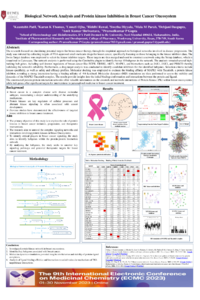
The research focused on elucidating potential targets for breast cancer therapy through the empirical approach to biological networks involved in disease progression. The study was initiated by collecting targets of FDA-approved small-molecule drugs for breast cancer, specifically focusing on those belonging to the kinase inhibitor class. The Swiss Target database was employed to select the kinase inhibitor targets. These targets are then merged and used to construct a network using the String database, which is visualized in Cytoscape. The network analysis is performed using the Cytohubba plugin to identify the top 10 hubgenes in the network. The analysis revealed several high-ranking hub genes, including well-known regulators of breast cancer like EGFR, ERBB2, AKT1, MAPK1, and biomarkers such as JAK1, JAK3, and PRKCD thereby validating the network's reliability. Furthermore, a drug-target analysis was conducted to identify candidate inhibitors for the identified hubgenes. Selection criteria include kinase-specificity, as well as safety and efficacy profiles. Molecular docking was employed to evaluate the binding affinity of MAPK1 with Tucatinib, a protein kinase inhibitor, revealing a strong interaction having a binding affinity of -9.6 kcal/mol. Molecular dynamics (MD) simulations are then performed to assess the stability and dynamics of the MAPK1-Tucatinib complex. The results provide insights into the initial binding conformation and interactions between the protein and ligand. The constructed protein-protein interaction networks offer valuable information on the crosstalk and network interactions of Protein Kinase (PK) within breast oncosystems, while hub genes offer significant targets for interventions in personalized medicine in breast cancer treatment.
Keywords
Network
Kinase
Molecular Docking
Breast Cancer
Inhibitors
Manuscript
Breast-OncoSystem-MDPI-2023.pdf
Poster
Breast-OncoSystem-MDPI-2023.pdf
Sex hormone-binding globulin restores mitochondrial integrity in PPARγ-depleted mesenchymal stromal cells
Single and combined effects of sertraline and polyhydroxybutyrate nanoplastics to Amphibians: An in vivo and in vitro approach