Event submissions
Published
 10.3390/ECMC2023-15916 (registering DOI)
 This submission belongs to the session S7. Emerging technologies in drug discovery of the event 9th International Electronic Conference on Medicinal Chemistry
Published date
08 Nov, 2023
Academic Editor
'%3e%3cpath%20d='M12.6657%2010.9104C12.4185%2010.325%2012.0599%209.79327%2011.6097%209.34482C11.1609%208.89508%2010.6293%208.5365%2010.0442%208.28888C10.0389%208.28626%2010.0337%208.28495%2010.0285%208.28233C10.8446%207.69279%2011.3752%206.73249%2011.3752%205.64904C11.3752%203.8542%209.92103%202.39999%208.1262%202.39999C6.33136%202.39999%204.87715%203.8542%204.87715%205.64904C4.87715%206.73249%205.40774%207.69279%206.22393%208.28364C6.21869%208.28626%206.21345%208.28757%206.20821%208.29019C5.62129%208.5378%205.09463%208.89284%204.64265%209.34613C4.1929%209.79493%203.83432%2010.3266%203.58671%2010.9117C3.34345%2011.4845%203.21226%2012.0987%203.20023%2012.7209C3.19988%2012.7349%203.20233%2012.7488%203.20744%2012.7619C3.21255%2012.7749%203.22022%2012.7867%203.22998%2012.7968C3.23975%2012.8068%203.25142%2012.8147%203.26431%2012.8202C3.2772%2012.8256%203.29105%2012.8284%203.30504%2012.8284H4.09109C4.14874%2012.8284%204.19459%2012.7825%204.1959%2012.7262C4.2221%2011.7148%204.62823%2010.7676%205.34617%2010.0497C6.08899%209.30683%207.0755%208.89808%208.1262%208.89808C9.17689%208.89808%2010.1634%209.30683%2010.9062%2010.0497C11.6242%2010.7676%2012.0303%2011.7148%2012.0565%2012.7262C12.0578%2012.7838%2012.1037%2012.8284%2012.1613%2012.8284H12.9474C12.9613%2012.8284%2012.9752%2012.8256%2012.9881%2012.8202C13.001%2012.8147%2013.0126%2012.8068%2013.0224%2012.7968C13.0322%2012.7867%2013.0398%2012.7749%2013.0449%2012.7619C13.0501%2012.7488%2013.0525%2012.7349%2013.0522%2012.7209C13.0391%2012.0947%2012.9094%2011.4855%2012.6657%2010.9104ZM8.1262%207.9024C7.52486%207.9024%206.9589%207.6679%206.53312%207.24211C6.10733%206.81633%205.87283%206.25037%205.87283%205.64904C5.87283%205.0477%206.10733%204.48174%206.53312%204.05596C6.9589%203.63018%207.52486%203.39567%208.1262%203.39567C8.72753%203.39567%209.29349%203.63018%209.71927%204.05596C10.1451%204.48174%2010.3796%205.0477%2010.3796%205.64904C10.3796%206.25037%2010.1451%206.81633%209.71927%207.24211C9.29349%207.6679%208.72753%207.9024%208.1262%207.9024Z'%20fill='%235D1EE1'/%3e%3c/g%3e%3c/svg%3e) Alfredo Berzal-Herranz
Alfredo Berzal-HerranzCitation
KAMAL LOCHAN MISRA, Sidhartha Sankar Kar, Nrusingha Prasad Nanda, DFT studies on the mechanism of base-catalyzed hydrocyanation of alpha, beta-unsaturated ketone, in Proceedings of 9th International Electronic Conference on Medicinal Chemistry, 1 November–30 November 2023, MDPI: Basel, Switzerland, doi: 10.3390/ECMC2023-15916
Share
Email
Facebook
Twitter
LinkedIn
DFT studies on the mechanism of base-catalyzed hydrocyanation of alpha, beta-unsaturated ketone
'%3e%3cpath%20d='M12.6647%2010.9104C12.4176%2010.325%2012.0589%209.7933%2011.6088%209.34485C11.16%208.89511%2010.6283%208.53653%2010.0432%208.28891C10.038%208.28629%2010.0327%208.28498%2010.0275%208.28236C10.8437%207.69282%2011.3743%206.73252%2011.3743%205.64907C11.3743%203.85423%209.92005%202.40002%208.12522%202.40002C6.33038%202.40002%204.87618%203.85423%204.87618%205.64907C4.87618%206.73252%205.40677%207.69282%206.22296%208.28367C6.21772%208.28629%206.21248%208.2876%206.20724%208.29022C5.62031%208.53783%205.09365%208.89287%204.64167%209.34616C4.19192%209.79496%203.83334%2010.3266%203.58573%2010.9117C3.34247%2011.4846%203.21128%2012.0987%203.19925%2012.721C3.1989%2012.735%203.20135%2012.7489%203.20646%2012.7619C3.21157%2012.7749%203.21924%2012.7868%203.22901%2012.7968C3.23877%2012.8068%203.25045%2012.8148%203.26334%2012.8202C3.27623%2012.8256%203.29007%2012.8284%203.30406%2012.8284H4.09012C4.14776%2012.8284%204.19362%2012.7825%204.19493%2012.7262C4.22113%2011.7148%204.62726%2010.7676%205.34519%2010.0497C6.08802%209.30686%207.07452%208.89811%208.12522%208.89811C9.17592%208.89811%2010.1624%209.30686%2010.9052%2010.0497C11.6232%2010.7676%2012.0293%2011.7148%2012.0555%2012.7262C12.0568%2012.7839%2012.1027%2012.8284%2012.1603%2012.8284H12.9464C12.9604%2012.8284%2012.9742%2012.8256%2012.9871%2012.8202C13%2012.8148%2013.0117%2012.8068%2013.0214%2012.7968C13.0312%2012.7868%2013.0389%2012.7749%2013.044%2012.7619C13.0491%2012.7489%2013.0515%2012.735%2013.0512%2012.721C13.0381%2012.0947%2012.9084%2011.4856%2012.6647%2010.9104ZM8.12522%207.90243C7.52388%207.90243%206.95792%207.66793%206.53214%207.24215C6.10636%206.81636%205.87185%206.2504%205.87185%205.64907C5.87185%205.04773%206.10636%204.48177%206.53214%204.05599C6.95792%203.63021%207.52388%203.3957%208.12522%203.3957C8.72655%203.3957%209.29252%203.63021%209.7183%204.05599C10.1441%204.48177%2010.3786%205.04773%2010.3786%205.64907C10.3786%206.2504%2010.1441%206.81636%209.7183%207.24215C9.29252%207.66793%208.72655%207.90243%208.12522%207.90243Z'%20fill='%235D1EE1'/%3e%3c/g%3e%3c/svg%3e)
KAMAL LOCHAN MISRA 1
Sidhartha Sankar Kar 2
Nrusingha Prasad Nanda 1
1. Department of Pharmaceutical Chemistry, Institute of Pharmacy and Technology, Salipur, Cuttack, 754202
2. Faculty of Pharmaceutical Sciences
C. V. Raman Global University, Mahura, Bhubaneswar- 752054
Abstract
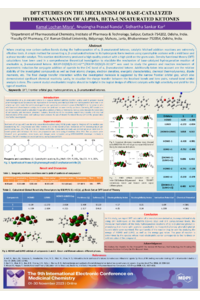
When it comes to creating new carbon-carbon bonds during the hydrocyanation of α, β-unsaturated ketones, catalytic Michael addition reactions are extremely effective tools. A simple method for converting α, β-unsaturated ketone to its hydrocyanic form involves using cyanohydrin acetone with a mild base and a phase transfer catalyst. This reaction stoichiometry produced a high-quality product with a high yield on the gram scale. Density functional theory (DFT) calculations have been used in a comprehensive theoretical investigation to elucidate the mechanism of base-catalyzed hydrocyanation reaction of enolizable α, β-unsaturated ketone. B3LYP-D3(BJ)/6-311+G**//B3LYP-D3(BJ)/6-311G** was used to study the genesis and reaction mechanism of asymmetric induction for conjugate addition of cyanide to the C=C bond of α, β-unsaturated ketone. Additionally taken into account are the relative stability of the investigated compounds as well as their atomic charges, electron densities, energetic characteristics, chemical thermodynamics, dipole moments, etc. The final charge transfer interaction within the investigated molecule is suggested by the narrow frontier orbital gap, which also demonstrated significant chemical reactivity. Lastly, to visualise the charge transfer between the localised bonds and lone pairs, natural bond orbital analysis is done. The current study's mechanistic insights should be helpful in the logical design of efficient catalysts with high selectivity and yield for this type of reaction.
Keywords
DFT
Frontier orbital gap
Hydrocyanation
α
β-unsaturated ketones
Manuscript
MDPI pdf.pdf
Poster
9th-ECMC_Kamal_2.11.23.pdf
Single and combined effects of sertraline and polyhydroxybutyrate nanoplastics to Amphibians: An in vivo and in vitro approach
Benefits of combining vitamins C and E consumption when using aspartame