Event submissions
Published

This submission belongs to the session J. Poster Session of the event The 4th International Electronic Conference on Applied Sciences
Published date
09 Nov, 2023
Academic Editor
'%3e%3cpath%20d='M12.6657%2010.9104C12.4185%2010.325%2012.0599%209.79327%2011.6097%209.34482C11.1609%208.89508%2010.6293%208.5365%2010.0442%208.28888C10.0389%208.28626%2010.0337%208.28495%2010.0285%208.28233C10.8446%207.69279%2011.3752%206.73249%2011.3752%205.64904C11.3752%203.8542%209.92103%202.39999%208.1262%202.39999C6.33136%202.39999%204.87715%203.8542%204.87715%205.64904C4.87715%206.73249%205.40774%207.69279%206.22393%208.28364C6.21869%208.28626%206.21345%208.28757%206.20821%208.29019C5.62129%208.5378%205.09463%208.89284%204.64265%209.34613C4.1929%209.79493%203.83432%2010.3266%203.58671%2010.9117C3.34345%2011.4845%203.21226%2012.0987%203.20023%2012.7209C3.19988%2012.7349%203.20233%2012.7488%203.20744%2012.7619C3.21255%2012.7749%203.22022%2012.7867%203.22998%2012.7968C3.23975%2012.8068%203.25142%2012.8147%203.26431%2012.8202C3.2772%2012.8256%203.29105%2012.8284%203.30504%2012.8284H4.09109C4.14874%2012.8284%204.19459%2012.7825%204.1959%2012.7262C4.2221%2011.7148%204.62823%2010.7676%205.34617%2010.0497C6.08899%209.30683%207.0755%208.89808%208.1262%208.89808C9.17689%208.89808%2010.1634%209.30683%2010.9062%2010.0497C11.6242%2010.7676%2012.0303%2011.7148%2012.0565%2012.7262C12.0578%2012.7838%2012.1037%2012.8284%2012.1613%2012.8284H12.9474C12.9613%2012.8284%2012.9752%2012.8256%2012.9881%2012.8202C13.001%2012.8147%2013.0126%2012.8068%2013.0224%2012.7968C13.0322%2012.7867%2013.0398%2012.7749%2013.0449%2012.7619C13.0501%2012.7488%2013.0525%2012.7349%2013.0522%2012.7209C13.0391%2012.0947%2012.9094%2011.4855%2012.6657%2010.9104ZM8.1262%207.9024C7.52486%207.9024%206.9589%207.6679%206.53312%207.24211C6.10733%206.81633%205.87283%206.25037%205.87283%205.64904C5.87283%205.0477%206.10733%204.48174%206.53312%204.05596C6.9589%203.63018%207.52486%203.39567%208.1262%203.39567C8.72753%203.39567%209.29349%203.63018%209.71927%204.05596C10.1451%204.48174%2010.3796%205.0477%2010.3796%205.64904C10.3796%206.25037%2010.1451%206.81633%209.71927%207.24211C9.29349%207.6679%208.72753%207.9024%208.1262%207.9024Z'%20fill='%235D1EE1'/%3e%3c/g%3e%3c/svg%3e) Cosimo Trono
Cosimo TronoCitation
Priyansh Brahmbhatt, Shivani R Bharucha, Ashish Bhatt, Mehul S Dave, Synthesis, Characterization and Antimicrobial activity of Magnetite (Fe₃O₄) Nanoparticles by the Sol-Gel Method, in Proceedings of The 4th International Electronic Conference on Applied Sciences, 27 October–10 November 2023, MDPI: Basel, Switzerland, doi: 10.3390/ASEC2023-15950
Share
Email
Facebook
Twitter
LinkedIn
Synthesis, Characterization and Antimicrobial activity of Magnetite (Fe3O4) Nanoparticles by the Sol-Gel Method
'%3e%3cpath%20d='M12.6647%2010.9104C12.4176%2010.325%2012.0589%209.7933%2011.6088%209.34485C11.16%208.89511%2010.6283%208.53653%2010.0432%208.28891C10.038%208.28629%2010.0327%208.28498%2010.0275%208.28236C10.8437%207.69282%2011.3743%206.73252%2011.3743%205.64907C11.3743%203.85423%209.92005%202.40002%208.12522%202.40002C6.33038%202.40002%204.87618%203.85423%204.87618%205.64907C4.87618%206.73252%205.40677%207.69282%206.22296%208.28367C6.21772%208.28629%206.21248%208.2876%206.20724%208.29022C5.62031%208.53783%205.09365%208.89287%204.64167%209.34616C4.19192%209.79496%203.83334%2010.3266%203.58573%2010.9117C3.34247%2011.4846%203.21128%2012.0987%203.19925%2012.721C3.1989%2012.735%203.20135%2012.7489%203.20646%2012.7619C3.21157%2012.7749%203.21924%2012.7868%203.22901%2012.7968C3.23877%2012.8068%203.25045%2012.8148%203.26334%2012.8202C3.27623%2012.8256%203.29007%2012.8284%203.30406%2012.8284H4.09012C4.14776%2012.8284%204.19362%2012.7825%204.19493%2012.7262C4.22113%2011.7148%204.62726%2010.7676%205.34519%2010.0497C6.08802%209.30686%207.07452%208.89811%208.12522%208.89811C9.17592%208.89811%2010.1624%209.30686%2010.9052%2010.0497C11.6232%2010.7676%2012.0293%2011.7148%2012.0555%2012.7262C12.0568%2012.7839%2012.1027%2012.8284%2012.1603%2012.8284H12.9464C12.9604%2012.8284%2012.9742%2012.8256%2012.9871%2012.8202C13%2012.8148%2013.0117%2012.8068%2013.0214%2012.7968C13.0312%2012.7868%2013.0389%2012.7749%2013.044%2012.7619C13.0491%2012.7489%2013.0515%2012.735%2013.0512%2012.721C13.0381%2012.0947%2012.9084%2011.4856%2012.6647%2010.9104ZM8.12522%207.90243C7.52388%207.90243%206.95792%207.66793%206.53214%207.24215C6.10636%206.81636%205.87185%206.2504%205.87185%205.64907C5.87185%205.04773%206.10636%204.48177%206.53214%204.05599C6.95792%203.63021%207.52388%203.3957%208.12522%203.3957C8.72655%203.3957%209.29252%203.63021%209.7183%204.05599C10.1441%204.48177%2010.3786%205.04773%2010.3786%205.64907C10.3786%206.2504%2010.1441%206.81636%209.7183%207.24215C9.29252%207.66793%208.72655%207.90243%208.12522%207.90243Z'%20fill='%235D1EE1'/%3e%3c/g%3e%3c/svg%3e)
Priyansh Brahmbhatt 1
Shivani R Bharucha 1
Ashish Bhatt 1
Mehul S Dave 1
1. Natubhai V. Patel College of Pure & Applied Sciences, The C.V.M. University, Vallabh Vidyanagar-388 120, Anand, Gujarat, India
Abstract
Transition Metal Oxide (TMO) nanoparticles have emerged as promising materials for various applications including color imaging, magnetic recording media, soft magnetic materials, heterogeneous catalysis, and different field of biomedical science. Apart from the TMO, Fe3O4 nanoparticles hold great promise in a variety of biomedical uses such as drug delivery, cell separation, and MRI imaging. Magnetite (Fe304) nanoparticles exhibit their potential as antimicrobial agents due to their unique properties and interactions with microorganisms. This study focuses on the synthesis, characterization, and evaluation of the antimicrobial activity of magnetite (Fe3O4) nanoparticles prepared using the sol-gel method. The Fe3O4 nanoparticles were synthesized through a facile and cost-effective sol-gel route, involving the ferric nitrate and ethanol as precursors. Different characterization techniques, including Energy-Dispersive X-ray Spectroscopy (EDAX), X-ray diffraction (XRD), and UV-VIS NIR spectroscopy were employed to analyze the compositional analysis, crystalline structure, and optical properties of the nanoparticles. The EDAX and XRD analysis confirmed that the synthesized nanoparticles are near to stoichiometry and formation of single-phase magnetite nanoparticles. The obtained bandgap of synthesized nanoparticles is 5.03 eV. Furthermore, the synthesized Fe3O4 nanoparticles were evaluated for their antimicrobial efficacy against a panel of including both Gram-positive (e.g., Staphylococcus aureus) and Gram-negative (e.g., Enterobacter aerogenes) bacteria. Investigations into the nanoparticles biocompatibility and long-term effects would be crucial for their safe and effective utilization in real-world applications.
Keywords
Magnetite Nanoparticles
Sol-gel Method
Optical Properties
Manuscript
sciforum-077621.pdf
Poster
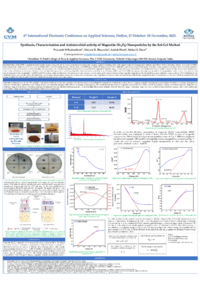
ASEC2023_PNB_Poster.pdf
Noise Reduction Transactions for Bio- Medical Image Processing Techniques using Artificial Intelligence
Assessing Disparities in Community Water Fluoridation Across US States: A Spectral Clustering Approach