Event submissions
Published

This submission belongs to the session C. The Role of Gut Microbiota in Precision Nutrition of the event The 3rd International Electronic Conference on Nutrients
Published date
13 Nov, 2023
Academic Editor
'%3e%3cpath%20d='M12.6657%2010.9104C12.4185%2010.325%2012.0599%209.79327%2011.6097%209.34482C11.1609%208.89508%2010.6293%208.5365%2010.0442%208.28888C10.0389%208.28626%2010.0337%208.28495%2010.0285%208.28233C10.8446%207.69279%2011.3752%206.73249%2011.3752%205.64904C11.3752%203.8542%209.92103%202.39999%208.1262%202.39999C6.33136%202.39999%204.87715%203.8542%204.87715%205.64904C4.87715%206.73249%205.40774%207.69279%206.22393%208.28364C6.21869%208.28626%206.21345%208.28757%206.20821%208.29019C5.62129%208.5378%205.09463%208.89284%204.64265%209.34613C4.1929%209.79493%203.83432%2010.3266%203.58671%2010.9117C3.34345%2011.4845%203.21226%2012.0987%203.20023%2012.7209C3.19988%2012.7349%203.20233%2012.7488%203.20744%2012.7619C3.21255%2012.7749%203.22022%2012.7867%203.22998%2012.7968C3.23975%2012.8068%203.25142%2012.8147%203.26431%2012.8202C3.2772%2012.8256%203.29105%2012.8284%203.30504%2012.8284H4.09109C4.14874%2012.8284%204.19459%2012.7825%204.1959%2012.7262C4.2221%2011.7148%204.62823%2010.7676%205.34617%2010.0497C6.08899%209.30683%207.0755%208.89808%208.1262%208.89808C9.17689%208.89808%2010.1634%209.30683%2010.9062%2010.0497C11.6242%2010.7676%2012.0303%2011.7148%2012.0565%2012.7262C12.0578%2012.7838%2012.1037%2012.8284%2012.1613%2012.8284H12.9474C12.9613%2012.8284%2012.9752%2012.8256%2012.9881%2012.8202C13.001%2012.8147%2013.0126%2012.8068%2013.0224%2012.7968C13.0322%2012.7867%2013.0398%2012.7749%2013.0449%2012.7619C13.0501%2012.7488%2013.0525%2012.7349%2013.0522%2012.7209C13.0391%2012.0947%2012.9094%2011.4855%2012.6657%2010.9104ZM8.1262%207.9024C7.52486%207.9024%206.9589%207.6679%206.53312%207.24211C6.10733%206.81633%205.87283%206.25037%205.87283%205.64904C5.87283%205.0477%206.10733%204.48174%206.53312%204.05596C6.9589%203.63018%207.52486%203.39567%208.1262%203.39567C8.72753%203.39567%209.29349%203.63018%209.71927%204.05596C10.1451%204.48174%2010.3796%205.0477%2010.3796%205.64904C10.3796%206.25037%2010.1451%206.81633%209.71927%207.24211C9.29349%207.6679%208.72753%207.9024%208.1262%207.9024Z'%20fill='%235D1EE1'/%3e%3c/g%3e%3c/svg%3e) Egeria Scoditti
Egeria ScodittiCitation
Valentín Varela Floriano, Marielisa Rojas López, Salma Suárez Méndez, Fabiola Luna Vázquez, Julia Rodríguez Castelán, Diet-induced metabolic syndrome alteres bladder urothelium in adult female rats, in Proceedings of The 3rd International Electronic Conference on Nutrients, 1 November–15 November 2023, MDPI: Basel, Switzerland, doi: 10.3390/IECN2023-15969
Share
Email
Facebook
Twitter
LinkedIn
Diet-induced metabolic syndrome alteres bladder urothelium in adult female rats
'%3e%3cpath%20d='M12.6647%2010.9104C12.4176%2010.325%2012.0589%209.7933%2011.6088%209.34485C11.16%208.89511%2010.6283%208.53653%2010.0432%208.28891C10.038%208.28629%2010.0327%208.28498%2010.0275%208.28236C10.8437%207.69282%2011.3743%206.73252%2011.3743%205.64907C11.3743%203.85423%209.92005%202.40002%208.12522%202.40002C6.33038%202.40002%204.87618%203.85423%204.87618%205.64907C4.87618%206.73252%205.40677%207.69282%206.22296%208.28367C6.21772%208.28629%206.21248%208.2876%206.20724%208.29022C5.62031%208.53783%205.09365%208.89287%204.64167%209.34616C4.19192%209.79496%203.83334%2010.3266%203.58573%2010.9117C3.34247%2011.4846%203.21128%2012.0987%203.19925%2012.721C3.1989%2012.735%203.20135%2012.7489%203.20646%2012.7619C3.21157%2012.7749%203.21924%2012.7868%203.22901%2012.7968C3.23877%2012.8068%203.25045%2012.8148%203.26334%2012.8202C3.27623%2012.8256%203.29007%2012.8284%203.30406%2012.8284H4.09012C4.14776%2012.8284%204.19362%2012.7825%204.19493%2012.7262C4.22113%2011.7148%204.62726%2010.7676%205.34519%2010.0497C6.08802%209.30686%207.07452%208.89811%208.12522%208.89811C9.17592%208.89811%2010.1624%209.30686%2010.9052%2010.0497C11.6232%2010.7676%2012.0293%2011.7148%2012.0555%2012.7262C12.0568%2012.7839%2012.1027%2012.8284%2012.1603%2012.8284H12.9464C12.9604%2012.8284%2012.9742%2012.8256%2012.9871%2012.8202C13%2012.8148%2013.0117%2012.8068%2013.0214%2012.7968C13.0312%2012.7868%2013.0389%2012.7749%2013.044%2012.7619C13.0491%2012.7489%2013.0515%2012.735%2013.0512%2012.721C13.0381%2012.0947%2012.9084%2011.4856%2012.6647%2010.9104ZM8.12522%207.90243C7.52388%207.90243%206.95792%207.66793%206.53214%207.24215C6.10636%206.81636%205.87185%206.2504%205.87185%205.64907C5.87185%205.04773%206.10636%204.48177%206.53214%204.05599C6.95792%203.63021%207.52388%203.3957%208.12522%203.3957C8.72655%203.3957%209.29252%203.63021%209.7183%204.05599C10.1441%204.48177%2010.3786%205.04773%2010.3786%205.64907C10.3786%206.2504%2010.1441%206.81636%209.7183%207.24215C9.29252%207.66793%208.72655%207.90243%208.12522%207.90243Z'%20fill='%235D1EE1'/%3e%3c/g%3e%3c/svg%3e)
Valentín Varela Floriano 1
Marielisa Rojas López 2
Salma Suárez Méndez 2
Fabiola Luna Vázquez 3
Julia Rodríguez Castelán 4
1. Área Ciencias de la Salud, Universidad del Desarrollo Profesional, Veracruz, Ver.
2. Licenciatura en Nutrición y Ciencia de los Alimentos, Universidad Cristóbal Colón, Veracruz, Ver.
3. Área Académica de Nutrición y Ciencia de los Alimentos, Universidad Cristóbal Colón, Veracruz. Ver.
4. División Académica de Ciencias de la Salud, Universidad Cristóbal Colón, Veracruzano, Ver.
Abstract
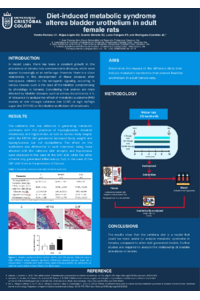
In recent years, there has been a constant growth in the prevalence of chronic non-communicable diseases, which even appear increasingly at an earlier age. However, there is a close relationship in the development of these diseases after menopause, related to the estrogenic signaling occurring in various tissues; such is the case of the bladder, compromising its physiology in females. Considering that women are more affected by bladder diseases such as urinary incontinence, it is of relevance to analyze the effect of metabolic syndrome (MS) models of diet through cafeteria diet (CAF) or high fat/high sugar diet (HF/HS) on the bladder urothelium of female rats. Eighteen 12-week-old Wistar rats were used. The female rats were divided into an intact control group (C, n=6), a cafeteria diet SMet group (CAF, n=6), and a high-fat/high-sugar diet SMet group (HF/HS, n=6). Control group had access to water and feed (23% protein, 50% carbohydrate, and 27% lipid) ad libitum; the cafeteria group had a designed diet (approximately 11% protein, 60% carbohydrate, and 29% lipid) in which ultra-processed feeds were used, the high-fat/high-sugar diet (HF/HS) was designed and pellets were prepared with a composition of (18% protein, 55% carbohydrate, and 27% lipid). The duration of the treatments was 10 weeks. After treatment, all animals were euthanized and blood was obtained for biochemical evaluations (cholesterol and triglycerides), as well as bladder. Each tissue was stained with Masson's trichrome and PAS, and photographs were taken at 10x, 40x, and 100x. Data were analyzed statistically and differences were considered when P< 0.05, using graph Pad v.6 statistical packages. The cafeteria diet was effective in generating metabolic syndrome, with the presence of hyperglycemia, elevated cholesterol, and triglycerides, as well as excess body weight, while the HF/HS diet generated increased body weight and hyperglycemia, but not dyslipidemia. The effect on the urothelium was differential in each treatment, being more affected with the cafeteria diet. Atrophy and hyperplasia were observed in the case of the CAF diet, while the other scheme only generated inflammatory foci, in the case of the CAF diet there is the presence of fibrosis. The results show that the cafeteria diet is a model that could be more useful to analyze metabolic syndrome in females, compared to other diet-generated models. Further studies are required to analyze the relationship of bladder alterations in females.
Keywords
Bladder endothelium
metabolic syndrome
urinary incontinence
Manuscript
Varela Floriano V 2023-2-2.pdf
Poster
The 3rd International Electronic Conference on Nutrients . 2023.pdf
Mechanistic Insights into the Metabolic Pathways using High-Resolution Mass Spectrometry and Predictive Models in Pancreatic β-Cell Lines (β-TC-6).
A maternal diet enriched in fibre and polyphenols during pregestation, gestation and lactation has an intestinal trophic effect in both the dam and the offspring.