Event submissions
Published

This submission belongs to the session C. Sensor Networks, IoT and Structural Health Monitoring of the event 10th International Electronic Conference on Sensors and Applications
Published date
15 Nov, 2023
Academic Editor
'%3e%3cpath%20d='M12.6657%2010.9104C12.4185%2010.325%2012.0599%209.79327%2011.6097%209.34482C11.1609%208.89508%2010.6293%208.5365%2010.0442%208.28888C10.0389%208.28626%2010.0337%208.28495%2010.0285%208.28233C10.8446%207.69279%2011.3752%206.73249%2011.3752%205.64904C11.3752%203.8542%209.92103%202.39999%208.1262%202.39999C6.33136%202.39999%204.87715%203.8542%204.87715%205.64904C4.87715%206.73249%205.40774%207.69279%206.22393%208.28364C6.21869%208.28626%206.21345%208.28757%206.20821%208.29019C5.62129%208.5378%205.09463%208.89284%204.64265%209.34613C4.1929%209.79493%203.83432%2010.3266%203.58671%2010.9117C3.34345%2011.4845%203.21226%2012.0987%203.20023%2012.7209C3.19988%2012.7349%203.20233%2012.7488%203.20744%2012.7619C3.21255%2012.7749%203.22022%2012.7867%203.22998%2012.7968C3.23975%2012.8068%203.25142%2012.8147%203.26431%2012.8202C3.2772%2012.8256%203.29105%2012.8284%203.30504%2012.8284H4.09109C4.14874%2012.8284%204.19459%2012.7825%204.1959%2012.7262C4.2221%2011.7148%204.62823%2010.7676%205.34617%2010.0497C6.08899%209.30683%207.0755%208.89808%208.1262%208.89808C9.17689%208.89808%2010.1634%209.30683%2010.9062%2010.0497C11.6242%2010.7676%2012.0303%2011.7148%2012.0565%2012.7262C12.0578%2012.7838%2012.1037%2012.8284%2012.1613%2012.8284H12.9474C12.9613%2012.8284%2012.9752%2012.8256%2012.9881%2012.8202C13.001%2012.8147%2013.0126%2012.8068%2013.0224%2012.7968C13.0322%2012.7867%2013.0398%2012.7749%2013.0449%2012.7619C13.0501%2012.7488%2013.0525%2012.7349%2013.0522%2012.7209C13.0391%2012.0947%2012.9094%2011.4855%2012.6657%2010.9104ZM8.1262%207.9024C7.52486%207.9024%206.9589%207.6679%206.53312%207.24211C6.10733%206.81633%205.87283%206.25037%205.87283%205.64904C5.87283%205.0477%206.10733%204.48174%206.53312%204.05596C6.9589%203.63018%207.52486%203.39567%208.1262%203.39567C8.72753%203.39567%209.29349%203.63018%209.71927%204.05596C10.1451%204.48174%2010.3796%205.0477%2010.3796%205.64904C10.3796%206.25037%2010.1451%206.81633%209.71927%207.24211C9.29349%207.6679%208.72753%207.9024%208.1262%207.9024Z'%20fill='%235D1EE1'/%3e%3c/g%3e%3c/svg%3e) Francisco Falcone
Francisco FalconeCitation
Kim-Ming Tsoi, King-Pong YU, Chu-Kei Ng, Suk-Mun Wong, Ka-Leung Chan, Wai-Ling Ma, Development of an Embedded Device for Quantifying and Recording Daily Standing Profiles in Individuals with Lower Limb Motor Impairment Using an Assistive Standing Mobile Device, in Proceedings of 10th International Electronic Conference on Sensors and Applications, 15 November–30 November 2023, MDPI: Basel, Switzerland, doi: 10.3390/ecsa-10-16011
Share
Email
Facebook
Twitter
LinkedIn
Development of an Embedded Device for Quantifying and Recording Daily Standing Profiles in Individuals with Lower Limb Motor Impairment Using an Assistive Standing Mobile Device
'%3e%3cpath%20d='M12.6647%2010.9104C12.4176%2010.325%2012.0589%209.7933%2011.6088%209.34485C11.16%208.89511%2010.6283%208.53653%2010.0432%208.28891C10.038%208.28629%2010.0327%208.28498%2010.0275%208.28236C10.8437%207.69282%2011.3743%206.73252%2011.3743%205.64907C11.3743%203.85423%209.92005%202.40002%208.12522%202.40002C6.33038%202.40002%204.87618%203.85423%204.87618%205.64907C4.87618%206.73252%205.40677%207.69282%206.22296%208.28367C6.21772%208.28629%206.21248%208.2876%206.20724%208.29022C5.62031%208.53783%205.09365%208.89287%204.64167%209.34616C4.19192%209.79496%203.83334%2010.3266%203.58573%2010.9117C3.34247%2011.4846%203.21128%2012.0987%203.19925%2012.721C3.1989%2012.735%203.20135%2012.7489%203.20646%2012.7619C3.21157%2012.7749%203.21924%2012.7868%203.22901%2012.7968C3.23877%2012.8068%203.25045%2012.8148%203.26334%2012.8202C3.27623%2012.8256%203.29007%2012.8284%203.30406%2012.8284H4.09012C4.14776%2012.8284%204.19362%2012.7825%204.19493%2012.7262C4.22113%2011.7148%204.62726%2010.7676%205.34519%2010.0497C6.08802%209.30686%207.07452%208.89811%208.12522%208.89811C9.17592%208.89811%2010.1624%209.30686%2010.9052%2010.0497C11.6232%2010.7676%2012.0293%2011.7148%2012.0555%2012.7262C12.0568%2012.7839%2012.1027%2012.8284%2012.1603%2012.8284H12.9464C12.9604%2012.8284%2012.9742%2012.8256%2012.9871%2012.8202C13%2012.8148%2013.0117%2012.8068%2013.0214%2012.7968C13.0312%2012.7868%2013.0389%2012.7749%2013.044%2012.7619C13.0491%2012.7489%2013.0515%2012.735%2013.0512%2012.721C13.0381%2012.0947%2012.9084%2011.4856%2012.6647%2010.9104ZM8.12522%207.90243C7.52388%207.90243%206.95792%207.66793%206.53214%207.24215C6.10636%206.81636%205.87185%206.2504%205.87185%205.64907C5.87185%205.04773%206.10636%204.48177%206.53214%204.05599C6.95792%203.63021%207.52388%203.3957%208.12522%203.3957C8.72655%203.3957%209.29252%203.63021%209.7183%204.05599C10.1441%204.48177%2010.3786%205.04773%2010.3786%205.64907C10.3786%206.2504%2010.1441%206.81636%209.7183%207.24215C9.29252%207.66793%208.72655%207.90243%208.12522%207.90243Z'%20fill='%235D1EE1'/%3e%3c/g%3e%3c/svg%3e)
Kim-Ming Tsoi 1
King-Pong YU 1
Chu-Kei Ng 1
Suk-Mun Wong 1
Ka-Leung Chan 1
Wai-Ling Ma 1
1. The Hospital Authority Community Rehabilitation Service Support Center (CRSSC)
Abstract
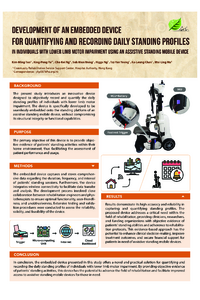
The present study introduces an innovative device designed to objectively record and quantify the daily standing profiles of individuals with lower limb motor impairment. The device is specifically developed to be seamlessly embedded onto the standing platform of an assistive standing mobile device, without compromising its structural integrity or functional capabilities. The primary objective of this device is to provide objective evidence of patients' standing activities within their home environment, thus facilitating the assessment of patient performance and usage. The embedded device captures and stores comprehensive data regarding the duration, frequency, and interval of patients' standing sessions. Furthermore, the device integrates wireless connectivity to facilitate data transfer and analysis. The development process involved close collaboration between rehabilitation engineers and physiotherapists to ensure optimal functionality, user-friendliness, and unobtrusiveness. Extensive testing and validation procedures were conducted to assess the reliability, validity, and feasibility of the device. Results demonstrate its high accuracy and reliability in capturing and quantifying standing profiles. The proposed device addresses a critical need within the field of rehabilitation, providing clinicians, researchers, and funding organizations with objective evidence of patients' standing abilities and adherence to rehabilitation protocols. This evidence-based approach has the potential to enhance clinical decision-making, improve treatment outcomes, and secure financial support for patients in need of assistive standing mobile devices. In conclusion, the embedded device presented in this study offers a novel and practical solution for quantifying and recording the daily standing profiles of individuals with lower limb motor impairment. By providing objective evidence of patients' standing activities, this device has the potential to advance the field of rehabilitation and facilitate improved access to assistive standing mobile devices for those in need.
Keywords
REhabilitation
Standing
IoT
Compliance checking
Manuscript
(revised) sciforum-080126-clean.pdf
Poster
Poster_standing tracker.pdf
Crop Recommendation System based on Soil and Environmental factors using Graph Convolution Network and Graph Neural Network: A systematic Literature Review
Internet of Things for Smart Farming: Measuring Productivity and Effectiveness