Event submissions
Published
This submission belongs to the session G. Poster session of the event 10th International Electronic Conference on Sensors and Applications
Published date
15 Nov, 2023
Academic Editor
'%3e%3cpath%20d='M12.6657%2010.9104C12.4185%2010.325%2012.0599%209.79327%2011.6097%209.34482C11.1609%208.89508%2010.6293%208.5365%2010.0442%208.28888C10.0389%208.28626%2010.0337%208.28495%2010.0285%208.28233C10.8446%207.69279%2011.3752%206.73249%2011.3752%205.64904C11.3752%203.8542%209.92103%202.39999%208.1262%202.39999C6.33136%202.39999%204.87715%203.8542%204.87715%205.64904C4.87715%206.73249%205.40774%207.69279%206.22393%208.28364C6.21869%208.28626%206.21345%208.28757%206.20821%208.29019C5.62129%208.5378%205.09463%208.89284%204.64265%209.34613C4.1929%209.79493%203.83432%2010.3266%203.58671%2010.9117C3.34345%2011.4845%203.21226%2012.0987%203.20023%2012.7209C3.19988%2012.7349%203.20233%2012.7488%203.20744%2012.7619C3.21255%2012.7749%203.22022%2012.7867%203.22998%2012.7968C3.23975%2012.8068%203.25142%2012.8147%203.26431%2012.8202C3.2772%2012.8256%203.29105%2012.8284%203.30504%2012.8284H4.09109C4.14874%2012.8284%204.19459%2012.7825%204.1959%2012.7262C4.2221%2011.7148%204.62823%2010.7676%205.34617%2010.0497C6.08899%209.30683%207.0755%208.89808%208.1262%208.89808C9.17689%208.89808%2010.1634%209.30683%2010.9062%2010.0497C11.6242%2010.7676%2012.0303%2011.7148%2012.0565%2012.7262C12.0578%2012.7838%2012.1037%2012.8284%2012.1613%2012.8284H12.9474C12.9613%2012.8284%2012.9752%2012.8256%2012.9881%2012.8202C13.001%2012.8147%2013.0126%2012.8068%2013.0224%2012.7968C13.0322%2012.7867%2013.0398%2012.7749%2013.0449%2012.7619C13.0501%2012.7488%2013.0525%2012.7349%2013.0522%2012.7209C13.0391%2012.0947%2012.9094%2011.4855%2012.6657%2010.9104ZM8.1262%207.9024C7.52486%207.9024%206.9589%207.6679%206.53312%207.24211C6.10733%206.81633%205.87283%206.25037%205.87283%205.64904C5.87283%205.0477%206.10733%204.48174%206.53312%204.05596C6.9589%203.63018%207.52486%203.39567%208.1262%203.39567C8.72753%203.39567%209.29349%203.63018%209.71927%204.05596C10.1451%204.48174%2010.3796%205.0477%2010.3796%205.64904C10.3796%206.25037%2010.1451%206.81633%209.71927%207.24211C9.29349%207.6679%208.72753%207.9024%208.1262%207.9024Z'%20fill='%235D1EE1'/%3e%3c/g%3e%3c/svg%3e) Stefano Mariani
Stefano MarianiCitation
Amir Hatamie, Samira Fathi, New Approaches to Direct Electroanalysis of Ascorbic Acid in Biosamples Using a Combined Ultra-microelectrode, in Proceedings of 10th International Electronic Conference on Sensors and Applications, 15 November–30 November 2023, MDPI: Basel, Switzerland
Share
Email
Facebook
Twitter
LinkedIn
New Approaches to Direct Electroanalysis of Ascorbic Acid in Biosamples Using a Combined Ultra-microelectrode

Amir Hatamie 1,2
'%3e%3cpath%20d='M12.6647%2010.9104C12.4176%2010.325%2012.0589%209.7933%2011.6088%209.34485C11.16%208.89511%2010.6283%208.53653%2010.0432%208.28891C10.038%208.28629%2010.0327%208.28498%2010.0275%208.28236C10.8437%207.69282%2011.3743%206.73252%2011.3743%205.64907C11.3743%203.85423%209.92005%202.40002%208.12522%202.40002C6.33038%202.40002%204.87618%203.85423%204.87618%205.64907C4.87618%206.73252%205.40677%207.69282%206.22296%208.28367C6.21772%208.28629%206.21248%208.2876%206.20724%208.29022C5.62031%208.53783%205.09365%208.89287%204.64167%209.34616C4.19192%209.79496%203.83334%2010.3266%203.58573%2010.9117C3.34247%2011.4846%203.21128%2012.0987%203.19925%2012.721C3.1989%2012.735%203.20135%2012.7489%203.20646%2012.7619C3.21157%2012.7749%203.21924%2012.7868%203.22901%2012.7968C3.23877%2012.8068%203.25045%2012.8148%203.26334%2012.8202C3.27623%2012.8256%203.29007%2012.8284%203.30406%2012.8284H4.09012C4.14776%2012.8284%204.19362%2012.7825%204.19493%2012.7262C4.22113%2011.7148%204.62726%2010.7676%205.34519%2010.0497C6.08802%209.30686%207.07452%208.89811%208.12522%208.89811C9.17592%208.89811%2010.1624%209.30686%2010.9052%2010.0497C11.6232%2010.7676%2012.0293%2011.7148%2012.0555%2012.7262C12.0568%2012.7839%2012.1027%2012.8284%2012.1603%2012.8284H12.9464C12.9604%2012.8284%2012.9742%2012.8256%2012.9871%2012.8202C13%2012.8148%2013.0117%2012.8068%2013.0214%2012.7968C13.0312%2012.7868%2013.0389%2012.7749%2013.044%2012.7619C13.0491%2012.7489%2013.0515%2012.735%2013.0512%2012.721C13.0381%2012.0947%2012.9084%2011.4856%2012.6647%2010.9104ZM8.12522%207.90243C7.52388%207.90243%206.95792%207.66793%206.53214%207.24215C6.10636%206.81636%205.87185%206.2504%205.87185%205.64907C5.87185%205.04773%206.10636%204.48177%206.53214%204.05599C6.95792%203.63021%207.52388%203.3957%208.12522%203.3957C8.72655%203.3957%209.29252%203.63021%209.7183%204.05599C10.1441%204.48177%2010.3786%205.04773%2010.3786%205.64907C10.3786%206.2504%2010.1441%206.81636%209.7183%207.24215C9.29252%207.66793%208.72655%207.90243%208.12522%207.90243Z'%20fill='%235D1EE1'/%3e%3c/g%3e%3c/svg%3e)
Samira Fathi 3
1. Department of Chemistry, University of Gothenburg-Sweden.
2. Department of Chemistry, Institute for Advanced Studies in Basic Sciences, Iran.
3. Department of Chemistry, Institute for Advanced Studies in Basic Sciences, Zanjan-Iran.
Abstract
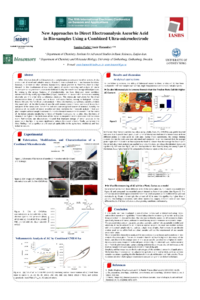
While direct analysis of real biosamples is a complex process compared to other systems, it also yields a set of novel and valuable results. Ascorbic acid or Vitamin C plays a pivotal role in our immune functions; however, in contrast to other vitamins, the human body cannot generate it. Therefore, there is a high demand for the development of new tools capable of onsite monitoring and fast analysis of natural sources without any treatment, even in the field and during the transfer and storage of food products. By leveraging the unique features of microelectrodes, we have developed novel combined microelectrodes by modifying carbon fiber (33 μm) coated with an Au nano-film to serve as a working electrode and tiny silver wire as a reference electrode. This microscale tool allows for the direct microelectroanalysis of ascorbic acid in lemon and cactus bodies, serving as biological matrices. Beyond the potential for direct electroanalysis in these bio-matrices, our primary objectives include examining the distribution of ascorbic acid content across different sections of lemon fruit and parts of the cactus plant. Both lemon and cactus are recognized sources of vitamin C. Notably, the micro-size of the combined sensor provides sufficient resolution for microscale analysis in fruit and plant samples without sample treatment. Our electrochemical measurements revealed that the center of the lemon contains notably higher levels of Vitamin C compared to its sides. Also, the levels of Vitamin C are higher in the fresh arms of the cactus compared to the older arms and the cactus trunk. Furthermore, our observations indicated that improper storage of lemon products in the presence of daylight in one week significantly reduces the vitamin C level. Finally, we believe these findings hold significance and practical applicability in the agricultural, medicinal, and food industries.
Keywords
Microelctrode
Carbon fiber electrode
Electroanalysis
Ascorbic Acid
Lemon
Cactus
Poster
sciforum-079488. poster. Ac.pdf
Indoor Air Quality Assessment Using a Low-Cost Sensor: A Case Study of Ikere-Ekiti, Nigeria
An AI powered, low-cost, IoT node oriented to flood Early Warning Systems