Event submissions
Published

This submission belongs to the session S2. Bioorganic, Medicinal and Natural Products Chemistry of the event The 27th International Electronic Conference on Synthetic Organic Chemistry
Published date
15 Nov, 2023
Academic Editor
'%3e%3cpath%20d='M12.6657%2010.9104C12.4185%2010.325%2012.0599%209.79327%2011.6097%209.34482C11.1609%208.89508%2010.6293%208.5365%2010.0442%208.28888C10.0389%208.28626%2010.0337%208.28495%2010.0285%208.28233C10.8446%207.69279%2011.3752%206.73249%2011.3752%205.64904C11.3752%203.8542%209.92103%202.39999%208.1262%202.39999C6.33136%202.39999%204.87715%203.8542%204.87715%205.64904C4.87715%206.73249%205.40774%207.69279%206.22393%208.28364C6.21869%208.28626%206.21345%208.28757%206.20821%208.29019C5.62129%208.5378%205.09463%208.89284%204.64265%209.34613C4.1929%209.79493%203.83432%2010.3266%203.58671%2010.9117C3.34345%2011.4845%203.21226%2012.0987%203.20023%2012.7209C3.19988%2012.7349%203.20233%2012.7488%203.20744%2012.7619C3.21255%2012.7749%203.22022%2012.7867%203.22998%2012.7968C3.23975%2012.8068%203.25142%2012.8147%203.26431%2012.8202C3.2772%2012.8256%203.29105%2012.8284%203.30504%2012.8284H4.09109C4.14874%2012.8284%204.19459%2012.7825%204.1959%2012.7262C4.2221%2011.7148%204.62823%2010.7676%205.34617%2010.0497C6.08899%209.30683%207.0755%208.89808%208.1262%208.89808C9.17689%208.89808%2010.1634%209.30683%2010.9062%2010.0497C11.6242%2010.7676%2012.0303%2011.7148%2012.0565%2012.7262C12.0578%2012.7838%2012.1037%2012.8284%2012.1613%2012.8284H12.9474C12.9613%2012.8284%2012.9752%2012.8256%2012.9881%2012.8202C13.001%2012.8147%2013.0126%2012.8068%2013.0224%2012.7968C13.0322%2012.7867%2013.0398%2012.7749%2013.0449%2012.7619C13.0501%2012.7488%2013.0525%2012.7349%2013.0522%2012.7209C13.0391%2012.0947%2012.9094%2011.4855%2012.6657%2010.9104ZM8.1262%207.9024C7.52486%207.9024%206.9589%207.6679%206.53312%207.24211C6.10733%206.81633%205.87283%206.25037%205.87283%205.64904C5.87283%205.0477%206.10733%204.48174%206.53312%204.05596C6.9589%203.63018%207.52486%203.39567%208.1262%203.39567C8.72753%203.39567%209.29349%203.63018%209.71927%204.05596C10.1451%204.48174%2010.3796%205.0477%2010.3796%205.64904C10.3796%206.25037%2010.1451%206.81633%209.71927%207.24211C9.29349%207.6679%208.72753%207.9024%208.1262%207.9024Z'%20fill='%235D1EE1'/%3e%3c/g%3e%3c/svg%3e) Julio A. Seijas
Julio A. SeijasCitation
Zlatko Lozanovski, Ivana Todorovska, Katerina Dragarska, Jane Bogdanov, Synthesis of Symmetrical Monocarbonyl Analogs of Curcumin (MACs) Containing 2-Bromobenzylidene Moiety and Spectrophotometric Assessment of Their Reactivity with 2-(Dimethylamino)ethanethiol, in Proceedings of The 27th International Electronic Conference on Synthetic Organic Chemistry, 15 November–30 November 2023, MDPI: Basel, Switzerland, doi: 10.3390/ecsoc-27-16084
Share
Email
Facebook
Twitter
LinkedIn
Synthesis of Symmetrical Monocarbonyl Analogs of Curcumin (MACs) Containing 2-Bromobenzylidene Moiety and Spectrophotometric Assessment of Their Reactivity with 2-(Dimethylamino)ethanethiol
'%3e%3cpath%20d='M12.6647%2010.9104C12.4176%2010.325%2012.0589%209.7933%2011.6088%209.34485C11.16%208.89511%2010.6283%208.53653%2010.0432%208.28891C10.038%208.28629%2010.0327%208.28498%2010.0275%208.28236C10.8437%207.69282%2011.3743%206.73252%2011.3743%205.64907C11.3743%203.85423%209.92005%202.40002%208.12522%202.40002C6.33038%202.40002%204.87618%203.85423%204.87618%205.64907C4.87618%206.73252%205.40677%207.69282%206.22296%208.28367C6.21772%208.28629%206.21248%208.2876%206.20724%208.29022C5.62031%208.53783%205.09365%208.89287%204.64167%209.34616C4.19192%209.79496%203.83334%2010.3266%203.58573%2010.9117C3.34247%2011.4846%203.21128%2012.0987%203.19925%2012.721C3.1989%2012.735%203.20135%2012.7489%203.20646%2012.7619C3.21157%2012.7749%203.21924%2012.7868%203.22901%2012.7968C3.23877%2012.8068%203.25045%2012.8148%203.26334%2012.8202C3.27623%2012.8256%203.29007%2012.8284%203.30406%2012.8284H4.09012C4.14776%2012.8284%204.19362%2012.7825%204.19493%2012.7262C4.22113%2011.7148%204.62726%2010.7676%205.34519%2010.0497C6.08802%209.30686%207.07452%208.89811%208.12522%208.89811C9.17592%208.89811%2010.1624%209.30686%2010.9052%2010.0497C11.6232%2010.7676%2012.0293%2011.7148%2012.0555%2012.7262C12.0568%2012.7839%2012.1027%2012.8284%2012.1603%2012.8284H12.9464C12.9604%2012.8284%2012.9742%2012.8256%2012.9871%2012.8202C13%2012.8148%2013.0117%2012.8068%2013.0214%2012.7968C13.0312%2012.7868%2013.0389%2012.7749%2013.044%2012.7619C13.0491%2012.7489%2013.0515%2012.735%2013.0512%2012.721C13.0381%2012.0947%2012.9084%2011.4856%2012.6647%2010.9104ZM8.12522%207.90243C7.52388%207.90243%206.95792%207.66793%206.53214%207.24215C6.10636%206.81636%205.87185%206.2504%205.87185%205.64907C5.87185%205.04773%206.10636%204.48177%206.53214%204.05599C6.95792%203.63021%207.52388%203.3957%208.12522%203.3957C8.72655%203.3957%209.29252%203.63021%209.7183%204.05599C10.1441%204.48177%2010.3786%205.04773%2010.3786%205.64907C10.3786%206.2504%2010.1441%206.81636%209.7183%207.24215C9.29252%207.66793%208.72655%207.90243%208.12522%207.90243Z'%20fill='%235D1EE1'/%3e%3c/g%3e%3c/svg%3e)
Zlatko Lozanovski 1,2
Ivana Todorovska 2
Katerina Dragarska 3
Jane Bogdanov 4
1. Higher Medical School, St. Kliment Ohridski University, Partizanska bb, 7000 Bitola, R.N. Macedonia
2. Institute of Chemistry, Faculty of Natural Sciences and Mathematics, Ss. Cyril and Methodius University in Skopje, Arhimedova 5, 1000 Skopje, R.N. Macedonia
3. Institute of Chemistry, Faculty of Natural Sciences and Mathematics, Ss. Cyril and Methodius University in Skopje, Arhimedova 5, 1000 Skopje, R. N. Macedonia
4. Institute of Chemistry, Faculty of Natural Sciences and Mathematics, Ss. Cyril and Methodius University, Arhimedova 5, 1000 Skopje, R.N. Macedonia
Abstract
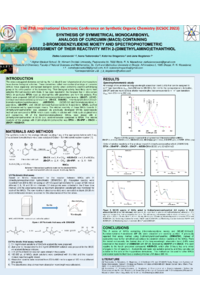
The cross-conjugated dienones containing the 1,5-diaryl-3-oxo-1,4-pentadienyl pharmacophore have diverse biological activities. These sometimes called monocarbonyl analogs of curcumin (MACs) have especially pronounced biological activity when containing electron-withdrawing group at the ortho position of the benzene ring. Their biological activity most likely stems from selective Michael reaction with thiols. It has been reported in the literature that in vitro certain MACs (in particular, EF24) react as electrophiles with glutathione and form bis adducts. Five MACs were prepared ((2Е,5Е)-2,5-bis(2-bromobenzylidene)cyclopentanone, (2BrCP), (2E,6E)-2,6-bis(2-bromo-benzylidene)cyclohexanone (2BrCX), 4-tert-butyl-(2E,6E)-2,6-bis(2-bromobenzylidene)cyclohexanone (4tB2BrCX), (3E,5E)-3,5-bis(2-bromobenzylidene)-4-piperidone, (2Br4PIP), and (3Е,5Е)-3,5-bis(2-fluoro-benzylidene)-4-piperidone, EF24), purified and characterized by spectroscopic means. The relative reactivity of these MACs towards 2-(dimethylamino)ethanethiol was assessed via previously developed UV-Vis spectroscopic method and compared to EF24, which reacts readily in solution with thiols such as glutathione and cysteamine. All of the bis(2-bromobenzylidene) MACs, react slower with 2-(dimethylamino)thiol in 80:20 (v/v) acetonitrile/water compared to EF24. The relative reactivity of the analogs with 2-(dimethylamino)ethanethiol was EF24 > 2Br4PIP > 2BrCX > 4tB2BrCX ≈ 2BrCP.
Keywords
monocarbonyl analogs of curcumin
symmetrical 2-bromobenzylidene MACs
synthesis
2-(dimethylamino)ethanethiol
Michael reaction with thiols
UV-Vis spectroscopy
Manuscript
sciforum-082041-clean.pdf
Poster
poster 27th ecsoc_FIN.pdf
Reaction of 1,6-diamino-4-aryl-2-oxo-1,2-dihydropyridine-3,5-dicarbonitrile with electrophilic agents
DFT study on ring-chain isomerism of semicarbazones