Event submissions
Published

This submission belongs to the session S5. Computational Chemistry of the event The 27th International Electronic Conference on Synthetic Organic Chemistry
Published date
15 Nov, 2023
Academic Editor
'%3e%3cpath%20d='M12.6657%2010.9104C12.4185%2010.325%2012.0599%209.79327%2011.6097%209.34482C11.1609%208.89508%2010.6293%208.5365%2010.0442%208.28888C10.0389%208.28626%2010.0337%208.28495%2010.0285%208.28233C10.8446%207.69279%2011.3752%206.73249%2011.3752%205.64904C11.3752%203.8542%209.92103%202.39999%208.1262%202.39999C6.33136%202.39999%204.87715%203.8542%204.87715%205.64904C4.87715%206.73249%205.40774%207.69279%206.22393%208.28364C6.21869%208.28626%206.21345%208.28757%206.20821%208.29019C5.62129%208.5378%205.09463%208.89284%204.64265%209.34613C4.1929%209.79493%203.83432%2010.3266%203.58671%2010.9117C3.34345%2011.4845%203.21226%2012.0987%203.20023%2012.7209C3.19988%2012.7349%203.20233%2012.7488%203.20744%2012.7619C3.21255%2012.7749%203.22022%2012.7867%203.22998%2012.7968C3.23975%2012.8068%203.25142%2012.8147%203.26431%2012.8202C3.2772%2012.8256%203.29105%2012.8284%203.30504%2012.8284H4.09109C4.14874%2012.8284%204.19459%2012.7825%204.1959%2012.7262C4.2221%2011.7148%204.62823%2010.7676%205.34617%2010.0497C6.08899%209.30683%207.0755%208.89808%208.1262%208.89808C9.17689%208.89808%2010.1634%209.30683%2010.9062%2010.0497C11.6242%2010.7676%2012.0303%2011.7148%2012.0565%2012.7262C12.0578%2012.7838%2012.1037%2012.8284%2012.1613%2012.8284H12.9474C12.9613%2012.8284%2012.9752%2012.8256%2012.9881%2012.8202C13.001%2012.8147%2013.0126%2012.8068%2013.0224%2012.7968C13.0322%2012.7867%2013.0398%2012.7749%2013.0449%2012.7619C13.0501%2012.7488%2013.0525%2012.7349%2013.0522%2012.7209C13.0391%2012.0947%2012.9094%2011.4855%2012.6657%2010.9104ZM8.1262%207.9024C7.52486%207.9024%206.9589%207.6679%206.53312%207.24211C6.10733%206.81633%205.87283%206.25037%205.87283%205.64904C5.87283%205.0477%206.10733%204.48174%206.53312%204.05596C6.9589%203.63018%207.52486%203.39567%208.1262%203.39567C8.72753%203.39567%209.29349%203.63018%209.71927%204.05596C10.1451%204.48174%2010.3796%205.0477%2010.3796%205.64904C10.3796%206.25037%2010.1451%206.81633%209.71927%207.24211C9.29349%207.6679%208.72753%207.9024%208.1262%207.9024Z'%20fill='%235D1EE1'/%3e%3c/g%3e%3c/svg%3e) Julio A. Seijas
Julio A. SeijasCitation
Kevin S. Umoette, Charles O. Nnadi, Wilfred O. Obonga, A Robust Regression-Based Modeling to Predict Antiplasmodial Activity of Thiazolyl-pyrimidine hybrid derivatives against Plasmodium falciparum, in Proceedings of The 27th International Electronic Conference on Synthetic Organic Chemistry, 15 November–30 November 2023, MDPI: Basel, Switzerland, doi: 10.3390/ecsoc-27-16167
Share
Email
Facebook
Twitter
LinkedIn
A Robust Regression-Based Modeling to Predict Antiplasmodial Activity of Thiazolyl-pyrimidine hybrid derivatives against Plasmodium falciparum
'%3e%3cpath%20d='M12.6647%2010.9104C12.4176%2010.325%2012.0589%209.7933%2011.6088%209.34485C11.16%208.89511%2010.6283%208.53653%2010.0432%208.28891C10.038%208.28629%2010.0327%208.28498%2010.0275%208.28236C10.8437%207.69282%2011.3743%206.73252%2011.3743%205.64907C11.3743%203.85423%209.92005%202.40002%208.12522%202.40002C6.33038%202.40002%204.87618%203.85423%204.87618%205.64907C4.87618%206.73252%205.40677%207.69282%206.22296%208.28367C6.21772%208.28629%206.21248%208.2876%206.20724%208.29022C5.62031%208.53783%205.09365%208.89287%204.64167%209.34616C4.19192%209.79496%203.83334%2010.3266%203.58573%2010.9117C3.34247%2011.4846%203.21128%2012.0987%203.19925%2012.721C3.1989%2012.735%203.20135%2012.7489%203.20646%2012.7619C3.21157%2012.7749%203.21924%2012.7868%203.22901%2012.7968C3.23877%2012.8068%203.25045%2012.8148%203.26334%2012.8202C3.27623%2012.8256%203.29007%2012.8284%203.30406%2012.8284H4.09012C4.14776%2012.8284%204.19362%2012.7825%204.19493%2012.7262C4.22113%2011.7148%204.62726%2010.7676%205.34519%2010.0497C6.08802%209.30686%207.07452%208.89811%208.12522%208.89811C9.17592%208.89811%2010.1624%209.30686%2010.9052%2010.0497C11.6232%2010.7676%2012.0293%2011.7148%2012.0555%2012.7262C12.0568%2012.7839%2012.1027%2012.8284%2012.1603%2012.8284H12.9464C12.9604%2012.8284%2012.9742%2012.8256%2012.9871%2012.8202C13%2012.8148%2013.0117%2012.8068%2013.0214%2012.7968C13.0312%2012.7868%2013.0389%2012.7749%2013.044%2012.7619C13.0491%2012.7489%2013.0515%2012.735%2013.0512%2012.721C13.0381%2012.0947%2012.9084%2011.4856%2012.6647%2010.9104ZM8.12522%207.90243C7.52388%207.90243%206.95792%207.66793%206.53214%207.24215C6.10636%206.81636%205.87185%206.2504%205.87185%205.64907C5.87185%205.04773%206.10636%204.48177%206.53214%204.05599C6.95792%203.63021%207.52388%203.3957%208.12522%203.3957C8.72655%203.3957%209.29252%203.63021%209.7183%204.05599C10.1441%204.48177%2010.3786%205.04773%2010.3786%205.64907C10.3786%206.2504%2010.1441%206.81636%209.7183%207.24215C9.29252%207.66793%208.72655%207.90243%208.12522%207.90243Z'%20fill='%235D1EE1'/%3e%3c/g%3e%3c/svg%3e)
Kevin S. Umoette 1

Charles O. Nnadi 1
Wilfred O. Obonga 1
1. Department of Pharmaceutical and Medicinal Chemistry, Faculty of Pharmaceutical Sciences, University of Nigeria Nsukka, 410001 Enugu, Nigeria
Abstract
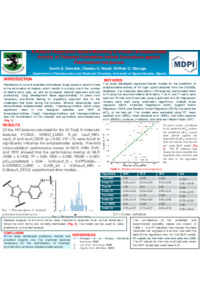
Thiazolyl-pyrimidine hybrid plays significant roles in the biological activities and SAR of thiazolylpyrimidines (Tzpd), thiazolopyrimidines and thienopyrimidines due the combination of the thiazole and pyrimidine pharmacophores. The study developed regression-based models for the prediction of antiplasmodial activity of 43 Tzpd hybrid obtained from the ChEMBL database. The molecular descriptors (145 features) were scaled down to 6 using the recursive feature elimination. The X- and Y-matrix were split into 34 train and 9 test sets using a split ratio of 0.20. Regression models were built using scikit-learn algorithms: k-Nearest Neighbours (kNN), Support Vector Regressor (SVR) and Random Forest Regressor (RFR)) to predict the pIC50 of the test set. The models were evaluated using R2, mean squared error (MSE), mean absolute error (MAE), root mean squared error (RMSE), p-values, F-statistic, and variance inflation factor (VIF). Of the 145 features calculated for the 43 TzPd, 6 molecular features: FCASA-, MNDO_LUMO, E_str, vsurf_HB1, vsurf_G and vsurf_DD12 (p < 0.05; VIF < 5) were found to significantly influence the antiplasmodial activity. Five-fold cross-validation performance scores of kNN, SVR, and RFR showed that the performance metrics of SVR (MSE = 0.052; R2 = 0.610; MAE = 0.174; RMSE = 0.230; pIC50(predicted) = 8.06 - 0.45vsurf_G + 0.37FCASA‒ - 0.42MNDO_LUMO – 0.20E_str + 0.30vsurf_HB1 – 0.38vsurf_DD12) outperformed models. The study developed predictive models and provided insights into the chemical features necessary for the optimization of thiazolyl-pyrimidine to enhance antiplasmodial activity.
Keywords
Machine learning
Plasmodium falciparum
QSAR
Regression
Thiazolylpyrimidines
Manuscript
sciforum-080224-clean.pdf
Poster
ECMC poster2023-Charles-Revised.pdf
Europium recovery process by means of polymeric nanoparticles functionalized with acrylic acid, curcumin and fumaramide
DFT approach towards accurate prediction of 1H/13C NMR chemical shifts for dipterocarpol oxime