Event submissions
Published
This submission belongs to the session F. Student Session of the event 10th International Electronic Conference on Sensors and Applications
Published date
15 Nov, 2023
Academic Editor
'%3e%3cpath%20d='M12.6657%2010.9104C12.4185%2010.325%2012.0599%209.79327%2011.6097%209.34482C11.1609%208.89508%2010.6293%208.5365%2010.0442%208.28888C10.0389%208.28626%2010.0337%208.28495%2010.0285%208.28233C10.8446%207.69279%2011.3752%206.73249%2011.3752%205.64904C11.3752%203.8542%209.92103%202.39999%208.1262%202.39999C6.33136%202.39999%204.87715%203.8542%204.87715%205.64904C4.87715%206.73249%205.40774%207.69279%206.22393%208.28364C6.21869%208.28626%206.21345%208.28757%206.20821%208.29019C5.62129%208.5378%205.09463%208.89284%204.64265%209.34613C4.1929%209.79493%203.83432%2010.3266%203.58671%2010.9117C3.34345%2011.4845%203.21226%2012.0987%203.20023%2012.7209C3.19988%2012.7349%203.20233%2012.7488%203.20744%2012.7619C3.21255%2012.7749%203.22022%2012.7867%203.22998%2012.7968C3.23975%2012.8068%203.25142%2012.8147%203.26431%2012.8202C3.2772%2012.8256%203.29105%2012.8284%203.30504%2012.8284H4.09109C4.14874%2012.8284%204.19459%2012.7825%204.1959%2012.7262C4.2221%2011.7148%204.62823%2010.7676%205.34617%2010.0497C6.08899%209.30683%207.0755%208.89808%208.1262%208.89808C9.17689%208.89808%2010.1634%209.30683%2010.9062%2010.0497C11.6242%2010.7676%2012.0303%2011.7148%2012.0565%2012.7262C12.0578%2012.7838%2012.1037%2012.8284%2012.1613%2012.8284H12.9474C12.9613%2012.8284%2012.9752%2012.8256%2012.9881%2012.8202C13.001%2012.8147%2013.0126%2012.8068%2013.0224%2012.7968C13.0322%2012.7867%2013.0398%2012.7749%2013.0449%2012.7619C13.0501%2012.7488%2013.0525%2012.7349%2013.0522%2012.7209C13.0391%2012.0947%2012.9094%2011.4855%2012.6657%2010.9104ZM8.1262%207.9024C7.52486%207.9024%206.9589%207.6679%206.53312%207.24211C6.10733%206.81633%205.87283%206.25037%205.87283%205.64904C5.87283%205.0477%206.10733%204.48174%206.53312%204.05596C6.9589%203.63018%207.52486%203.39567%208.1262%203.39567C8.72753%203.39567%209.29349%203.63018%209.71927%204.05596C10.1451%204.48174%2010.3796%205.0477%2010.3796%205.64904C10.3796%206.25037%2010.1451%206.81633%209.71927%207.24211C9.29349%207.6679%208.72753%207.9024%208.1262%207.9024Z'%20fill='%235D1EE1'/%3e%3c/g%3e%3c/svg%3e) Stefano Mariani
Stefano MarianiCitation
Elisabetta Bodo, Valentina Bello, Artificial nutrition monitoring through an optofluidic platform, in Proceedings of 10th International Electronic Conference on Sensors and Applications, 15 November–30 November 2023, MDPI: Basel, Switzerland
Share
Email
Facebook
Twitter
LinkedIn
Artificial nutrition monitoring through an optofluidic platform

Elisabetta Bodo 1

Valentina Bello 1
1. Department of Electrical, Computer and Biomedical Engineering, University of Pavia, 27100 Pavia, Italy
Abstract
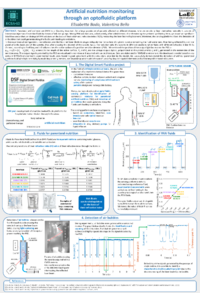
We present a smart optoelectronic system for fluid sensing by measuring the laser beam displacement induced by the difference in refractive index between liquids. In the experimental configuration, the radiation provided by a red laser diode impinges obliquely the flat surface of a plastic cuvette containing the fluid under test. After being reflected by a mirror glued onto the back side of the cuvette, thus after crossing the channel of the cuvette twice, the radiation exits the cuvette in different positions when fluids with different refractive index fill its channel, according to Snell law, and it finally reaches the active surface of a position sensitive detector (PSD). We retrieved the position of the output light beam onto the PSD as pPSD = L/2 × (V1 – V2)/(V1 + V2), where L is the length of the active surface, V1 and V2 are the voltage output signals, proportional to the photocurrents I1 and I2 generated at the extremities of the sensitive area. The output signals provided by the PSD are visualized in real-time and acquired with an oscilloscope. Data are elaborated in MATLAB environment. We exploited the sensing platform to distinguish fluids for artificial parenteral nutrition on the basis of their refractive indices, that are determined by knowing the different concentrations of solutes such as glucose, amino acids and electrolytes. We developed a model based on ray optics in MATLAB environment: experimental results were found in good agreement with the simulations provided by the model. We successfully demonstrated the detection of artificial parenteral nutrition fluid with high sensitivity by exploiting a totally remote, non-invasive approach with the use of just a few low-cost optical elements and a biocompatible standard cuvette.
Keywords
artificial nutrition
optical sensors
optofluidics
refractive index
remote detection
Poster
BodoECSA10_poster_reviewed.pdf
Modeling and characterization of microspheres with silver molecular clusters for sensor applications
Half-open photoacoustic cell design for solid samples