Event submissions
Published
This submission belongs to the session C. The Role of Gut Microbiota in Precision Nutrition of the event The 3rd International Electronic Conference on Nutrients
Published date
15 Nov, 2023
Academic Editor
'%3e%3cpath%20d='M12.6657%2010.9104C12.4185%2010.325%2012.0599%209.79327%2011.6097%209.34482C11.1609%208.89508%2010.6293%208.5365%2010.0442%208.28888C10.0389%208.28626%2010.0337%208.28495%2010.0285%208.28233C10.8446%207.69279%2011.3752%206.73249%2011.3752%205.64904C11.3752%203.8542%209.92103%202.39999%208.1262%202.39999C6.33136%202.39999%204.87715%203.8542%204.87715%205.64904C4.87715%206.73249%205.40774%207.69279%206.22393%208.28364C6.21869%208.28626%206.21345%208.28757%206.20821%208.29019C5.62129%208.5378%205.09463%208.89284%204.64265%209.34613C4.1929%209.79493%203.83432%2010.3266%203.58671%2010.9117C3.34345%2011.4845%203.21226%2012.0987%203.20023%2012.7209C3.19988%2012.7349%203.20233%2012.7488%203.20744%2012.7619C3.21255%2012.7749%203.22022%2012.7867%203.22998%2012.7968C3.23975%2012.8068%203.25142%2012.8147%203.26431%2012.8202C3.2772%2012.8256%203.29105%2012.8284%203.30504%2012.8284H4.09109C4.14874%2012.8284%204.19459%2012.7825%204.1959%2012.7262C4.2221%2011.7148%204.62823%2010.7676%205.34617%2010.0497C6.08899%209.30683%207.0755%208.89808%208.1262%208.89808C9.17689%208.89808%2010.1634%209.30683%2010.9062%2010.0497C11.6242%2010.7676%2012.0303%2011.7148%2012.0565%2012.7262C12.0578%2012.7838%2012.1037%2012.8284%2012.1613%2012.8284H12.9474C12.9613%2012.8284%2012.9752%2012.8256%2012.9881%2012.8202C13.001%2012.8147%2013.0126%2012.8068%2013.0224%2012.7968C13.0322%2012.7867%2013.0398%2012.7749%2013.0449%2012.7619C13.0501%2012.7488%2013.0525%2012.7349%2013.0522%2012.7209C13.0391%2012.0947%2012.9094%2011.4855%2012.6657%2010.9104ZM8.1262%207.9024C7.52486%207.9024%206.9589%207.6679%206.53312%207.24211C6.10733%206.81633%205.87283%206.25037%205.87283%205.64904C5.87283%205.0477%206.10733%204.48174%206.53312%204.05596C6.9589%203.63018%207.52486%203.39567%208.1262%203.39567C8.72753%203.39567%209.29349%203.63018%209.71927%204.05596C10.1451%204.48174%2010.3796%205.0477%2010.3796%205.64904C10.3796%206.25037%2010.1451%206.81633%209.71927%207.24211C9.29349%207.6679%208.72753%207.9024%208.1262%207.9024Z'%20fill='%235D1EE1'/%3e%3c/g%3e%3c/svg%3e) Maria-Luz Fernandez
Maria-Luz FernandezCitation
Gordana Kenđel Jovanović, Marin Golčić, Luka Simetić, Davorin Herceg, Krešimir Blažević, Ivan Dražić, Andrej Belančić, Nataša Skočibušić, Dora Palčevski, Igor Rubinić, Vera Vlahović-Palčevski, Tea Majnarić, Renata Dobrila-Dintinjana, Stjepko Pleština, The difference in gut microbiome composition of melanoma patients regarding their dietary fibre intake, in Proceedings of The 3rd International Electronic Conference on Nutrients, 1 November–15 November 2023, MDPI: Basel, Switzerland
Share
Email
Facebook
Twitter
LinkedIn
The difference in gut microbiome composition of melanoma patients regarding their dietary fibre intake
'%3e%3cpath%20d='M12.6647%2010.9104C12.4176%2010.325%2012.0589%209.7933%2011.6088%209.34485C11.16%208.89511%2010.6283%208.53653%2010.0432%208.28891C10.038%208.28629%2010.0327%208.28498%2010.0275%208.28236C10.8437%207.69282%2011.3743%206.73252%2011.3743%205.64907C11.3743%203.85423%209.92005%202.40002%208.12522%202.40002C6.33038%202.40002%204.87618%203.85423%204.87618%205.64907C4.87618%206.73252%205.40677%207.69282%206.22296%208.28367C6.21772%208.28629%206.21248%208.2876%206.20724%208.29022C5.62031%208.53783%205.09365%208.89287%204.64167%209.34616C4.19192%209.79496%203.83334%2010.3266%203.58573%2010.9117C3.34247%2011.4846%203.21128%2012.0987%203.19925%2012.721C3.1989%2012.735%203.20135%2012.7489%203.20646%2012.7619C3.21157%2012.7749%203.21924%2012.7868%203.22901%2012.7968C3.23877%2012.8068%203.25045%2012.8148%203.26334%2012.8202C3.27623%2012.8256%203.29007%2012.8284%203.30406%2012.8284H4.09012C4.14776%2012.8284%204.19362%2012.7825%204.19493%2012.7262C4.22113%2011.7148%204.62726%2010.7676%205.34519%2010.0497C6.08802%209.30686%207.07452%208.89811%208.12522%208.89811C9.17592%208.89811%2010.1624%209.30686%2010.9052%2010.0497C11.6232%2010.7676%2012.0293%2011.7148%2012.0555%2012.7262C12.0568%2012.7839%2012.1027%2012.8284%2012.1603%2012.8284H12.9464C12.9604%2012.8284%2012.9742%2012.8256%2012.9871%2012.8202C13%2012.8148%2013.0117%2012.8068%2013.0214%2012.7968C13.0312%2012.7868%2013.0389%2012.7749%2013.044%2012.7619C13.0491%2012.7489%2013.0515%2012.735%2013.0512%2012.721C13.0381%2012.0947%2012.9084%2011.4856%2012.6647%2010.9104ZM8.12522%207.90243C7.52388%207.90243%206.95792%207.66793%206.53214%207.24215C6.10636%206.81636%205.87185%206.2504%205.87185%205.64907C5.87185%205.04773%206.10636%204.48177%206.53214%204.05599C6.95792%203.63021%207.52388%203.3957%208.12522%203.3957C8.72655%203.3957%209.29252%203.63021%209.7183%204.05599C10.1441%204.48177%2010.3786%205.04773%2010.3786%205.64907C10.3786%206.2504%2010.1441%206.81636%209.7183%207.24215C9.29252%207.66793%208.72655%207.90243%208.12522%207.90243Z'%20fill='%235D1EE1'/%3e%3c/g%3e%3c/svg%3e)
Gordana Kenđel Jovanović 1

Marin Golčić 2
Luka Simetić 3
Davorin Herceg 3
Krešimir Blažević 3

Ivan Dražić 4

Andrej Belančić 5
Nataša Skočibušić 5
Dora Palčevski 6
Igor Rubinić 5
Vera Vlahović-Palčevski 5
Tea Majnarić 7
Renata Dobrila-Dintinjana 2
Stjepko Pleština 3
1. Department of Health Ecology, Teaching Institute of Public Health of Primorsko-Goranska County, Rijeka, Croatia
2. Department of Radiotherapy and Oncology, University Hospital Center Rijeka, 51000 Rijeka, Croatia
3. Department of Oncology, University Hospital Center Zagreb, 10000 Zagreb, Croatia
4. Department of Mathematics, Physics and Foreign Languages, Faculty of Engineering, University of Rijeka, 51000 Rijeka, Croatia
5. Department of Clinical Pharmacology, University Hospital Center Rijeka, 51000 Rijeka, Croatia
6. Department of Internal Medicine, University Hospital Center Rijeka, 51000 Rijeka, Croatia
7. Community Health Center of Primorsko-Goranska County, 51000 Rijeka, Croatia
Abstract
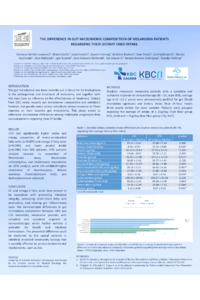
Introduction: The gut microbiome has been recently put in focus for its implications in the pathogenesis and treatment of melanoma, and together with diet may have an influence on the effectiveness of treatment. Dietary fibre (DF) intake impacts gut microbiome composition and metabolic function but greatly varies across individuals whose response to fibres depends on their baseline gut microbiome. This study aimed to determine microbiome differences among melanoma progression-free survival patients regarding their DF intake.
Methods: Croatian metastatic melanoma patients with a complete and sustained response to immunotherapy (N = 15, male 80%, average age 61.0 ±12.2 years) were prospectively profiled for gut (faecal) microbiota signatures and dietary intake (four 24-hour recalls three weeks before the stool sample). Patients were grouped regarding the average DF intake of ≥ 25g/day (high fibre group HFG, N=8) and < 25g/day (low fibre group LFG, N=7).
Results: HFG had significantly higher intake and energy proportion of mono-unsaturated fatty acids (p=0.007) and omega-3 fatty acids (p=0.049), and lower alcohol intake (p=0.046) than LFG patients. HFG patients showed an increase in the proportion of Phocaeicola dorei, Bacteroides cellulosilyticus and Holdemania massiliensis on LEfSE analysis, while LFG exhibited a higher abundance of Ruminococcus, Blautia wexlerae, Anaerobytricum hellii, and Ruthenibacterium edouardi.
Conclusion: DF and omega-3 fatty acids have proven to be associated with promoting intestinal integrity, enhancing short-chain fatty acid production, and altering gut inflammatory state. We demonstrated differences in gut microbiome composition between HFG and LFG metastatic melanoma patients with complete and sustained response to immunotherapy; which further exhibits a potential for health and intestinal homeostasis. The presented difference could be explained by the causal variance in intestinal microbial community ecology that is possibly affected by various environmental involvements, such as diet.
Keywords
dietary fibres
gut microbiome
melanoma
Manuscript
3rd IECN2023 The difference in gut microbiome composition of melanoma patients.pdf
Poster
3rd IECN2023 The difference in gut microbiome composition of melanoma patients.pdf
Cow Milk Oligosaccharides and Their relevance to infant nutrition
BIFIDOBACTERIUM ANIMALIS AND LAETIPORUS SULPHUREUS EXTRACT CAUSE OXIDATIVE STRESS IN MRC-5 CELLS BY INCREASING THE LEVEL OF GSH