Event submissions
Published
 10.3390/ECMC2023-16298 (registering DOI)
 This submission belongs to the session S3. General of the event 9th International Electronic Conference on Medicinal Chemistry
Published date
17 Nov, 2023
Academic Editor
'%3e%3cpath%20d='M12.6657%2010.9104C12.4185%2010.325%2012.0599%209.79327%2011.6097%209.34482C11.1609%208.89508%2010.6293%208.5365%2010.0442%208.28888C10.0389%208.28626%2010.0337%208.28495%2010.0285%208.28233C10.8446%207.69279%2011.3752%206.73249%2011.3752%205.64904C11.3752%203.8542%209.92103%202.39999%208.1262%202.39999C6.33136%202.39999%204.87715%203.8542%204.87715%205.64904C4.87715%206.73249%205.40774%207.69279%206.22393%208.28364C6.21869%208.28626%206.21345%208.28757%206.20821%208.29019C5.62129%208.5378%205.09463%208.89284%204.64265%209.34613C4.1929%209.79493%203.83432%2010.3266%203.58671%2010.9117C3.34345%2011.4845%203.21226%2012.0987%203.20023%2012.7209C3.19988%2012.7349%203.20233%2012.7488%203.20744%2012.7619C3.21255%2012.7749%203.22022%2012.7867%203.22998%2012.7968C3.23975%2012.8068%203.25142%2012.8147%203.26431%2012.8202C3.2772%2012.8256%203.29105%2012.8284%203.30504%2012.8284H4.09109C4.14874%2012.8284%204.19459%2012.7825%204.1959%2012.7262C4.2221%2011.7148%204.62823%2010.7676%205.34617%2010.0497C6.08899%209.30683%207.0755%208.89808%208.1262%208.89808C9.17689%208.89808%2010.1634%209.30683%2010.9062%2010.0497C11.6242%2010.7676%2012.0303%2011.7148%2012.0565%2012.7262C12.0578%2012.7838%2012.1037%2012.8284%2012.1613%2012.8284H12.9474C12.9613%2012.8284%2012.9752%2012.8256%2012.9881%2012.8202C13.001%2012.8147%2013.0126%2012.8068%2013.0224%2012.7968C13.0322%2012.7867%2013.0398%2012.7749%2013.0449%2012.7619C13.0501%2012.7488%2013.0525%2012.7349%2013.0522%2012.7209C13.0391%2012.0947%2012.9094%2011.4855%2012.6657%2010.9104ZM8.1262%207.9024C7.52486%207.9024%206.9589%207.6679%206.53312%207.24211C6.10733%206.81633%205.87283%206.25037%205.87283%205.64904C5.87283%205.0477%206.10733%204.48174%206.53312%204.05596C6.9589%203.63018%207.52486%203.39567%208.1262%203.39567C8.72753%203.39567%209.29349%203.63018%209.71927%204.05596C10.1451%204.48174%2010.3796%205.0477%2010.3796%205.64904C10.3796%206.25037%2010.1451%206.81633%209.71927%207.24211C9.29349%207.6679%208.72753%207.9024%208.1262%207.9024Z'%20fill='%235D1EE1'/%3e%3c/g%3e%3c/svg%3e) Alfredo Berzal-Herranz
Alfredo Berzal-HerranzCitation
Daniele Suzete Persike de Oliveira, Maria José da Silva Fernades, Proteomic analysis of rats submitted to the animal model of epilepsy induced by pilocarpine., in Proceedings of 9th International Electronic Conference on Medicinal Chemistry, 1 November–30 November 2023, MDPI: Basel, Switzerland, doi: 10.3390/ECMC2023-16298
Share
Email
Facebook
Twitter
LinkedIn
Proteomic analysis of rats submitted to the animal model of epilepsy induced by pilocarpine.
'%3e%3cpath%20d='M12.6647%2010.9104C12.4176%2010.325%2012.0589%209.7933%2011.6088%209.34485C11.16%208.89511%2010.6283%208.53653%2010.0432%208.28891C10.038%208.28629%2010.0327%208.28498%2010.0275%208.28236C10.8437%207.69282%2011.3743%206.73252%2011.3743%205.64907C11.3743%203.85423%209.92005%202.40002%208.12522%202.40002C6.33038%202.40002%204.87618%203.85423%204.87618%205.64907C4.87618%206.73252%205.40677%207.69282%206.22296%208.28367C6.21772%208.28629%206.21248%208.2876%206.20724%208.29022C5.62031%208.53783%205.09365%208.89287%204.64167%209.34616C4.19192%209.79496%203.83334%2010.3266%203.58573%2010.9117C3.34247%2011.4846%203.21128%2012.0987%203.19925%2012.721C3.1989%2012.735%203.20135%2012.7489%203.20646%2012.7619C3.21157%2012.7749%203.21924%2012.7868%203.22901%2012.7968C3.23877%2012.8068%203.25045%2012.8148%203.26334%2012.8202C3.27623%2012.8256%203.29007%2012.8284%203.30406%2012.8284H4.09012C4.14776%2012.8284%204.19362%2012.7825%204.19493%2012.7262C4.22113%2011.7148%204.62726%2010.7676%205.34519%2010.0497C6.08802%209.30686%207.07452%208.89811%208.12522%208.89811C9.17592%208.89811%2010.1624%209.30686%2010.9052%2010.0497C11.6232%2010.7676%2012.0293%2011.7148%2012.0555%2012.7262C12.0568%2012.7839%2012.1027%2012.8284%2012.1603%2012.8284H12.9464C12.9604%2012.8284%2012.9742%2012.8256%2012.9871%2012.8202C13%2012.8148%2013.0117%2012.8068%2013.0214%2012.7968C13.0312%2012.7868%2013.0389%2012.7749%2013.044%2012.7619C13.0491%2012.7489%2013.0515%2012.735%2013.0512%2012.721C13.0381%2012.0947%2012.9084%2011.4856%2012.6647%2010.9104ZM8.12522%207.90243C7.52388%207.90243%206.95792%207.66793%206.53214%207.24215C6.10636%206.81636%205.87185%206.2504%205.87185%205.64907C5.87185%205.04773%206.10636%204.48177%206.53214%204.05599C6.95792%203.63021%207.52388%203.3957%208.12522%203.3957C8.72655%203.3957%209.29252%203.63021%209.7183%204.05599C10.1441%204.48177%2010.3786%205.04773%2010.3786%205.64907C10.3786%206.2504%2010.1441%206.81636%209.7183%207.24215C9.29252%207.66793%208.72655%207.90243%208.12522%207.90243Z'%20fill='%235D1EE1'/%3e%3c/g%3e%3c/svg%3e)
Daniele Suzete Persike de Oliveira 1
Maria José da Silva Fernades 2
1. Department of Medicinal Chemistry, College of Pharmacy, University of Dohuk, Kurdistan Region, Iraq
2. Departamento de Neurologia/Neurocirurgia, Escola Paulista de Medicina, Universidade Federal de São Paulo–UNIFESP, Rua Pedro de Toledo, 669, CEP, São Paulo 04039-032, Brazil
Abstract
Background and Purpose: The temporal lobe epilepsy (TLE) is the most common type of partial complex seizure in adulthood. High doses of pilocarpine to rats induce status epilepticus (SE) and reproduce the main characteristics of TLE. This model appears to be highly isomorphic with the human disease, so it has been used to elucidate the main mechanisms involved with epileptogenesis. Methods: Here, we employed a two-dimensional gel electrophoresis (2-DE) to study differential expression of proteins in the hippocampus of rats exhibiting SRS induced by pilocarpine (360mg/kg, N=6) compared to a control group (saline, N=6). Both groups were analyzed 90 days after SE onset. Hippocampi were homogenized in a lysis buffer and used to perform 2-DE. Protein spots analyzed by PDQuest software and identified by LC-ESI-MS/MS and MASCOT MS/MS ions search. Results: forty proteins were found differentially expressed in the hippocampus of epileptic rats compared to control animals from which thirty-seven were successfully identified. Twenty-nine of the identified proteins were up-regulated in epileptic rats while six proteins were down-regulated and two proteins were expressed only in the control animals. Conclusion: Some of the proteins differentially expressed in the hippocampus of rats with SRS were also observed altered in the hippocampus of patients with TLE. Such proteins are part of metabolic pathways responsible for the maintenance of vital functions for the cell. Besides, proteins potentially involved in neuronal development and plasticity, neuroprotection mechanisms and neuronal excitability were also found up-regulated in epileptic rats.
Keywords
mesial temporal lobe epilepsy
pilocarpine
hippocampus
proteomics
biomarkers.
Manuscript
Poster MTLE model proteomics 2023.pdf
Poster
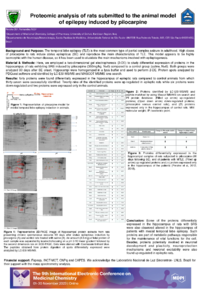
Poster MTLE model proteomics 2023.pdf
Marine-inspired compounds with anti-inflammatory properties and potential anti-pruritic activity
New 2-heteroaryl-4-aminoquinolines to tackle Pseudomonas aeruginosa virulence