Event submissions
Published
This submission belongs to the session S7. Poster Session of the event The 3rd International Electronic Conference on Antibiotics
Published date
30 Nov, 2023
Academic Editor
'%3e%3cpath%20d='M12.6657%2010.9104C12.4185%2010.325%2012.0599%209.79327%2011.6097%209.34482C11.1609%208.89508%2010.6293%208.5365%2010.0442%208.28888C10.0389%208.28626%2010.0337%208.28495%2010.0285%208.28233C10.8446%207.69279%2011.3752%206.73249%2011.3752%205.64904C11.3752%203.8542%209.92103%202.39999%208.1262%202.39999C6.33136%202.39999%204.87715%203.8542%204.87715%205.64904C4.87715%206.73249%205.40774%207.69279%206.22393%208.28364C6.21869%208.28626%206.21345%208.28757%206.20821%208.29019C5.62129%208.5378%205.09463%208.89284%204.64265%209.34613C4.1929%209.79493%203.83432%2010.3266%203.58671%2010.9117C3.34345%2011.4845%203.21226%2012.0987%203.20023%2012.7209C3.19988%2012.7349%203.20233%2012.7488%203.20744%2012.7619C3.21255%2012.7749%203.22022%2012.7867%203.22998%2012.7968C3.23975%2012.8068%203.25142%2012.8147%203.26431%2012.8202C3.2772%2012.8256%203.29105%2012.8284%203.30504%2012.8284H4.09109C4.14874%2012.8284%204.19459%2012.7825%204.1959%2012.7262C4.2221%2011.7148%204.62823%2010.7676%205.34617%2010.0497C6.08899%209.30683%207.0755%208.89808%208.1262%208.89808C9.17689%208.89808%2010.1634%209.30683%2010.9062%2010.0497C11.6242%2010.7676%2012.0303%2011.7148%2012.0565%2012.7262C12.0578%2012.7838%2012.1037%2012.8284%2012.1613%2012.8284H12.9474C12.9613%2012.8284%2012.9752%2012.8256%2012.9881%2012.8202C13.001%2012.8147%2013.0126%2012.8068%2013.0224%2012.7968C13.0322%2012.7867%2013.0398%2012.7749%2013.0449%2012.7619C13.0501%2012.7488%2013.0525%2012.7349%2013.0522%2012.7209C13.0391%2012.0947%2012.9094%2011.4855%2012.6657%2010.9104ZM8.1262%207.9024C7.52486%207.9024%206.9589%207.6679%206.53312%207.24211C6.10733%206.81633%205.87283%206.25037%205.87283%205.64904C5.87283%205.0477%206.10733%204.48174%206.53312%204.05596C6.9589%203.63018%207.52486%203.39567%208.1262%203.39567C8.72753%203.39567%209.29349%203.63018%209.71927%204.05596C10.1451%204.48174%2010.3796%205.0477%2010.3796%205.64904C10.3796%206.25037%2010.1451%206.81633%209.71927%207.24211C9.29349%207.6679%208.72753%207.9024%208.1262%207.9024Z'%20fill='%235D1EE1'/%3e%3c/g%3e%3c/svg%3e) Marc Maresca
Marc MarescaCitation
Inna A. Volynkina, Anastasiia O. Karakchieva, Alexander S. Tikhomirov, George V. Zatonsky, Maksim Martynov, Anna N. Tevyashova, Elena N. Bychkova, Natalia E. Grammatikova, Andrey G. Tereshchenkov, Petr V. Sergiev, Olga A. Dontsova, Ilya A. Osterman, Chloramphenicol and Metronidazole Derivatives of Azithromycin Overcome the Inducible Resistance to Macrolide Antibiotics, in Proceedings of The 3rd International Electronic Conference on Antibiotics, 1 December–15 December 2023, MDPI: Basel, Switzerland
Share
Email
Facebook
Twitter
LinkedIn
Chloramphenicol and Metronidazole Derivatives of Azithromycin Overcome the Inducible Resistance to Macrolide Antibiotics
'%3e%3cpath%20d='M12.6647%2010.9104C12.4176%2010.325%2012.0589%209.7933%2011.6088%209.34485C11.16%208.89511%2010.6283%208.53653%2010.0432%208.28891C10.038%208.28629%2010.0327%208.28498%2010.0275%208.28236C10.8437%207.69282%2011.3743%206.73252%2011.3743%205.64907C11.3743%203.85423%209.92005%202.40002%208.12522%202.40002C6.33038%202.40002%204.87618%203.85423%204.87618%205.64907C4.87618%206.73252%205.40677%207.69282%206.22296%208.28367C6.21772%208.28629%206.21248%208.2876%206.20724%208.29022C5.62031%208.53783%205.09365%208.89287%204.64167%209.34616C4.19192%209.79496%203.83334%2010.3266%203.58573%2010.9117C3.34247%2011.4846%203.21128%2012.0987%203.19925%2012.721C3.1989%2012.735%203.20135%2012.7489%203.20646%2012.7619C3.21157%2012.7749%203.21924%2012.7868%203.22901%2012.7968C3.23877%2012.8068%203.25045%2012.8148%203.26334%2012.8202C3.27623%2012.8256%203.29007%2012.8284%203.30406%2012.8284H4.09012C4.14776%2012.8284%204.19362%2012.7825%204.19493%2012.7262C4.22113%2011.7148%204.62726%2010.7676%205.34519%2010.0497C6.08802%209.30686%207.07452%208.89811%208.12522%208.89811C9.17592%208.89811%2010.1624%209.30686%2010.9052%2010.0497C11.6232%2010.7676%2012.0293%2011.7148%2012.0555%2012.7262C12.0568%2012.7839%2012.1027%2012.8284%2012.1603%2012.8284H12.9464C12.9604%2012.8284%2012.9742%2012.8256%2012.9871%2012.8202C13%2012.8148%2013.0117%2012.8068%2013.0214%2012.7968C13.0312%2012.7868%2013.0389%2012.7749%2013.044%2012.7619C13.0491%2012.7489%2013.0515%2012.735%2013.0512%2012.721C13.0381%2012.0947%2012.9084%2011.4856%2012.6647%2010.9104ZM8.12522%207.90243C7.52388%207.90243%206.95792%207.66793%206.53214%207.24215C6.10636%206.81636%205.87185%206.2504%205.87185%205.64907C5.87185%205.04773%206.10636%204.48177%206.53214%204.05599C6.95792%203.63021%207.52388%203.3957%208.12522%203.3957C8.72655%203.3957%209.29252%203.63021%209.7183%204.05599C10.1441%204.48177%2010.3786%205.04773%2010.3786%205.64907C10.3786%206.2504%2010.1441%206.81636%209.7183%207.24215C9.29252%207.66793%208.72655%207.90243%208.12522%207.90243Z'%20fill='%235D1EE1'/%3e%3c/g%3e%3c/svg%3e)
Inna A. Volynkina 1,2
Anastasiia O. Karakchieva 2
Alexander S. Tikhomirov 3
George V. Zatonsky 3
Maksim Martynov 3
Anna N. Tevyashova 3
Elena N. Bychkova 3
Natalia E. Grammatikova 3
Andrey G. Tereshchenkov 4
Petr V. Sergiev 1,2,4,5

Olga A. Dontsova 1,2,4,6
Ilya A. Osterman 1,2
1. Center for Molecular and Cellular Biology, Skolkovo Institute of Science and Technology
2. Department of Chemistry, Lomonosov Moscow State University
3. Gause Institute of New Antibiotics
4. Belozersky Institute of Physico-Chemical Biology, Lomonosov Moscow State University
5. Institute of Functional Genomics, Lomonosov Moscow State University
6. Shemyakin-Ovchinnikov Institute of Bioorganic Chemistry
Abstract
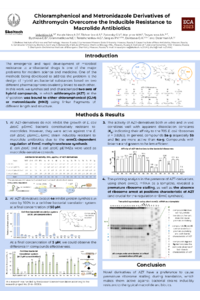
The emergence and rapid development of microbial resistance to antibacterial drugs is one of the major problems for modern science and medicine. One of the methods being developed to address the problem is the design of hybrid antibacterial substances based on two different pharmacophores covalently linked to each other. In this work, we synthesized and characterized two sets of hybrid compounds, in which azithromycin was bound to chloramphenicol or metronidazole at 4″ position using linker fragments of different length and structure. Almost all conjugates were shown to efficiently inhibit protein synthesis in vitro in a cell-free bacterial translation system similar to azithromycin. Moreover, we demonstrate that novel derivatives of azithromycin are active against Escherichia coli strain inducibly resistant to macrolide antibiotics due to the ermCL-dependent regulation of ErmC methyltransferase synthesis. Further toe-printing analysis revealed a premature ribosome stalling at the Phe codon (UUU), as well as the absence of ribosome arrest at positions characteristic of azithromycin (and crucial for the regulation or ErmC synthesis) in the presence of hybrid compounds. Thus, we demonstrate that novel derivatives of azithromycin have a preference to cause premature ribosome stalling during translation, which makes them active against bacterial strains inducibly resistant to the typical macrolide antibiotics. Investigation of the mechanism of action of the synthesized compounds was funded by the Russian Science Foundation according to the research project No. 21-64-00006.
Keywords
hybrid antibiotics
azithromycin derivatives
macrolide antibiotics
mode of action
drug resistance
Manuscript
ECA2023-abstract submission_VIA.pdf
Poster
ECA 2023_poster_VIA.pdf
Hydrogel phage formulation for combating Pseudomonas aeruginosa
Enzymatic Inactivation of Antibiotics to Combat Antimicrobial Resistances