Event submissions
Published
This submission belongs to the session S7. Poster Session of the event The 3rd International Electronic Conference on Antibiotics
Published date
30 Nov, 2023
Academic Editor
'%3e%3cpath%20d='M12.6657%2010.9104C12.4185%2010.325%2012.0599%209.79327%2011.6097%209.34482C11.1609%208.89508%2010.6293%208.5365%2010.0442%208.28888C10.0389%208.28626%2010.0337%208.28495%2010.0285%208.28233C10.8446%207.69279%2011.3752%206.73249%2011.3752%205.64904C11.3752%203.8542%209.92103%202.39999%208.1262%202.39999C6.33136%202.39999%204.87715%203.8542%204.87715%205.64904C4.87715%206.73249%205.40774%207.69279%206.22393%208.28364C6.21869%208.28626%206.21345%208.28757%206.20821%208.29019C5.62129%208.5378%205.09463%208.89284%204.64265%209.34613C4.1929%209.79493%203.83432%2010.3266%203.58671%2010.9117C3.34345%2011.4845%203.21226%2012.0987%203.20023%2012.7209C3.19988%2012.7349%203.20233%2012.7488%203.20744%2012.7619C3.21255%2012.7749%203.22022%2012.7867%203.22998%2012.7968C3.23975%2012.8068%203.25142%2012.8147%203.26431%2012.8202C3.2772%2012.8256%203.29105%2012.8284%203.30504%2012.8284H4.09109C4.14874%2012.8284%204.19459%2012.7825%204.1959%2012.7262C4.2221%2011.7148%204.62823%2010.7676%205.34617%2010.0497C6.08899%209.30683%207.0755%208.89808%208.1262%208.89808C9.17689%208.89808%2010.1634%209.30683%2010.9062%2010.0497C11.6242%2010.7676%2012.0303%2011.7148%2012.0565%2012.7262C12.0578%2012.7838%2012.1037%2012.8284%2012.1613%2012.8284H12.9474C12.9613%2012.8284%2012.9752%2012.8256%2012.9881%2012.8202C13.001%2012.8147%2013.0126%2012.8068%2013.0224%2012.7968C13.0322%2012.7867%2013.0398%2012.7749%2013.0449%2012.7619C13.0501%2012.7488%2013.0525%2012.7349%2013.0522%2012.7209C13.0391%2012.0947%2012.9094%2011.4855%2012.6657%2010.9104ZM8.1262%207.9024C7.52486%207.9024%206.9589%207.6679%206.53312%207.24211C6.10733%206.81633%205.87283%206.25037%205.87283%205.64904C5.87283%205.0477%206.10733%204.48174%206.53312%204.05596C6.9589%203.63018%207.52486%203.39567%208.1262%203.39567C8.72753%203.39567%209.29349%203.63018%209.71927%204.05596C10.1451%204.48174%2010.3796%205.0477%2010.3796%205.64904C10.3796%206.25037%2010.1451%206.81633%209.71927%207.24211C9.29349%207.6679%208.72753%207.9024%208.1262%207.9024Z'%20fill='%235D1EE1'/%3e%3c/g%3e%3c/svg%3e) Marc Maresca
Marc MarescaCitation
Márcia Braz, Carla Pereira, Carmen S. R. Freire, Adelaide Almeida, Application of phages for the inactivation of Escherichia coli in ham, in Proceedings of The 3rd International Electronic Conference on Antibiotics, 1 December–15 December 2023, MDPI: Basel, Switzerland
Share
Email
Facebook
Twitter
LinkedIn
Application of phages for the inactivation of Escherichia coli in ham

Márcia Braz 1

Carla Pereira 1

Carmen S. R. Freire 2

Adelaide Almeida 1
1. CESAM, Department of Biology, University of Aveiro, 3810-193 Aveiro, Portugal
2. CICECO-Aveiro Institute of Materials, Department of Chemistry, University of Aveiro, 3810-193 Aveiro, Portugal.
Abstract
Foodborne illnesses are a serious health problem worldwide due to the increasing bacterial resistance to antibiotics. Bacteriophages or simply phages (viruses that only infect bacteria) have been recognized for their effectiveness in controlling bacterial pathogens in the food industry. Phages exhibit important characteristics that make them promising antibacterial candidates, such as their ubiquity, high specificity against a target host, ability to self-replicate in the presence of the host, low toxicity and easy and economical isolation and production. Since Escherichia coli is one of the most important foodborne pathogens, the objective of this work was to evaluate the effectiveness of the phT4A phage (strain specific) in the inactivation of E. coli in ham. The inactivation of E. coli was first evaluated in vitro in Tryptic Soy Broth (TSB) with a reduction of about 6 log of colony forming units per milliliter (CFU/mL) for all tested values of multiplicity of infection (MOI, number of phages per bacterium), namely MOI 1, 10, 100 and 1000. In ham, a maximum reduction of about 2 log CFU/mL was obtained after 24 h (MOI of 100 and 1000). The inactivation results obtained in the ham compared to those obtained in vitro can be explained by the greater complexity of the ham matrix compared with the liquid medium TSB. Even so, the results are very promising, and the use of phages can be considered as a sustainable approach to improve food safety, namely ham, and thus prevent the infectious diseases that can arise from the ingestion of contaminated food.
The authors are grateful for financial support to CESAM by FCT/MCTES (UIDP/50017/2020 + UIDB/50017/2020 + LA/P/0094/2020) and to CICECO - Institute of Materials of Aveiro (UIDB/50011/2020, UIDP /50011/2020 & LA/P/0006/2020), funded by national funds through FCT/MEC (PIDDAC). Márcia Braz thanks FCT for her doctoral scholarship (2020.06571.BD). Carla Pereira is supported by a Junior Research contract (CEEC Individual/03974/2017). Thanks also to the Department of Biology and University of Aveiro, where this research work was carried out.
Keywords
Escherichia coli/Phage treatment/Food safety
Manuscript
Abstract_Marcia_Braz_ECA23.pdf
Poster
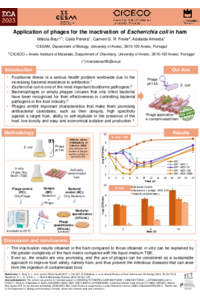
Poster_Marcia_Braz_ECA23.pdf
Species distribution and antimicrobial susceptibility of Staphylococcus spp. in the porcine nasal microbiota
Development of membrane targeting antimicrobials against resistant bacteria