Event submissions
Published
This submission belongs to the session S7. Poster Session of the event The 3rd International Electronic Conference on Antibiotics
Published date
30 Nov, 2023
Academic Editor
'%3e%3cpath%20d='M12.6657%2010.9104C12.4185%2010.325%2012.0599%209.79327%2011.6097%209.34482C11.1609%208.89508%2010.6293%208.5365%2010.0442%208.28888C10.0389%208.28626%2010.0337%208.28495%2010.0285%208.28233C10.8446%207.69279%2011.3752%206.73249%2011.3752%205.64904C11.3752%203.8542%209.92103%202.39999%208.1262%202.39999C6.33136%202.39999%204.87715%203.8542%204.87715%205.64904C4.87715%206.73249%205.40774%207.69279%206.22393%208.28364C6.21869%208.28626%206.21345%208.28757%206.20821%208.29019C5.62129%208.5378%205.09463%208.89284%204.64265%209.34613C4.1929%209.79493%203.83432%2010.3266%203.58671%2010.9117C3.34345%2011.4845%203.21226%2012.0987%203.20023%2012.7209C3.19988%2012.7349%203.20233%2012.7488%203.20744%2012.7619C3.21255%2012.7749%203.22022%2012.7867%203.22998%2012.7968C3.23975%2012.8068%203.25142%2012.8147%203.26431%2012.8202C3.2772%2012.8256%203.29105%2012.8284%203.30504%2012.8284H4.09109C4.14874%2012.8284%204.19459%2012.7825%204.1959%2012.7262C4.2221%2011.7148%204.62823%2010.7676%205.34617%2010.0497C6.08899%209.30683%207.0755%208.89808%208.1262%208.89808C9.17689%208.89808%2010.1634%209.30683%2010.9062%2010.0497C11.6242%2010.7676%2012.0303%2011.7148%2012.0565%2012.7262C12.0578%2012.7838%2012.1037%2012.8284%2012.1613%2012.8284H12.9474C12.9613%2012.8284%2012.9752%2012.8256%2012.9881%2012.8202C13.001%2012.8147%2013.0126%2012.8068%2013.0224%2012.7968C13.0322%2012.7867%2013.0398%2012.7749%2013.0449%2012.7619C13.0501%2012.7488%2013.0525%2012.7349%2013.0522%2012.7209C13.0391%2012.0947%2012.9094%2011.4855%2012.6657%2010.9104ZM8.1262%207.9024C7.52486%207.9024%206.9589%207.6679%206.53312%207.24211C6.10733%206.81633%205.87283%206.25037%205.87283%205.64904C5.87283%205.0477%206.10733%204.48174%206.53312%204.05596C6.9589%203.63018%207.52486%203.39567%208.1262%203.39567C8.72753%203.39567%209.29349%203.63018%209.71927%204.05596C10.1451%204.48174%2010.3796%205.0477%2010.3796%205.64904C10.3796%206.25037%2010.1451%206.81633%209.71927%207.24211C9.29349%207.6679%208.72753%207.9024%208.1262%207.9024Z'%20fill='%235D1EE1'/%3e%3c/g%3e%3c/svg%3e) Marc Maresca
Marc MarescaCitation
Lara C. Ribeiro, Ana R. M. Ribeiro, Marta O. Teixeira, Carla Silva, Helena P. Felgueiras, Fiber-Hydrogel Composites For Chronic Wound Management, in Proceedings of The 3rd International Electronic Conference on Antibiotics, 1 December–15 December 2023, MDPI: Basel, Switzerland
Share
Email
Facebook
Twitter
LinkedIn
Fiber-Hydrogel Composites For Chronic Wound Management
'%3e%3cpath%20d='M12.6647%2010.9104C12.4176%2010.325%2012.0589%209.7933%2011.6088%209.34485C11.16%208.89511%2010.6283%208.53653%2010.0432%208.28891C10.038%208.28629%2010.0327%208.28498%2010.0275%208.28236C10.8437%207.69282%2011.3743%206.73252%2011.3743%205.64907C11.3743%203.85423%209.92005%202.40002%208.12522%202.40002C6.33038%202.40002%204.87618%203.85423%204.87618%205.64907C4.87618%206.73252%205.40677%207.69282%206.22296%208.28367C6.21772%208.28629%206.21248%208.2876%206.20724%208.29022C5.62031%208.53783%205.09365%208.89287%204.64167%209.34616C4.19192%209.79496%203.83334%2010.3266%203.58573%2010.9117C3.34247%2011.4846%203.21128%2012.0987%203.19925%2012.721C3.1989%2012.735%203.20135%2012.7489%203.20646%2012.7619C3.21157%2012.7749%203.21924%2012.7868%203.22901%2012.7968C3.23877%2012.8068%203.25045%2012.8148%203.26334%2012.8202C3.27623%2012.8256%203.29007%2012.8284%203.30406%2012.8284H4.09012C4.14776%2012.8284%204.19362%2012.7825%204.19493%2012.7262C4.22113%2011.7148%204.62726%2010.7676%205.34519%2010.0497C6.08802%209.30686%207.07452%208.89811%208.12522%208.89811C9.17592%208.89811%2010.1624%209.30686%2010.9052%2010.0497C11.6232%2010.7676%2012.0293%2011.7148%2012.0555%2012.7262C12.0568%2012.7839%2012.1027%2012.8284%2012.1603%2012.8284H12.9464C12.9604%2012.8284%2012.9742%2012.8256%2012.9871%2012.8202C13%2012.8148%2013.0117%2012.8068%2013.0214%2012.7968C13.0312%2012.7868%2013.0389%2012.7749%2013.044%2012.7619C13.0491%2012.7489%2013.0515%2012.735%2013.0512%2012.721C13.0381%2012.0947%2012.9084%2011.4856%2012.6647%2010.9104ZM8.12522%207.90243C7.52388%207.90243%206.95792%207.66793%206.53214%207.24215C6.10636%206.81636%205.87185%206.2504%205.87185%205.64907C5.87185%205.04773%206.10636%204.48177%206.53214%204.05599C6.95792%203.63021%207.52388%203.3957%208.12522%203.3957C8.72655%203.3957%209.29252%203.63021%209.7183%204.05599C10.1441%204.48177%2010.3786%205.04773%2010.3786%205.64907C10.3786%206.2504%2010.1441%206.81636%209.7183%207.24215C9.29252%207.66793%208.72655%207.90243%208.12522%207.90243Z'%20fill='%235D1EE1'/%3e%3c/g%3e%3c/svg%3e)
Lara C. Ribeiro 1,2

Ana R. M. Ribeiro 1
Marta O. Teixeira 1

Carla Silva 2

Helena P. Felgueiras 1
1. Centre for Textile Science and Technology, University of Minho
2. Centre of Biological Engineering, University of Minho
Abstract
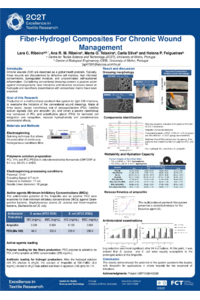
The conventional dressings used nowadays present a passive action against microorganisms. Here, a multifunctional sandwich-like system was proposed and examined for its potential in control CW infections. The scaffolding system was made of three layers: (outer) fibrous mat of polycaprolactone (PCL) working as a barrier for preventing other microorganisms from reaching the wound bed, and was prepared at 14% w/v in chloroform/dimethylformamide (CHF/DMF) at 90/10% v/v (4 h at 50ºC); (middle) sodium alginate (SA) hydrogel loaded with the antibiotic, ampicillin (Amp), examined against Staphylococcus aureus and Escherichia coli using the broth micro-dilution assay (determination of minimum inhibitory concentration or MIC), and used to maintain a moisture environment and absorb exudates. The hydrogel was obtained by solvent casting-phase inversion method using a 2%w/v SA solution load with Amp at MBC (6,4 µg/mL) and coagulation bath of 2%w/v CaCl2. Finally, (inner) a second fibrous mat composed of PCL and polyethylene glycol (PEG), also examined against S.aureus e E.coli (MBC of 256 µg/mL), was used to facilitate cell integration and recognition and reduce mat hydrophobicity. Mats were produced via electrospinning (12kV, 0.7mL/h, 17cm, 18G). The sandwich-like system was generated by pouring the hydrogel solution onto a casting mold lined with the inner layer and depositing the outer layer at the top of the viscous solution. After 1h of intimate contact, the casting solution was added and afterwards the scaffolding system was ready and totally detached from the mold. Data reports the effectiveness of this sandwich-like system for potential applications in CW care.
Keywords
ampicillin
chronic wounds
fibrous polymer films
hydrogel
sandwich-like system
Manuscript
2023_ ECA Abstract.pdf
Poster
Poster_ECA2023.pdf
Development of membrane targeting antimicrobials against resistant bacteria
Antimicrobial efficacy of Moringa oleifera leaf and seed extract against Candida species - An invitro study