Event submissions
Published
This submission belongs to the session S7. Poster Session of the event The 3rd International Electronic Conference on Antibiotics
Published date
30 Nov, 2023
Academic Editor
'%3e%3cpath%20d='M12.6657%2010.9104C12.4185%2010.325%2012.0599%209.79327%2011.6097%209.34482C11.1609%208.89508%2010.6293%208.5365%2010.0442%208.28888C10.0389%208.28626%2010.0337%208.28495%2010.0285%208.28233C10.8446%207.69279%2011.3752%206.73249%2011.3752%205.64904C11.3752%203.8542%209.92103%202.39999%208.1262%202.39999C6.33136%202.39999%204.87715%203.8542%204.87715%205.64904C4.87715%206.73249%205.40774%207.69279%206.22393%208.28364C6.21869%208.28626%206.21345%208.28757%206.20821%208.29019C5.62129%208.5378%205.09463%208.89284%204.64265%209.34613C4.1929%209.79493%203.83432%2010.3266%203.58671%2010.9117C3.34345%2011.4845%203.21226%2012.0987%203.20023%2012.7209C3.19988%2012.7349%203.20233%2012.7488%203.20744%2012.7619C3.21255%2012.7749%203.22022%2012.7867%203.22998%2012.7968C3.23975%2012.8068%203.25142%2012.8147%203.26431%2012.8202C3.2772%2012.8256%203.29105%2012.8284%203.30504%2012.8284H4.09109C4.14874%2012.8284%204.19459%2012.7825%204.1959%2012.7262C4.2221%2011.7148%204.62823%2010.7676%205.34617%2010.0497C6.08899%209.30683%207.0755%208.89808%208.1262%208.89808C9.17689%208.89808%2010.1634%209.30683%2010.9062%2010.0497C11.6242%2010.7676%2012.0303%2011.7148%2012.0565%2012.7262C12.0578%2012.7838%2012.1037%2012.8284%2012.1613%2012.8284H12.9474C12.9613%2012.8284%2012.9752%2012.8256%2012.9881%2012.8202C13.001%2012.8147%2013.0126%2012.8068%2013.0224%2012.7968C13.0322%2012.7867%2013.0398%2012.7749%2013.0449%2012.7619C13.0501%2012.7488%2013.0525%2012.7349%2013.0522%2012.7209C13.0391%2012.0947%2012.9094%2011.4855%2012.6657%2010.9104ZM8.1262%207.9024C7.52486%207.9024%206.9589%207.6679%206.53312%207.24211C6.10733%206.81633%205.87283%206.25037%205.87283%205.64904C5.87283%205.0477%206.10733%204.48174%206.53312%204.05596C6.9589%203.63018%207.52486%203.39567%208.1262%203.39567C8.72753%203.39567%209.29349%203.63018%209.71927%204.05596C10.1451%204.48174%2010.3796%205.0477%2010.3796%205.64904C10.3796%206.25037%2010.1451%206.81633%209.71927%207.24211C9.29349%207.6679%208.72753%207.9024%208.1262%207.9024Z'%20fill='%235D1EE1'/%3e%3c/g%3e%3c/svg%3e) Marc Maresca
Marc MarescaCitation
Eric Mühlberg, Julia Werner, Florian Umstätter, Tobias Hertlein, Sabrina Wohlfart, Tyra Christian, Stefan Zimmermann, Cornelius Domhan, Knut Ohlsen, Walter Mier, Philipp Uhl, ROVANCE – Resistance Overcoming Antibiotics New Chemical Entities: A Platform Technology to Overcome Bacterial Resistance, in Proceedings of The 3rd International Electronic Conference on Antibiotics, 1 December–15 December 2023, MDPI: Basel, Switzerland
Share
Email
Facebook
Twitter
LinkedIn
ROVANCE – Resistance Overcoming Antibiotics New Chemical Entities: A Platform Technology to Overcome Bacterial Resistance
'%3e%3cpath%20d='M12.6647%2010.9104C12.4176%2010.325%2012.0589%209.7933%2011.6088%209.34485C11.16%208.89511%2010.6283%208.53653%2010.0432%208.28891C10.038%208.28629%2010.0327%208.28498%2010.0275%208.28236C10.8437%207.69282%2011.3743%206.73252%2011.3743%205.64907C11.3743%203.85423%209.92005%202.40002%208.12522%202.40002C6.33038%202.40002%204.87618%203.85423%204.87618%205.64907C4.87618%206.73252%205.40677%207.69282%206.22296%208.28367C6.21772%208.28629%206.21248%208.2876%206.20724%208.29022C5.62031%208.53783%205.09365%208.89287%204.64167%209.34616C4.19192%209.79496%203.83334%2010.3266%203.58573%2010.9117C3.34247%2011.4846%203.21128%2012.0987%203.19925%2012.721C3.1989%2012.735%203.20135%2012.7489%203.20646%2012.7619C3.21157%2012.7749%203.21924%2012.7868%203.22901%2012.7968C3.23877%2012.8068%203.25045%2012.8148%203.26334%2012.8202C3.27623%2012.8256%203.29007%2012.8284%203.30406%2012.8284H4.09012C4.14776%2012.8284%204.19362%2012.7825%204.19493%2012.7262C4.22113%2011.7148%204.62726%2010.7676%205.34519%2010.0497C6.08802%209.30686%207.07452%208.89811%208.12522%208.89811C9.17592%208.89811%2010.1624%209.30686%2010.9052%2010.0497C11.6232%2010.7676%2012.0293%2011.7148%2012.0555%2012.7262C12.0568%2012.7839%2012.1027%2012.8284%2012.1603%2012.8284H12.9464C12.9604%2012.8284%2012.9742%2012.8256%2012.9871%2012.8202C13%2012.8148%2013.0117%2012.8068%2013.0214%2012.7968C13.0312%2012.7868%2013.0389%2012.7749%2013.044%2012.7619C13.0491%2012.7489%2013.0515%2012.735%2013.0512%2012.721C13.0381%2012.0947%2012.9084%2011.4856%2012.6647%2010.9104ZM8.12522%207.90243C7.52388%207.90243%206.95792%207.66793%206.53214%207.24215C6.10636%206.81636%205.87185%206.2504%205.87185%205.64907C5.87185%205.04773%206.10636%204.48177%206.53214%204.05599C6.95792%203.63021%207.52388%203.3957%208.12522%203.3957C8.72655%203.3957%209.29252%203.63021%209.7183%204.05599C10.1441%204.48177%2010.3786%205.04773%2010.3786%205.64907C10.3786%206.2504%2010.1441%206.81636%209.7183%207.24215C9.29252%207.66793%208.72655%207.90243%208.12522%207.90243Z'%20fill='%235D1EE1'/%3e%3c/g%3e%3c/svg%3e)
Eric Mühlberg 1,2
Julia Werner 2
Florian Umstätter 2
Tobias Hertlein 3
Sabrina Wohlfart 2
Tyra Christian 2

Stefan Zimmermann 4
Cornelius Domhan 1
Knut Ohlsen 3
Walter Mier 2
Philipp Uhl 1,2
1. Institute of Pharmacy and Molecular Biotechnology, Heidelberg University, Heidelberg, Germany
2. Department of Nuclear Medicine, Heidelberg University Hospital, Heidelberg, Germany
3. Institute for Molecular Infection Biology, University of Würzburg, Würzburg, Germany
4. Department of Infectious Diseases, Heidelberg University Hospital, Heidelberg, Germany
Abstract
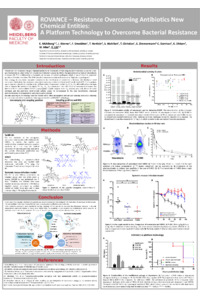
Multidrug-resistant bacteria represent one of the greatest challenges for modern medicine. The increasing resistance against glycopeptide antibiotics compromises the efficacy of vancomycin, for a long time considered as the last resort for the treatment of resistant Gram-positive bacteria.1,2 To reestablish its activity, polycationic peptides were conjugated to vancomycin. Several derivatives that bear the poly arginine peptide moiety at four different sites of vancomycin were synthesized through site-specific conjugation.3-5
The lead conjugate VN-R6C showed high antimicrobial activity (up to 1000-fold increased) on 15 clinical isolates of linezolid- and vancomycin-resistant enterococci (LVRE, E. faecium) as well as on 25 clinical isolates of vancomycin resistant E. faecium and E. faecalis. The higher antimicrobial activity was also demonstrated by improved killing kinetics against selected strains of enterococci and staphylococci. Furthermore, the antimicrobial potential of the lead candidate VN-R6C could be demonstrated in a murine in vivo systemic infection model. Blocking experiments using d‑Ala‑d‑Ala revealed a mode of action beyond the inhibition of cell-wall formation. Further, the peptide modification enables modulation of the pharmacokinetics allowing specific organ targeting.
Encapsulation of VN-R6C in PEGylated liposomal nanocarrier systems prolonged the half-life of the drug after intravenous administration: studies in Wistar rats revealed a significantly prolonged circulation of the liposomal antibiotic. Microdilution testing proved that the liposomal encapsulation of VN-R6C does not diminish the antimicrobial activity against staphylococci and enterococci. Highlighting its great potency, liposomal VN-R6C exhibited a superior therapeutic efficacy when compared to the free drug in a Galleria mellonella larvae infection model.
Beyond vancomycin, the strategy could be proven effective for other glycopeptide and cell wall targeting antibiotics, indicating its potential applicability as a platform technology (referred to as ROVANCE technology).
Keywords
Antibiotics
Resistance
Vancomycin
Polycationic peptides
Liposomes
Manuscript
Abstract_ROVANCE_ECA2023.pdf
Poster
Poster_UHL.pdf
Antibiotic-Resistant in Sea Turtles
Nature-Inspired Antibacterial Agents: Derivatization of Eugenol toward promising anti-H. pylori agents