Event submissions
Published
This submission belongs to the session S7. Poster Session of the event The 3rd International Electronic Conference on Antibiotics
Published date
30 Nov, 2023
Academic Editor
'%3e%3cpath%20d='M12.6657%2010.9104C12.4185%2010.325%2012.0599%209.79327%2011.6097%209.34482C11.1609%208.89508%2010.6293%208.5365%2010.0442%208.28888C10.0389%208.28626%2010.0337%208.28495%2010.0285%208.28233C10.8446%207.69279%2011.3752%206.73249%2011.3752%205.64904C11.3752%203.8542%209.92103%202.39999%208.1262%202.39999C6.33136%202.39999%204.87715%203.8542%204.87715%205.64904C4.87715%206.73249%205.40774%207.69279%206.22393%208.28364C6.21869%208.28626%206.21345%208.28757%206.20821%208.29019C5.62129%208.5378%205.09463%208.89284%204.64265%209.34613C4.1929%209.79493%203.83432%2010.3266%203.58671%2010.9117C3.34345%2011.4845%203.21226%2012.0987%203.20023%2012.7209C3.19988%2012.7349%203.20233%2012.7488%203.20744%2012.7619C3.21255%2012.7749%203.22022%2012.7867%203.22998%2012.7968C3.23975%2012.8068%203.25142%2012.8147%203.26431%2012.8202C3.2772%2012.8256%203.29105%2012.8284%203.30504%2012.8284H4.09109C4.14874%2012.8284%204.19459%2012.7825%204.1959%2012.7262C4.2221%2011.7148%204.62823%2010.7676%205.34617%2010.0497C6.08899%209.30683%207.0755%208.89808%208.1262%208.89808C9.17689%208.89808%2010.1634%209.30683%2010.9062%2010.0497C11.6242%2010.7676%2012.0303%2011.7148%2012.0565%2012.7262C12.0578%2012.7838%2012.1037%2012.8284%2012.1613%2012.8284H12.9474C12.9613%2012.8284%2012.9752%2012.8256%2012.9881%2012.8202C13.001%2012.8147%2013.0126%2012.8068%2013.0224%2012.7968C13.0322%2012.7867%2013.0398%2012.7749%2013.0449%2012.7619C13.0501%2012.7488%2013.0525%2012.7349%2013.0522%2012.7209C13.0391%2012.0947%2012.9094%2011.4855%2012.6657%2010.9104ZM8.1262%207.9024C7.52486%207.9024%206.9589%207.6679%206.53312%207.24211C6.10733%206.81633%205.87283%206.25037%205.87283%205.64904C5.87283%205.0477%206.10733%204.48174%206.53312%204.05596C6.9589%203.63018%207.52486%203.39567%208.1262%203.39567C8.72753%203.39567%209.29349%203.63018%209.71927%204.05596C10.1451%204.48174%2010.3796%205.0477%2010.3796%205.64904C10.3796%206.25037%2010.1451%206.81633%209.71927%207.24211C9.29349%207.6679%208.72753%207.9024%208.1262%207.9024Z'%20fill='%235D1EE1'/%3e%3c/g%3e%3c/svg%3e) Marc Maresca
Marc MarescaCitation
Elise Charrier, François Peltier, Alexandra Dassonville-Klimpt, Claire Andréjak, Pascal Sonnet, Synthesis and biological evaluation of new piperazine-based amino-alcohol-quinolines as promising antimycobacterial drugs, in Proceedings of The 3rd International Electronic Conference on Antibiotics, 1 December–15 December 2023, MDPI: Basel, Switzerland
Share
Email
Facebook
Twitter
LinkedIn
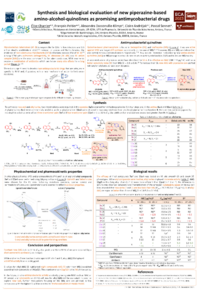
Synthesis and biological evaluation of new piperazine-based amino-alcohol-quinolines as promising antimycobacterial drugs
'%3e%3cpath%20d='M12.6647%2010.9104C12.4176%2010.325%2012.0589%209.7933%2011.6088%209.34485C11.16%208.89511%2010.6283%208.53653%2010.0432%208.28891C10.038%208.28629%2010.0327%208.28498%2010.0275%208.28236C10.8437%207.69282%2011.3743%206.73252%2011.3743%205.64907C11.3743%203.85423%209.92005%202.40002%208.12522%202.40002C6.33038%202.40002%204.87618%203.85423%204.87618%205.64907C4.87618%206.73252%205.40677%207.69282%206.22296%208.28367C6.21772%208.28629%206.21248%208.2876%206.20724%208.29022C5.62031%208.53783%205.09365%208.89287%204.64167%209.34616C4.19192%209.79496%203.83334%2010.3266%203.58573%2010.9117C3.34247%2011.4846%203.21128%2012.0987%203.19925%2012.721C3.1989%2012.735%203.20135%2012.7489%203.20646%2012.7619C3.21157%2012.7749%203.21924%2012.7868%203.22901%2012.7968C3.23877%2012.8068%203.25045%2012.8148%203.26334%2012.8202C3.27623%2012.8256%203.29007%2012.8284%203.30406%2012.8284H4.09012C4.14776%2012.8284%204.19362%2012.7825%204.19493%2012.7262C4.22113%2011.7148%204.62726%2010.7676%205.34519%2010.0497C6.08802%209.30686%207.07452%208.89811%208.12522%208.89811C9.17592%208.89811%2010.1624%209.30686%2010.9052%2010.0497C11.6232%2010.7676%2012.0293%2011.7148%2012.0555%2012.7262C12.0568%2012.7839%2012.1027%2012.8284%2012.1603%2012.8284H12.9464C12.9604%2012.8284%2012.9742%2012.8256%2012.9871%2012.8202C13%2012.8148%2013.0117%2012.8068%2013.0214%2012.7968C13.0312%2012.7868%2013.0389%2012.7749%2013.044%2012.7619C13.0491%2012.7489%2013.0515%2012.735%2013.0512%2012.721C13.0381%2012.0947%2012.9084%2011.4856%2012.6647%2010.9104ZM8.12522%207.90243C7.52388%207.90243%206.95792%207.66793%206.53214%207.24215C6.10636%206.81636%205.87185%206.2504%205.87185%205.64907C5.87185%205.04773%206.10636%204.48177%206.53214%204.05599C6.95792%203.63021%207.52388%203.3957%208.12522%203.3957C8.72655%203.3957%209.29252%203.63021%209.7183%204.05599C10.1441%204.48177%2010.3786%205.04773%2010.3786%205.64907C10.3786%206.2504%2010.1441%206.81636%209.7183%207.24215C9.29252%207.66793%208.72655%207.90243%208.12522%207.90243Z'%20fill='%235D1EE1'/%3e%3c/g%3e%3c/svg%3e)
Elise Charrier 1,2
François Peltier 1,2

Alexandra Dassonville-Klimpt 1
Claire Andréjak 1,3

Pascal Sonnet 1
1. AGents Infectieux, Résistance et chimiothérapie, UR 4294, UFR de Pharmacie, Université de Picardie Jules Verne, Amiens, France
2. Département de Bactériologie, CHU Amiens-Picardie, Amiens, France
3. Unité de soins intensifs respiratoires, CHU Amiens-Picardie, Amiens, France
Abstract
Worldwide, Mycobacterium tuberculosis (M. tb) is responsible for 10.6 million infections and 1.6 million deaths. In Europe and North America, the incidence of non-tuberculous mycobacteria (NTM) infections exceeds that of M. tb. NTM are ubiquitous and opportunistic for immunocompromised people and/or with chronic respiratory diseases. Among NTM with pulmonary pathogenicity, Mycobacterium abscessus is the most difficult to treat and Mycobacterium avium complex (MAC) is the most common, causing 80% of NTM infections. Current NTM treatments require a combination of antibiotics which can cause many side effects over a long period. For example, MAC infections should be treated with at least three drugs (macrolides, rifamycin and ethambutol) for 12 to 24 months. These drugs are not very effective with a success rate of 52 to 60%, as they were initially designed for M. tb infection treatment. In addition, they can occur many side effects, including hepatotoxicity, urine coloration, ocular disorders, … Thus, it is urgent to develop new molecules that are safer, more NTM specific and, if possible, with a novel mechanism of action. Quinoline-based pharmacophore is found in two compounds active against MAC, bedaquiline (BQ) and mefloquine (MQ). Interestingly, they target ATP synthase, an enzyme essential for mycobacteria. However, BQ and MQ can induce side effects on the liver and central nervous system, respectively. In order to reduce the toxicity of MQ, quinoline core has been pharmacomodulated. Herein, we present (i) the synthesis of piperazine-based amino-alcohol-quinolines active against NTM, (ii) their in silico physicochemical and pharmacokinetic properties and, (iii) their in vitro antimycobacterial evaluation.
Keywords
non-tuberculous mycobacteria
amino-alcohol-quinolines
heterocyclic synthesis
antimycobacterial evaluation
Manuscript
sciforum-077521.pdf
Poster
Elise Charrier-poster ECA.pdf
Culture medium modelisation for optimization of anti methycillin resistant Staphylococcus aureus metabolites by a coal mining soil derived Streptomyces rochei CMB47 strain
A study on prevalence of co-trimoxazole resistance among bacterial isolates from UTI patients and aquatic environment