Event submissions
Published
This submission belongs to the session S3. Antimicrobial Agents and Resistance of the event The 2nd International Electronic Conference on Microbiology
Published date
30 Nov, 2023
Academic Editor
'%3e%3cpath%20d='M12.6657%2010.9104C12.4185%2010.325%2012.0599%209.79327%2011.6097%209.34482C11.1609%208.89508%2010.6293%208.5365%2010.0442%208.28888C10.0389%208.28626%2010.0337%208.28495%2010.0285%208.28233C10.8446%207.69279%2011.3752%206.73249%2011.3752%205.64904C11.3752%203.8542%209.92103%202.39999%208.1262%202.39999C6.33136%202.39999%204.87715%203.8542%204.87715%205.64904C4.87715%206.73249%205.40774%207.69279%206.22393%208.28364C6.21869%208.28626%206.21345%208.28757%206.20821%208.29019C5.62129%208.5378%205.09463%208.89284%204.64265%209.34613C4.1929%209.79493%203.83432%2010.3266%203.58671%2010.9117C3.34345%2011.4845%203.21226%2012.0987%203.20023%2012.7209C3.19988%2012.7349%203.20233%2012.7488%203.20744%2012.7619C3.21255%2012.7749%203.22022%2012.7867%203.22998%2012.7968C3.23975%2012.8068%203.25142%2012.8147%203.26431%2012.8202C3.2772%2012.8256%203.29105%2012.8284%203.30504%2012.8284H4.09109C4.14874%2012.8284%204.19459%2012.7825%204.1959%2012.7262C4.2221%2011.7148%204.62823%2010.7676%205.34617%2010.0497C6.08899%209.30683%207.0755%208.89808%208.1262%208.89808C9.17689%208.89808%2010.1634%209.30683%2010.9062%2010.0497C11.6242%2010.7676%2012.0303%2011.7148%2012.0565%2012.7262C12.0578%2012.7838%2012.1037%2012.8284%2012.1613%2012.8284H12.9474C12.9613%2012.8284%2012.9752%2012.8256%2012.9881%2012.8202C13.001%2012.8147%2013.0126%2012.8068%2013.0224%2012.7968C13.0322%2012.7867%2013.0398%2012.7749%2013.0449%2012.7619C13.0501%2012.7488%2013.0525%2012.7349%2013.0522%2012.7209C13.0391%2012.0947%2012.9094%2011.4855%2012.6657%2010.9104ZM8.1262%207.9024C7.52486%207.9024%206.9589%207.6679%206.53312%207.24211C6.10733%206.81633%205.87283%206.25037%205.87283%205.64904C5.87283%205.0477%206.10733%204.48174%206.53312%204.05596C6.9589%203.63018%207.52486%203.39567%208.1262%203.39567C8.72753%203.39567%209.29349%203.63018%209.71927%204.05596C10.1451%204.48174%2010.3796%205.0477%2010.3796%205.64904C10.3796%206.25037%2010.1451%206.81633%209.71927%207.24211C9.29349%207.6679%208.72753%207.9024%208.1262%207.9024Z'%20fill='%235D1EE1'/%3e%3c/g%3e%3c/svg%3e) Gabriela Jorge Da Silva
Gabriela Jorge Da SilvaCitation
A. Pérez-Vázquez, P. Barciela, T. Ferreira F. da Silva, D.B. Rodrigues, T.C. Pires, M. Carpena, M.A. Prieto, L. Barros, Potential use of Euphorbia hirta and Euphorbia jolkinii extracts as antimicrobial agents against three clinical bacteria Indicate the species: Pseudomonas aeruginosa, Morganella morganii, and Klebsiella pneumoniae, in Proceedings of The 2nd International Electronic Conference on Microbiology, 1 December–15 December 2023, MDPI: Basel, Switzerland
Share
Email
Facebook
Twitter
LinkedIn
Potential use of Euphorbia hirta and Euphorbia jolkinii extracts as antimicrobial agents against three clinical bacteria Indicate the species: Pseudomonas aeruginosa, Morganella morganii, and Klebsiella pneumoniae
'%3e%3cpath%20d='M12.6647%2010.9104C12.4176%2010.325%2012.0589%209.7933%2011.6088%209.34485C11.16%208.89511%2010.6283%208.53653%2010.0432%208.28891C10.038%208.28629%2010.0327%208.28498%2010.0275%208.28236C10.8437%207.69282%2011.3743%206.73252%2011.3743%205.64907C11.3743%203.85423%209.92005%202.40002%208.12522%202.40002C6.33038%202.40002%204.87618%203.85423%204.87618%205.64907C4.87618%206.73252%205.40677%207.69282%206.22296%208.28367C6.21772%208.28629%206.21248%208.2876%206.20724%208.29022C5.62031%208.53783%205.09365%208.89287%204.64167%209.34616C4.19192%209.79496%203.83334%2010.3266%203.58573%2010.9117C3.34247%2011.4846%203.21128%2012.0987%203.19925%2012.721C3.1989%2012.735%203.20135%2012.7489%203.20646%2012.7619C3.21157%2012.7749%203.21924%2012.7868%203.22901%2012.7968C3.23877%2012.8068%203.25045%2012.8148%203.26334%2012.8202C3.27623%2012.8256%203.29007%2012.8284%203.30406%2012.8284H4.09012C4.14776%2012.8284%204.19362%2012.7825%204.19493%2012.7262C4.22113%2011.7148%204.62726%2010.7676%205.34519%2010.0497C6.08802%209.30686%207.07452%208.89811%208.12522%208.89811C9.17592%208.89811%2010.1624%209.30686%2010.9052%2010.0497C11.6232%2010.7676%2012.0293%2011.7148%2012.0555%2012.7262C12.0568%2012.7839%2012.1027%2012.8284%2012.1603%2012.8284H12.9464C12.9604%2012.8284%2012.9742%2012.8256%2012.9871%2012.8202C13%2012.8148%2013.0117%2012.8068%2013.0214%2012.7968C13.0312%2012.7868%2013.0389%2012.7749%2013.044%2012.7619C13.0491%2012.7489%2013.0515%2012.735%2013.0512%2012.721C13.0381%2012.0947%2012.9084%2011.4856%2012.6647%2010.9104ZM8.12522%207.90243C7.52388%207.90243%206.95792%207.66793%206.53214%207.24215C6.10636%206.81636%205.87185%206.2504%205.87185%205.64907C5.87185%205.04773%206.10636%204.48177%206.53214%204.05599C6.95792%203.63021%207.52388%203.3957%208.12522%203.3957C8.72655%203.3957%209.29252%203.63021%209.7183%204.05599C10.1441%204.48177%2010.3786%205.04773%2010.3786%205.64907C10.3786%206.2504%2010.1441%206.81636%209.7183%207.24215C9.29252%207.66793%208.72655%207.90243%208.12522%207.90243Z'%20fill='%235D1EE1'/%3e%3c/g%3e%3c/svg%3e)
A. Pérez-Vázquez 1

P. Barciela 1
T. Ferreira F. da Silva 2

D.B. Rodrigues 2

T.C. Pires 2,3

M. Carpena 1

M.A. Prieto 1,2
L. Barros 2
1. 1Universidade de Vigo, Nutrition and Bromatology Group, Department of Analytical Chemistry and Food Science, Faculty of Science, E32004 Ourense, Spain.
2. 2 Centro de Investigação de Montanha (CIMO), Instituto Politécnico de Bragança, Campus de Santa Apolonia, 5300-253 Bragança, Portugal.
3. 1 Universidade de Vigo, Nutrition and Bromatology Group, Department of Analytical Chemistry and Food Science, Faculty of Science, E32004 Ourense, Spain.
Abstract
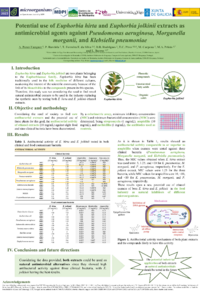
Euphorbia hirta and Euphorbia jolkinii are two plants belonging to the Euphorbiaceae family. Euphorbia hirta has been traditionally used in the folk medicine of different cultures, awakening the interest of the scientific community because of the link of its bioactivities to the compounds present in this species. Studies regarding Euphorbia jolkinii are scarce, although the phenolic profile of this plant is also attractive. Considering the need of society to find new antibacterial extracts and the potential use of these plants for this goal, the antibacterial activity of ethanol extracts (10 mg/mL) against eight food and nine clinical bacteria have been characterized. By a colorimetric assay, minimum inhibitory concentration (MIC) and minimum bactericidal concentration (MBC) were determined, being streptomycin (1 mg/mL), ampicillin (10 mg/mL), and methicillin (1 mg/mL), the antibiotics used as controls. The results showed an antibacterial activity comparable to or superior to ampicillin when extracts were tested against three clinical bacteria (Pseudomonas aeruginosa, Morganella morganii, and Klebsiella pneumoniae). Thus, the MIC values obtained when E. hirta extract was used were: 5, 1.25, and <10 mg/mL for K. pneumoniae, M. morganii, and P. aeruginosa, respectively. For the E. jolkinii extract, MIC values were 1.25 for the three bacteria, while MIC values for ampicillin were 10, <10, and <10 mg/mL for K. pneumoniae, M. morganii, and P. aeruginosa, respectively. Considering the data provided, both extracts could be alternatives since they showed high antibacterial activity against three clinical bacteria, with E. jolkinii having the best results.
Keywords
Euphorbia
antibacterial activity
Pseudomonas aeruginosa
Morganella morganii
and Klebsiella pneumoniae.
Manuscript
ECM2023_Ana.pdf
Poster
Póster_ECMANa.pdf
Responsibility of Food Animals Transferring Antimicrobial Resistance to The Human Population in Saudi Arabia
Unveiling the Potential of Raspberry Leaves for Cosmetic and Dermatological Formulations