Event submissions
Published
This submission belongs to the session S8. Poster Session of the event The 2nd International Electronic Conference on Microbiology
Published date
30 Nov, 2023
Academic Editor
'%3e%3cpath%20d='M12.6657%2010.9104C12.4185%2010.325%2012.0599%209.79327%2011.6097%209.34482C11.1609%208.89508%2010.6293%208.5365%2010.0442%208.28888C10.0389%208.28626%2010.0337%208.28495%2010.0285%208.28233C10.8446%207.69279%2011.3752%206.73249%2011.3752%205.64904C11.3752%203.8542%209.92103%202.39999%208.1262%202.39999C6.33136%202.39999%204.87715%203.8542%204.87715%205.64904C4.87715%206.73249%205.40774%207.69279%206.22393%208.28364C6.21869%208.28626%206.21345%208.28757%206.20821%208.29019C5.62129%208.5378%205.09463%208.89284%204.64265%209.34613C4.1929%209.79493%203.83432%2010.3266%203.58671%2010.9117C3.34345%2011.4845%203.21226%2012.0987%203.20023%2012.7209C3.19988%2012.7349%203.20233%2012.7488%203.20744%2012.7619C3.21255%2012.7749%203.22022%2012.7867%203.22998%2012.7968C3.23975%2012.8068%203.25142%2012.8147%203.26431%2012.8202C3.2772%2012.8256%203.29105%2012.8284%203.30504%2012.8284H4.09109C4.14874%2012.8284%204.19459%2012.7825%204.1959%2012.7262C4.2221%2011.7148%204.62823%2010.7676%205.34617%2010.0497C6.08899%209.30683%207.0755%208.89808%208.1262%208.89808C9.17689%208.89808%2010.1634%209.30683%2010.9062%2010.0497C11.6242%2010.7676%2012.0303%2011.7148%2012.0565%2012.7262C12.0578%2012.7838%2012.1037%2012.8284%2012.1613%2012.8284H12.9474C12.9613%2012.8284%2012.9752%2012.8256%2012.9881%2012.8202C13.001%2012.8147%2013.0126%2012.8068%2013.0224%2012.7968C13.0322%2012.7867%2013.0398%2012.7749%2013.0449%2012.7619C13.0501%2012.7488%2013.0525%2012.7349%2013.0522%2012.7209C13.0391%2012.0947%2012.9094%2011.4855%2012.6657%2010.9104ZM8.1262%207.9024C7.52486%207.9024%206.9589%207.6679%206.53312%207.24211C6.10733%206.81633%205.87283%206.25037%205.87283%205.64904C5.87283%205.0477%206.10733%204.48174%206.53312%204.05596C6.9589%203.63018%207.52486%203.39567%208.1262%203.39567C8.72753%203.39567%209.29349%203.63018%209.71927%204.05596C10.1451%204.48174%2010.3796%205.0477%2010.3796%205.64904C10.3796%206.25037%2010.1451%206.81633%209.71927%207.24211C9.29349%207.6679%208.72753%207.9024%208.1262%207.9024Z'%20fill='%235D1EE1'/%3e%3c/g%3e%3c/svg%3e) Nico Jehmlich
Nico JehmlichCitation
Bruna Pereira, Juliana Garcia, Daniela Correia, Tayse Silveira, Lillian Barros, Maria José Alves, Maria José Saavedra, Unveiling the Potential of Raspberry Leaves for Cosmetic and Dermatological Formulations, in Proceedings of The 2nd International Electronic Conference on Microbiology, 1 December–15 December 2023, MDPI: Basel, Switzerland
Share
Email
Facebook
Twitter
LinkedIn
Unveiling the Potential of Raspberry Leaves for Cosmetic and Dermatological Formulations
'%3e%3cpath%20d='M12.6647%2010.9104C12.4176%2010.325%2012.0589%209.7933%2011.6088%209.34485C11.16%208.89511%2010.6283%208.53653%2010.0432%208.28891C10.038%208.28629%2010.0327%208.28498%2010.0275%208.28236C10.8437%207.69282%2011.3743%206.73252%2011.3743%205.64907C11.3743%203.85423%209.92005%202.40002%208.12522%202.40002C6.33038%202.40002%204.87618%203.85423%204.87618%205.64907C4.87618%206.73252%205.40677%207.69282%206.22296%208.28367C6.21772%208.28629%206.21248%208.2876%206.20724%208.29022C5.62031%208.53783%205.09365%208.89287%204.64167%209.34616C4.19192%209.79496%203.83334%2010.3266%203.58573%2010.9117C3.34247%2011.4846%203.21128%2012.0987%203.19925%2012.721C3.1989%2012.735%203.20135%2012.7489%203.20646%2012.7619C3.21157%2012.7749%203.21924%2012.7868%203.22901%2012.7968C3.23877%2012.8068%203.25045%2012.8148%203.26334%2012.8202C3.27623%2012.8256%203.29007%2012.8284%203.30406%2012.8284H4.09012C4.14776%2012.8284%204.19362%2012.7825%204.19493%2012.7262C4.22113%2011.7148%204.62726%2010.7676%205.34519%2010.0497C6.08802%209.30686%207.07452%208.89811%208.12522%208.89811C9.17592%208.89811%2010.1624%209.30686%2010.9052%2010.0497C11.6232%2010.7676%2012.0293%2011.7148%2012.0555%2012.7262C12.0568%2012.7839%2012.1027%2012.8284%2012.1603%2012.8284H12.9464C12.9604%2012.8284%2012.9742%2012.8256%2012.9871%2012.8202C13%2012.8148%2013.0117%2012.8068%2013.0214%2012.7968C13.0312%2012.7868%2013.0389%2012.7749%2013.044%2012.7619C13.0491%2012.7489%2013.0515%2012.735%2013.0512%2012.721C13.0381%2012.0947%2012.9084%2011.4856%2012.6647%2010.9104ZM8.12522%207.90243C7.52388%207.90243%206.95792%207.66793%206.53214%207.24215C6.10636%206.81636%205.87185%206.2504%205.87185%205.64907C5.87185%205.04773%206.10636%204.48177%206.53214%204.05599C6.95792%203.63021%207.52388%203.3957%208.12522%203.3957C8.72655%203.3957%209.29252%203.63021%209.7183%204.05599C10.1441%204.48177%2010.3786%205.04773%2010.3786%205.64907C10.3786%206.2504%2010.1441%206.81636%209.7183%207.24215C9.29252%207.66793%208.72655%207.90243%208.12522%207.90243Z'%20fill='%235D1EE1'/%3e%3c/g%3e%3c/svg%3e)
Bruna Pereira 1
Juliana Garcia 2
Daniela Correia 2
Tayse Silveira 3

Lillian Barros 3
Maria José Alves 2,3

Maria José Saavedra 1
1. CITAB (Center for the Research and Technology of Agro-Environment and Biological Sciences) and Inov4Agro (Institute for Innovation, Capacity Building and Sustainability of Agri-Food Production), University of Trás-os-Montes e Alto Douro, 5001–801 Vila Rea
2. AquaValor – Centro de Valorização e Transferência de Tecnologia da Água – Associação, Rua Dr. Júlio Martins n.º 1, 5400-342 Chaves, Portugal
3. CIMO - Centro de Investigação de Montanha, Instituto Politécnico de Bragança, 5300-253 Bragança, Portugal
Abstract
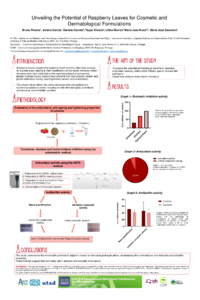
Raspberry leaves, despite their potential health benefits, often face wastage on a global scale, leading to their classification as bio-waste. However, recent advancements have shed light on the significant bioactive compounds present in these leaves. Studies have unveiled their high phenolic content and potent antioxidant activity, sparking interest across various industries. Indeed, the present study delves into recent advancements and applications concerning raspberry leaves, focusing on their dermatological, antioxidant, antimicrobial, and antibiofilm activities. The primary aims are to explore the potential dermatological benefits of raspberry, antioxidant capacity, antimicrobial efficacy against relevant skin pathogens, and their ability to hinder biofilm formation. The findings reveal notable properties: a total antioxidant activity of 93.5%±0.12, a complete inhibition of hyaluronidase activity (100%), 69.4%±2.7 suppression of elastase, and 30.0%±5.9 attenuation of tyrosinase. Moreover, the antibiofilm results exhibit substantial inhibitory effects, with a mass quantification inhibition rate of 51 % against Cutibacterium acnes, and 42% against Staphylococcus aureus, accompanied by 41 % and 41 % suppression of their respective metabolic activities.
This study underscores the remarkable potential of raspberry leaves for dermatological applications, emphasizing their antioxidative, antimicrobial, and antibiofilm properties. These findings suggest their promising role in skincare and cosmetic formulations
Keywords
antioxidant activity
raspberry
dermocosmetics
antimicrobial activity
antibiofilm properties
Manuscript
ECM_abstract_BrunaPereira_JG.pdf
Poster
ECM Poster framboesa Bruna.pdf
Potential use of Euphorbia hirta and Euphorbia jolkinii extracts as antimicrobial agents against three clinical bacteria Indicate the species: Pseudomonas aeruginosa, Morganella morganii, and Klebsiella pneumoniae
Honey Antibiofilm Effectiveness Against Multidrug-resistant Bacteria Isolated from Chronic Wound Infections.