Event submissions
Published
This submission belongs to the session S3. Antimicrobial Agents and Resistance of the event The 2nd International Electronic Conference on Microbiology
Published date
30 Nov, 2023
Academic Editor
'%3e%3cpath%20d='M12.6657%2010.9104C12.4185%2010.325%2012.0599%209.79327%2011.6097%209.34482C11.1609%208.89508%2010.6293%208.5365%2010.0442%208.28888C10.0389%208.28626%2010.0337%208.28495%2010.0285%208.28233C10.8446%207.69279%2011.3752%206.73249%2011.3752%205.64904C11.3752%203.8542%209.92103%202.39999%208.1262%202.39999C6.33136%202.39999%204.87715%203.8542%204.87715%205.64904C4.87715%206.73249%205.40774%207.69279%206.22393%208.28364C6.21869%208.28626%206.21345%208.28757%206.20821%208.29019C5.62129%208.5378%205.09463%208.89284%204.64265%209.34613C4.1929%209.79493%203.83432%2010.3266%203.58671%2010.9117C3.34345%2011.4845%203.21226%2012.0987%203.20023%2012.7209C3.19988%2012.7349%203.20233%2012.7488%203.20744%2012.7619C3.21255%2012.7749%203.22022%2012.7867%203.22998%2012.7968C3.23975%2012.8068%203.25142%2012.8147%203.26431%2012.8202C3.2772%2012.8256%203.29105%2012.8284%203.30504%2012.8284H4.09109C4.14874%2012.8284%204.19459%2012.7825%204.1959%2012.7262C4.2221%2011.7148%204.62823%2010.7676%205.34617%2010.0497C6.08899%209.30683%207.0755%208.89808%208.1262%208.89808C9.17689%208.89808%2010.1634%209.30683%2010.9062%2010.0497C11.6242%2010.7676%2012.0303%2011.7148%2012.0565%2012.7262C12.0578%2012.7838%2012.1037%2012.8284%2012.1613%2012.8284H12.9474C12.9613%2012.8284%2012.9752%2012.8256%2012.9881%2012.8202C13.001%2012.8147%2013.0126%2012.8068%2013.0224%2012.7968C13.0322%2012.7867%2013.0398%2012.7749%2013.0449%2012.7619C13.0501%2012.7488%2013.0525%2012.7349%2013.0522%2012.7209C13.0391%2012.0947%2012.9094%2011.4855%2012.6657%2010.9104ZM8.1262%207.9024C7.52486%207.9024%206.9589%207.6679%206.53312%207.24211C6.10733%206.81633%205.87283%206.25037%205.87283%205.64904C5.87283%205.0477%206.10733%204.48174%206.53312%204.05596C6.9589%203.63018%207.52486%203.39567%208.1262%203.39567C8.72753%203.39567%209.29349%203.63018%209.71927%204.05596C10.1451%204.48174%2010.3796%205.0477%2010.3796%205.64904C10.3796%206.25037%2010.1451%206.81633%209.71927%207.24211C9.29349%207.6679%208.72753%207.9024%208.1262%207.9024Z'%20fill='%235D1EE1'/%3e%3c/g%3e%3c/svg%3e) Gabriela Jorge Da Silva
Gabriela Jorge Da SilvaCitation
Rita Maioto, Inês Ribeiro, Mariana Girão, Maria Carvalho, Ana Sampaio, Investigating Anti-Aspergillus Activity in Extracts from Marine Actinobacteria, in Proceedings of The 2nd International Electronic Conference on Microbiology, 1 December–15 December 2023, MDPI: Basel, Switzerland
Share
Email
Facebook
Twitter
LinkedIn
Investigating Anti-Aspergillus Activity in Extracts from Marine Actinobacteria
'%3e%3cpath%20d='M12.6647%2010.9104C12.4176%2010.325%2012.0589%209.7933%2011.6088%209.34485C11.16%208.89511%2010.6283%208.53653%2010.0432%208.28891C10.038%208.28629%2010.0327%208.28498%2010.0275%208.28236C10.8437%207.69282%2011.3743%206.73252%2011.3743%205.64907C11.3743%203.85423%209.92005%202.40002%208.12522%202.40002C6.33038%202.40002%204.87618%203.85423%204.87618%205.64907C4.87618%206.73252%205.40677%207.69282%206.22296%208.28367C6.21772%208.28629%206.21248%208.2876%206.20724%208.29022C5.62031%208.53783%205.09365%208.89287%204.64167%209.34616C4.19192%209.79496%203.83334%2010.3266%203.58573%2010.9117C3.34247%2011.4846%203.21128%2012.0987%203.19925%2012.721C3.1989%2012.735%203.20135%2012.7489%203.20646%2012.7619C3.21157%2012.7749%203.21924%2012.7868%203.22901%2012.7968C3.23877%2012.8068%203.25045%2012.8148%203.26334%2012.8202C3.27623%2012.8256%203.29007%2012.8284%203.30406%2012.8284H4.09012C4.14776%2012.8284%204.19362%2012.7825%204.19493%2012.7262C4.22113%2011.7148%204.62726%2010.7676%205.34519%2010.0497C6.08802%209.30686%207.07452%208.89811%208.12522%208.89811C9.17592%208.89811%2010.1624%209.30686%2010.9052%2010.0497C11.6232%2010.7676%2012.0293%2011.7148%2012.0555%2012.7262C12.0568%2012.7839%2012.1027%2012.8284%2012.1603%2012.8284H12.9464C12.9604%2012.8284%2012.9742%2012.8256%2012.9871%2012.8202C13%2012.8148%2013.0117%2012.8068%2013.0214%2012.7968C13.0312%2012.7868%2013.0389%2012.7749%2013.044%2012.7619C13.0491%2012.7489%2013.0515%2012.735%2013.0512%2012.721C13.0381%2012.0947%2012.9084%2011.4856%2012.6647%2010.9104ZM8.12522%207.90243C7.52388%207.90243%206.95792%207.66793%206.53214%207.24215C6.10636%206.81636%205.87185%206.2504%205.87185%205.64907C5.87185%205.04773%206.10636%204.48177%206.53214%204.05599C6.95792%203.63021%207.52388%203.3957%208.12522%203.3957C8.72655%203.3957%209.29252%203.63021%209.7183%204.05599C10.1441%204.48177%2010.3786%205.04773%2010.3786%205.64907C10.3786%206.2504%2010.1441%206.81636%209.7183%207.24215C9.29252%207.66793%208.72655%207.90243%208.12522%207.90243Z'%20fill='%235D1EE1'/%3e%3c/g%3e%3c/svg%3e)
Rita Maioto 1,2
Inês Ribeiro 3

Mariana Girão 3
Maria Carvalho 3,4

Ana Sampaio 1,2
1. Center for Research and Agro-Environmental and Biological Technologies (CITAB)
2. University of Trás-os-Montes and Alto Douro (UTAD)
3. Interdisciplinary Center of Marine and Environmental Research (CIIMAR)
4. School of Medicine and Biomedical Sciences (University of Porto)
Abstract
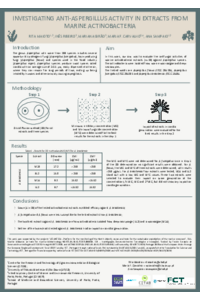
The genus Aspergillus with more than 300 species includes several opportunistic pathogenic fungi (Aspergillus fumigatus), toxin-producing fungi (Aspergillus flavus) and species used in the food industry (Aspergillus niger). Aspergillus species produce small spores called conidia with an average size of 2-3.5 µm, easily dispersed into the air, where they can remain for long periods of time, ending up being inhaled by humans and other animals, and causing aspergillosis.
In the present work extracts from marine Actinobacteria (n=30) were screened against three Aspergillus species: Aspergillus flavus ATCC 204304, Aspergillus fumigatus ATCC 204305 and Aspergillus brasiliensis ATCC 16404. For that, the disk diffusion method (DD) was performed, following the CLSI guidelines. Among the three species, the most susceptible to the extracts was A. brasiliensis. After DD, and for the best extracts, the values of minimum inhibitory/fungicide concentrations (respectively MIC and MFC) were determined. For A. flavus and A. fumigatus and for all extracts, both MIC and MCF were higher than 250 μg/mL. For A. brasiliensis only two extracts stood out, one from Actinobacteria isolated from deep-sea sponge and one from the macroalgae Laminaria ochroleuca, with MIC and MFC around 15.62 μg/mL. These two extracts were selected to evaluate their impact on spore germination at the concentrations, ½ MIC, MIC and 2*MIC, but the extracts did not show any impact on conidia germination. The tested actinobacterial extracts exhibited some efficacy against A. brasiliensis. The other species (A. fumigatus and A. flavus) were less susceptible to the tested extracts.
Keywords
Aspergillus
Marine Actinobacteria
Extracts
Manuscript
The 2nd International Electronic Conference on Microbiology.pdf
Poster
Poster_ECM_2023.pdf
Mycobacterium abscessus double-reporter strains: new tools to fight mycobacterial infections
A study on microbial mucin utilizers from healthy Indian adult human faeces