Event submissions
Published
This submission belongs to the session S8. Poster Session of the event The 2nd International Electronic Conference on Microbiology
Published date
30 Nov, 2023
Academic Editor
'%3e%3cpath%20d='M12.6657%2010.9104C12.4185%2010.325%2012.0599%209.79327%2011.6097%209.34482C11.1609%208.89508%2010.6293%208.5365%2010.0442%208.28888C10.0389%208.28626%2010.0337%208.28495%2010.0285%208.28233C10.8446%207.69279%2011.3752%206.73249%2011.3752%205.64904C11.3752%203.8542%209.92103%202.39999%208.1262%202.39999C6.33136%202.39999%204.87715%203.8542%204.87715%205.64904C4.87715%206.73249%205.40774%207.69279%206.22393%208.28364C6.21869%208.28626%206.21345%208.28757%206.20821%208.29019C5.62129%208.5378%205.09463%208.89284%204.64265%209.34613C4.1929%209.79493%203.83432%2010.3266%203.58671%2010.9117C3.34345%2011.4845%203.21226%2012.0987%203.20023%2012.7209C3.19988%2012.7349%203.20233%2012.7488%203.20744%2012.7619C3.21255%2012.7749%203.22022%2012.7867%203.22998%2012.7968C3.23975%2012.8068%203.25142%2012.8147%203.26431%2012.8202C3.2772%2012.8256%203.29105%2012.8284%203.30504%2012.8284H4.09109C4.14874%2012.8284%204.19459%2012.7825%204.1959%2012.7262C4.2221%2011.7148%204.62823%2010.7676%205.34617%2010.0497C6.08899%209.30683%207.0755%208.89808%208.1262%208.89808C9.17689%208.89808%2010.1634%209.30683%2010.9062%2010.0497C11.6242%2010.7676%2012.0303%2011.7148%2012.0565%2012.7262C12.0578%2012.7838%2012.1037%2012.8284%2012.1613%2012.8284H12.9474C12.9613%2012.8284%2012.9752%2012.8256%2012.9881%2012.8202C13.001%2012.8147%2013.0126%2012.8068%2013.0224%2012.7968C13.0322%2012.7867%2013.0398%2012.7749%2013.0449%2012.7619C13.0501%2012.7488%2013.0525%2012.7349%2013.0522%2012.7209C13.0391%2012.0947%2012.9094%2011.4855%2012.6657%2010.9104ZM8.1262%207.9024C7.52486%207.9024%206.9589%207.6679%206.53312%207.24211C6.10733%206.81633%205.87283%206.25037%205.87283%205.64904C5.87283%205.0477%206.10733%204.48174%206.53312%204.05596C6.9589%203.63018%207.52486%203.39567%208.1262%203.39567C8.72753%203.39567%209.29349%203.63018%209.71927%204.05596C10.1451%204.48174%2010.3796%205.0477%2010.3796%205.64904C10.3796%206.25037%2010.1451%206.81633%209.71927%207.24211C9.29349%207.6679%208.72753%207.9024%208.1262%207.9024Z'%20fill='%235D1EE1'/%3e%3c/g%3e%3c/svg%3e) Nico Jehmlich
Nico JehmlichCitation
Silvia Beltrami, Sabrina Rizzo, Valentina Gentili, Giovanna Schiuma, Roberta Rizzo, Daria Bortolotti, NEURODEGERATIVE ROLE OF WEST NILE VIRUS NON-STRUCTURAL PROTEIN 1: EFFECT ON TLR3 AND AMYLOID BETA EXPRESSION, in Proceedings of The 2nd International Electronic Conference on Microbiology, 1 December–15 December 2023, MDPI: Basel, Switzerland
Share
Email
Facebook
Twitter
LinkedIn
NEURODEGERATIVE ROLE OF WEST NILE VIRUS NON-STRUCTURAL PROTEIN 1: EFFECT ON TLR3 AND AMYLOID BETA EXPRESSION
'%3e%3cpath%20d='M12.6647%2010.9104C12.4176%2010.325%2012.0589%209.7933%2011.6088%209.34485C11.16%208.89511%2010.6283%208.53653%2010.0432%208.28891C10.038%208.28629%2010.0327%208.28498%2010.0275%208.28236C10.8437%207.69282%2011.3743%206.73252%2011.3743%205.64907C11.3743%203.85423%209.92005%202.40002%208.12522%202.40002C6.33038%202.40002%204.87618%203.85423%204.87618%205.64907C4.87618%206.73252%205.40677%207.69282%206.22296%208.28367C6.21772%208.28629%206.21248%208.2876%206.20724%208.29022C5.62031%208.53783%205.09365%208.89287%204.64167%209.34616C4.19192%209.79496%203.83334%2010.3266%203.58573%2010.9117C3.34247%2011.4846%203.21128%2012.0987%203.19925%2012.721C3.1989%2012.735%203.20135%2012.7489%203.20646%2012.7619C3.21157%2012.7749%203.21924%2012.7868%203.22901%2012.7968C3.23877%2012.8068%203.25045%2012.8148%203.26334%2012.8202C3.27623%2012.8256%203.29007%2012.8284%203.30406%2012.8284H4.09012C4.14776%2012.8284%204.19362%2012.7825%204.19493%2012.7262C4.22113%2011.7148%204.62726%2010.7676%205.34519%2010.0497C6.08802%209.30686%207.07452%208.89811%208.12522%208.89811C9.17592%208.89811%2010.1624%209.30686%2010.9052%2010.0497C11.6232%2010.7676%2012.0293%2011.7148%2012.0555%2012.7262C12.0568%2012.7839%2012.1027%2012.8284%2012.1603%2012.8284H12.9464C12.9604%2012.8284%2012.9742%2012.8256%2012.9871%2012.8202C13%2012.8148%2013.0117%2012.8068%2013.0214%2012.7968C13.0312%2012.7868%2013.0389%2012.7749%2013.044%2012.7619C13.0491%2012.7489%2013.0515%2012.735%2013.0512%2012.721C13.0381%2012.0947%2012.9084%2011.4856%2012.6647%2010.9104ZM8.12522%207.90243C7.52388%207.90243%206.95792%207.66793%206.53214%207.24215C6.10636%206.81636%205.87185%206.2504%205.87185%205.64907C5.87185%205.04773%206.10636%204.48177%206.53214%204.05599C6.95792%203.63021%207.52388%203.3957%208.12522%203.3957C8.72655%203.3957%209.29252%203.63021%209.7183%204.05599C10.1441%204.48177%2010.3786%205.04773%2010.3786%205.64907C10.3786%206.2504%2010.1441%206.81636%209.7183%207.24215C9.29252%207.66793%208.72655%207.90243%208.12522%207.90243Z'%20fill='%235D1EE1'/%3e%3c/g%3e%3c/svg%3e)
Silvia Beltrami 1
Sabrina Rizzo 2
Valentina Gentili 2
Giovanna Schiuma 2

Roberta Rizzo 2

Daria Bortolotti 2
1. National Institute of Food Science and Technology, University of Agriculture Faisalabad, Pakistan
2. University of Ferrara
Abstract
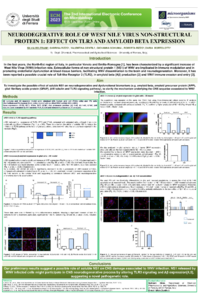
Introduction: In the last years, the North-Est region of Italy, in particular Veneto and Emilia-Romagna [1], has been characterized by a significant increase of West Nile Virus (WNV) infection rate. Neuroinvasive WNV viral infection may be linked epidemiologically and mechanistically to neurodegeneration, which have been associated with a significant prevalence of sequelae such as memory loss, confusion, and fatigue years later.
Non-structural protein 1 (NS1) is a highly conserved protein among Flaviviruses, which is actively secreted by infected cells and detected in the serum between days 3 and 8 post-infection, peaking on day 5, the day prior to the onset of clinical disease. Extracellular forms of NS1 are implicated in immune modulation and in promoting endothelial dysfunction at blood-tissue barriers, facilitating WNV dissemination to the brain and affecting disease outcomes.
Aim: Focusing on the recently discovered antimicrobial roles of amyloid beta [2], we connected WNV late pathology to overlapping features encountered in neurodegenerative diseases such as Alzheimer’s disease. We aimed to investigate the possible effect of soluble NS1 on neurodegenerative and dysfunctional biomarkers (e.g. amyloid beta (Aβ), total and phosphorylated tau protein (p-tau), alpha-synuclein (α-syn), transactive response (TAR) DNA-binding protein 43 (TDP-43), prion protein (PrPSc), neurofilament light chains (NFL)) expression in neuronal cells (neurons, oligodendrocytes, and microglia), to clarify the mechanism underlying the CNS sequelae associated to WNV infection.
Methods: 2D cultures and 3D neuronal model were obtained with iPS (Induced Pluripotent Stem) cells and treated with purified WNV NS1. The mRNA and proteomic profiles were evaluated.
Results: We observed the ability of soluble NS1 to affect the expression of neurodegenerative and dysfunctional biomarkers. In particular, NS1 induced Aβ altered expression via TLR3, an endosomal Pathogen Pattern Receptors (PPRs) involved in RNA viruses sensing [3].
Conclusion: Our preliminary results suggest a possible role of soluble NS1 on CNS damage associated to WNV infection. Interestingly, TLR3 increased expression has been found associated to Aβ plaque in AD brains [4] and Aβ itself stimulates TLRs expression, prompting the neurodegeneration [5]. NS1 released by WNV infected cells might participate in CNS neurodegenerative process by altering TLR3 signaling and Aβ expression, suggesting a novel pathogenetic role.
References
- Ricco, M., et al., West Nile Virus Infection: A Cross-Sectional Study on Italian Medical Professionals during Summer Season 2022. Trop Med Infect Dis, 2022. 7(12).
- Bortolotti, D., et al., HHV-6A infection induces amyloid-beta expression and activation of microglial cells. Alzheimers Res Ther, 2019. 11(1): p. 104.
- Wang, T., et al., Toll-like receptor 3 mediates West Nile virus entry into the brain causing lethal encephalitis. Nat Med, 2004. 10(12): p. 1366-73.
- Walker, D.G., T.M. Tang, and L.F. Lue, Increased expression of toll-like receptor 3, an anti-viral signaling molecule, and related genes in Alzheimer's disease brains. Exp Neurol, 2018. 309: p. 91-106.
- Caldeira, C., et al., Key Aging-Associated Alterations in Primary Microglia Response to Beta-Amyloid Stimulation. Front Aging Neurosci, 2017. 9: p. 277.
Keywords
West Nile Virus
amyloid beta
NS1
TLR3
neurodegeneration
Manuscript
blsf-sciforum_079948_original_Abstract_Silvia_Beltrami-done.pdf
Poster
poster Silvia Beltrami Sciforum 2023 definitivo.pdf
A study on microbial mucin utilizers from healthy Indian adult human faeces
Isolation and characterization of Enterococcus spp. from animal settings: surveillance for antimicrobial resistance