Event submissions
Published
This submission belongs to the session S3. Antimicrobial Agents and Resistance of the event The 2nd International Electronic Conference on Microbiology
Published date
30 Nov, 2023
Academic Editor
'%3e%3cpath%20d='M12.6657%2010.9104C12.4185%2010.325%2012.0599%209.79327%2011.6097%209.34482C11.1609%208.89508%2010.6293%208.5365%2010.0442%208.28888C10.0389%208.28626%2010.0337%208.28495%2010.0285%208.28233C10.8446%207.69279%2011.3752%206.73249%2011.3752%205.64904C11.3752%203.8542%209.92103%202.39999%208.1262%202.39999C6.33136%202.39999%204.87715%203.8542%204.87715%205.64904C4.87715%206.73249%205.40774%207.69279%206.22393%208.28364C6.21869%208.28626%206.21345%208.28757%206.20821%208.29019C5.62129%208.5378%205.09463%208.89284%204.64265%209.34613C4.1929%209.79493%203.83432%2010.3266%203.58671%2010.9117C3.34345%2011.4845%203.21226%2012.0987%203.20023%2012.7209C3.19988%2012.7349%203.20233%2012.7488%203.20744%2012.7619C3.21255%2012.7749%203.22022%2012.7867%203.22998%2012.7968C3.23975%2012.8068%203.25142%2012.8147%203.26431%2012.8202C3.2772%2012.8256%203.29105%2012.8284%203.30504%2012.8284H4.09109C4.14874%2012.8284%204.19459%2012.7825%204.1959%2012.7262C4.2221%2011.7148%204.62823%2010.7676%205.34617%2010.0497C6.08899%209.30683%207.0755%208.89808%208.1262%208.89808C9.17689%208.89808%2010.1634%209.30683%2010.9062%2010.0497C11.6242%2010.7676%2012.0303%2011.7148%2012.0565%2012.7262C12.0578%2012.7838%2012.1037%2012.8284%2012.1613%2012.8284H12.9474C12.9613%2012.8284%2012.9752%2012.8256%2012.9881%2012.8202C13.001%2012.8147%2013.0126%2012.8068%2013.0224%2012.7968C13.0322%2012.7867%2013.0398%2012.7749%2013.0449%2012.7619C13.0501%2012.7488%2013.0525%2012.7349%2013.0522%2012.7209C13.0391%2012.0947%2012.9094%2011.4855%2012.6657%2010.9104ZM8.1262%207.9024C7.52486%207.9024%206.9589%207.6679%206.53312%207.24211C6.10733%206.81633%205.87283%206.25037%205.87283%205.64904C5.87283%205.0477%206.10733%204.48174%206.53312%204.05596C6.9589%203.63018%207.52486%203.39567%208.1262%203.39567C8.72753%203.39567%209.29349%203.63018%209.71927%204.05596C10.1451%204.48174%2010.3796%205.0477%2010.3796%205.64904C10.3796%206.25037%2010.1451%206.81633%209.71927%207.24211C9.29349%207.6679%208.72753%207.9024%208.1262%207.9024Z'%20fill='%235D1EE1'/%3e%3c/g%3e%3c/svg%3e) Gabriela Jorge Da Silva
Gabriela Jorge Da SilvaCitation
Daniel Pinto, Joana Monteiro Marques, Teresa Barreto-Crespo, Teresa Semedo-Lemsaddek, Isolation and characterization of Enterococcus spp. from animal settings: surveillance for antimicrobial resistance, in Proceedings of The 2nd International Electronic Conference on Microbiology, 1 December–15 December 2023, MDPI: Basel, Switzerland
Share
Email
Facebook
Twitter
LinkedIn
Isolation and characterization of Enterococcus spp. from animal settings: surveillance for antimicrobial resistance
'%3e%3cpath%20d='M12.6647%2010.9104C12.4176%2010.325%2012.0589%209.7933%2011.6088%209.34485C11.16%208.89511%2010.6283%208.53653%2010.0432%208.28891C10.038%208.28629%2010.0327%208.28498%2010.0275%208.28236C10.8437%207.69282%2011.3743%206.73252%2011.3743%205.64907C11.3743%203.85423%209.92005%202.40002%208.12522%202.40002C6.33038%202.40002%204.87618%203.85423%204.87618%205.64907C4.87618%206.73252%205.40677%207.69282%206.22296%208.28367C6.21772%208.28629%206.21248%208.2876%206.20724%208.29022C5.62031%208.53783%205.09365%208.89287%204.64167%209.34616C4.19192%209.79496%203.83334%2010.3266%203.58573%2010.9117C3.34247%2011.4846%203.21128%2012.0987%203.19925%2012.721C3.1989%2012.735%203.20135%2012.7489%203.20646%2012.7619C3.21157%2012.7749%203.21924%2012.7868%203.22901%2012.7968C3.23877%2012.8068%203.25045%2012.8148%203.26334%2012.8202C3.27623%2012.8256%203.29007%2012.8284%203.30406%2012.8284H4.09012C4.14776%2012.8284%204.19362%2012.7825%204.19493%2012.7262C4.22113%2011.7148%204.62726%2010.7676%205.34519%2010.0497C6.08802%209.30686%207.07452%208.89811%208.12522%208.89811C9.17592%208.89811%2010.1624%209.30686%2010.9052%2010.0497C11.6232%2010.7676%2012.0293%2011.7148%2012.0555%2012.7262C12.0568%2012.7839%2012.1027%2012.8284%2012.1603%2012.8284H12.9464C12.9604%2012.8284%2012.9742%2012.8256%2012.9871%2012.8202C13%2012.8148%2013.0117%2012.8068%2013.0214%2012.7968C13.0312%2012.7868%2013.0389%2012.7749%2013.044%2012.7619C13.0491%2012.7489%2013.0515%2012.735%2013.0512%2012.721C13.0381%2012.0947%2012.9084%2011.4856%2012.6647%2010.9104ZM8.12522%207.90243C7.52388%207.90243%206.95792%207.66793%206.53214%207.24215C6.10636%206.81636%205.87185%206.2504%205.87185%205.64907C5.87185%205.04773%206.10636%204.48177%206.53214%204.05599C6.95792%203.63021%207.52388%203.3957%208.12522%203.3957C8.72655%203.3957%209.29252%203.63021%209.7183%204.05599C10.1441%204.48177%2010.3786%205.04773%2010.3786%205.64907C10.3786%206.2504%2010.1441%206.81636%209.7183%207.24215C9.29252%207.66793%208.72655%207.90243%208.12522%207.90243Z'%20fill='%235D1EE1'/%3e%3c/g%3e%3c/svg%3e)
Daniel Pinto 1,2
Joana Monteiro Marques 1,2
Teresa Barreto-Crespo 3,4

Teresa Semedo-Lemsaddek 1,2
1. Centre for Interdisciplinary Research in Animal Health (CIISA), Faculty of Veterinary Medicine, University of
Lisbon, Av. da Universidade Técnica de Lisboa, 1300-477 Lisbon, Portugal
2. Associate Laboratory for Animal and Veterinary Sciences (AL4AnimalS), 1300-477 Lisbon, Portugal
3. iBET - Institute of Experimental Biology and Technology, 2781-901 Oeiras, Portugal
4. ITQB NOVA – Instituto de Tecnologia Química e Biológica António Xavier, Universidade Nova de Lisboa, Avenida da República, 2780-157 Oeiras, Portugal
Abstract
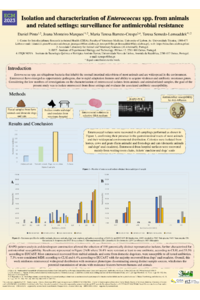
Enterococcus spp. are ubiquitous bacteria that inhabit the normal intestinal microbiota of most animals and are widespread in the environment. Enterococci have emerged as opportunistic pathogens, due to rapid adaptation features and ability to acquire virulence and antibiotic resistance genes. Considering the low numbers of investigations on the characterization of enterococcal isolates from animals and animal-related samples, the goal of the present study was to isolate enterococci from those settings and evaluate the associated antibiotic susceptibility.
Briefly, enterococci were isolated from faecal samples of stabled animals (horses, cows, and goats), healthy domestic cats and dogs, and from surface swabs and dogs’ anal exudates at a veterinary teaching hospital. Each sample was spread-plated in enterococcal selective media, Slanetz and Bartley agar, with/without vancomycin supplementation. Subsequently, 20% of the characteristic colonies were selected, submitted to DNA extraction and genetic comparison using RAPD-PCR. RAPD-pattern analysis and dendrogram construction allowed the selection of 110 genomically distinct representative isolates, further characterized for antibiotic susceptibility.
Regarding the results, around 3% were found to be vancomycin-resistant (two from goat and one from a domestic cat), while 10% were considered multidrug-resistant (isolates from one goat, one dogs’ scale, 1 tickets’ machine and 8 dogs’ anal exudates). Most enterococci recovered from stabled animals, and some from domestic dogs/cats, were classified as susceptible to all tested antibiotics.
Overall, relevant antibiotic resistances were detected, and resistance phenotypes were found to be disseminated among distinct sample sources.
Keywords
Enterococcus
animals
environment
antibiotic resistance
genetic lineages
Manuscript
ECM_2023_Abstract.pdf
Poster
ECM_2023_Poster.pdf
NEURODEGERATIVE ROLE OF WEST NILE VIRUS NON-STRUCTURAL PROTEIN 1: EFFECT ON TLR3 AND AMYLOID BETA EXPRESSION
Enterococcal community in traditional PDO cheeses: a roadmap on antibiotic resistance over the years