Event submissions
Published
This submission belongs to the session S8. Poster Session of the event The 2nd International Electronic Conference on Microbiology
Published date
30 Nov, 2023
Academic Editor
'%3e%3cpath%20d='M12.6657%2010.9104C12.4185%2010.325%2012.0599%209.79327%2011.6097%209.34482C11.1609%208.89508%2010.6293%208.5365%2010.0442%208.28888C10.0389%208.28626%2010.0337%208.28495%2010.0285%208.28233C10.8446%207.69279%2011.3752%206.73249%2011.3752%205.64904C11.3752%203.8542%209.92103%202.39999%208.1262%202.39999C6.33136%202.39999%204.87715%203.8542%204.87715%205.64904C4.87715%206.73249%205.40774%207.69279%206.22393%208.28364C6.21869%208.28626%206.21345%208.28757%206.20821%208.29019C5.62129%208.5378%205.09463%208.89284%204.64265%209.34613C4.1929%209.79493%203.83432%2010.3266%203.58671%2010.9117C3.34345%2011.4845%203.21226%2012.0987%203.20023%2012.7209C3.19988%2012.7349%203.20233%2012.7488%203.20744%2012.7619C3.21255%2012.7749%203.22022%2012.7867%203.22998%2012.7968C3.23975%2012.8068%203.25142%2012.8147%203.26431%2012.8202C3.2772%2012.8256%203.29105%2012.8284%203.30504%2012.8284H4.09109C4.14874%2012.8284%204.19459%2012.7825%204.1959%2012.7262C4.2221%2011.7148%204.62823%2010.7676%205.34617%2010.0497C6.08899%209.30683%207.0755%208.89808%208.1262%208.89808C9.17689%208.89808%2010.1634%209.30683%2010.9062%2010.0497C11.6242%2010.7676%2012.0303%2011.7148%2012.0565%2012.7262C12.0578%2012.7838%2012.1037%2012.8284%2012.1613%2012.8284H12.9474C12.9613%2012.8284%2012.9752%2012.8256%2012.9881%2012.8202C13.001%2012.8147%2013.0126%2012.8068%2013.0224%2012.7968C13.0322%2012.7867%2013.0398%2012.7749%2013.0449%2012.7619C13.0501%2012.7488%2013.0525%2012.7349%2013.0522%2012.7209C13.0391%2012.0947%2012.9094%2011.4855%2012.6657%2010.9104ZM8.1262%207.9024C7.52486%207.9024%206.9589%207.6679%206.53312%207.24211C6.10733%206.81633%205.87283%206.25037%205.87283%205.64904C5.87283%205.0477%206.10733%204.48174%206.53312%204.05596C6.9589%203.63018%207.52486%203.39567%208.1262%203.39567C8.72753%203.39567%209.29349%203.63018%209.71927%204.05596C10.1451%204.48174%2010.3796%205.0477%2010.3796%205.64904C10.3796%206.25037%2010.1451%206.81633%209.71927%207.24211C9.29349%207.6679%208.72753%207.9024%208.1262%207.9024Z'%20fill='%235D1EE1'/%3e%3c/g%3e%3c/svg%3e) Nico Jehmlich
Nico JehmlichCitation
Susana Serrano†, Maria Vitória Ferreira †, Cinthia Alves Barroco, Maria Teresa Barreto Crespo, Teresa Semedo-Lemsaddek, Enterococcal community in traditional PDO cheeses: a roadmap on antibiotic resistance over the years, in Proceedings of The 2nd International Electronic Conference on Microbiology, 1 December–15 December 2023, MDPI: Basel, Switzerland
Share
Email
Facebook
Twitter
LinkedIn
Enterococcal community in traditional PDO cheeses: a roadmap on antibiotic resistance over the years
'%3e%3cpath%20d='M12.6647%2010.9104C12.4176%2010.325%2012.0589%209.7933%2011.6088%209.34485C11.16%208.89511%2010.6283%208.53653%2010.0432%208.28891C10.038%208.28629%2010.0327%208.28498%2010.0275%208.28236C10.8437%207.69282%2011.3743%206.73252%2011.3743%205.64907C11.3743%203.85423%209.92005%202.40002%208.12522%202.40002C6.33038%202.40002%204.87618%203.85423%204.87618%205.64907C4.87618%206.73252%205.40677%207.69282%206.22296%208.28367C6.21772%208.28629%206.21248%208.2876%206.20724%208.29022C5.62031%208.53783%205.09365%208.89287%204.64167%209.34616C4.19192%209.79496%203.83334%2010.3266%203.58573%2010.9117C3.34247%2011.4846%203.21128%2012.0987%203.19925%2012.721C3.1989%2012.735%203.20135%2012.7489%203.20646%2012.7619C3.21157%2012.7749%203.21924%2012.7868%203.22901%2012.7968C3.23877%2012.8068%203.25045%2012.8148%203.26334%2012.8202C3.27623%2012.8256%203.29007%2012.8284%203.30406%2012.8284H4.09012C4.14776%2012.8284%204.19362%2012.7825%204.19493%2012.7262C4.22113%2011.7148%204.62726%2010.7676%205.34519%2010.0497C6.08802%209.30686%207.07452%208.89811%208.12522%208.89811C9.17592%208.89811%2010.1624%209.30686%2010.9052%2010.0497C11.6232%2010.7676%2012.0293%2011.7148%2012.0555%2012.7262C12.0568%2012.7839%2012.1027%2012.8284%2012.1603%2012.8284H12.9464C12.9604%2012.8284%2012.9742%2012.8256%2012.9871%2012.8202C13%2012.8148%2013.0117%2012.8068%2013.0214%2012.7968C13.0312%2012.7868%2013.0389%2012.7749%2013.044%2012.7619C13.0491%2012.7489%2013.0515%2012.735%2013.0512%2012.721C13.0381%2012.0947%2012.9084%2011.4856%2012.6647%2010.9104ZM8.12522%207.90243C7.52388%207.90243%206.95792%207.66793%206.53214%207.24215C6.10636%206.81636%205.87185%206.2504%205.87185%205.64907C5.87185%205.04773%206.10636%204.48177%206.53214%204.05599C6.95792%203.63021%207.52388%203.3957%208.12522%203.3957C8.72655%203.3957%209.29252%203.63021%209.7183%204.05599C10.1441%204.48177%2010.3786%205.04773%2010.3786%205.64907C10.3786%206.2504%2010.1441%206.81636%209.7183%207.24215C9.29252%207.66793%208.72655%207.90243%208.12522%207.90243Z'%20fill='%235D1EE1'/%3e%3c/g%3e%3c/svg%3e)
Susana Serrano† 1,2
Maria Vitória Ferreira † 3
Cinthia Alves Barroco 4,5
Maria Teresa Barreto Crespo 6,7

Teresa Semedo-Lemsaddek 4,5
1. CIISA - Center for Interdisciplinary Research in Animal Health, Faculty of Veterinary Medicine
2. Associate Laboratory for Animal and Veterinary Sciences (AL4AnimalS)
3. Faculty of Sciences (FCUL), University of Lisbon, Portugal.
4. CIISA – Centre for Interdisciplinary Research in Animal Health, Faculty of Veterinary Medicine, University of Lisbon, Lisbon, Portugal.
5. Associate Laboratory for Animal and Veterinary Sciences (AL4AnimalS).
6. IBET, Institute of Experimental Biology and Technology, PO box 12, 2781-901 Oeiras, Portugal.
7. ITQB, Institute of Chemical and Biological Technology António Xavier, Nova University of Lisbon, Republic Avenue, 2780-157 Oeiras, Portugal.
Abstract
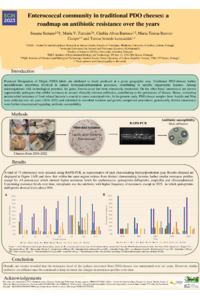
Protected Designation of Origin (PDO) labels are attributed to foods produced at a given geographic area. Traditional PDO-cheeses harbor autochthonous microbiota involved in natural fermentation/maturation processes, contributing to specific organoleptic features. Among microorganisms with technological potential, the genus Enterococcus has been extensively researched. On the other hand, enterococci are known opportunistic pathogens that exhibit resistance to several clinically relevant antibiotics, contributing to the persistence of the disease. Hence, evaluating antimicrobial resistance of food-related bacteria is crucial to assess associated risks. In the present study, PDO-cheese samples from Portugal were collected over six years (2016-2022) and submitted to microbial isolation procedures; genomically distinct enterococci were further characterized regarding antibiotic susceptibility.
Overall, a total of 73 enterococci (selected based on RAPD-patterns from a larger microbial collection) were screened by susceptibility testing, using various antibiotics representing distinct drug classes and bacterial targets.
Resistance levels among the cheese enterococci were as follows: quinupristin/dalfopristin (92%), streptomycin (74%), and tetracycline (71%), while lower levels of resistance (<10%) were observed for ampicillin, erythromycin, chloramphenicol, ciprofloxacin, norfloxacin, and vancomycin. All the isolates were sensitive to gentamicin and linezolid, but approximately 16% showed a multidrug-resistant (MDR) phenotype. No statistically significant differences were observed in antibiotic resistance patterns among enterococci recovered from cheeses produced in different years (p<0.05).
In conclusion, our results revealed that the resistance level of the isolates recovered from PDO-cheeses was maintained over six years. However, the presence of MDR-enterococci constitutes a matter of concern and further emphasizes the need for active surveillance procedures.
Keywords
Traditional cheese
Enterococcus
antibiotic resistance
multidrug-resistant (MDR).
Manuscript
Abstract conferencia online 25 de agosto_MV_Final.pdf
Poster
Póster - Enterococcal community in traditional PDO cheeses.pdf
Isolation and characterization of Enterococcus spp. from animal settings: surveillance for antimicrobial resistance
NATURAL KILLER CELLS IN SARS-COV-2-VACCINATED SUBJECTS WITH INCREASED EFFECTOR CYTOTOXIC CD56DIM CELLS AND MEMORY-LIKE CD57+NKG2C+CD56DIM CELLS.