Event submissions
Published
This submission belongs to the session S8. Poster Session of the event The 2nd International Electronic Conference on Microbiology
Published date
30 Nov, 2023
Academic Editor
'%3e%3cpath%20d='M12.6657%2010.9104C12.4185%2010.325%2012.0599%209.79327%2011.6097%209.34482C11.1609%208.89508%2010.6293%208.5365%2010.0442%208.28888C10.0389%208.28626%2010.0337%208.28495%2010.0285%208.28233C10.8446%207.69279%2011.3752%206.73249%2011.3752%205.64904C11.3752%203.8542%209.92103%202.39999%208.1262%202.39999C6.33136%202.39999%204.87715%203.8542%204.87715%205.64904C4.87715%206.73249%205.40774%207.69279%206.22393%208.28364C6.21869%208.28626%206.21345%208.28757%206.20821%208.29019C5.62129%208.5378%205.09463%208.89284%204.64265%209.34613C4.1929%209.79493%203.83432%2010.3266%203.58671%2010.9117C3.34345%2011.4845%203.21226%2012.0987%203.20023%2012.7209C3.19988%2012.7349%203.20233%2012.7488%203.20744%2012.7619C3.21255%2012.7749%203.22022%2012.7867%203.22998%2012.7968C3.23975%2012.8068%203.25142%2012.8147%203.26431%2012.8202C3.2772%2012.8256%203.29105%2012.8284%203.30504%2012.8284H4.09109C4.14874%2012.8284%204.19459%2012.7825%204.1959%2012.7262C4.2221%2011.7148%204.62823%2010.7676%205.34617%2010.0497C6.08899%209.30683%207.0755%208.89808%208.1262%208.89808C9.17689%208.89808%2010.1634%209.30683%2010.9062%2010.0497C11.6242%2010.7676%2012.0303%2011.7148%2012.0565%2012.7262C12.0578%2012.7838%2012.1037%2012.8284%2012.1613%2012.8284H12.9474C12.9613%2012.8284%2012.9752%2012.8256%2012.9881%2012.8202C13.001%2012.8147%2013.0126%2012.8068%2013.0224%2012.7968C13.0322%2012.7867%2013.0398%2012.7749%2013.0449%2012.7619C13.0501%2012.7488%2013.0525%2012.7349%2013.0522%2012.7209C13.0391%2012.0947%2012.9094%2011.4855%2012.6657%2010.9104ZM8.1262%207.9024C7.52486%207.9024%206.9589%207.6679%206.53312%207.24211C6.10733%206.81633%205.87283%206.25037%205.87283%205.64904C5.87283%205.0477%206.10733%204.48174%206.53312%204.05596C6.9589%203.63018%207.52486%203.39567%208.1262%203.39567C8.72753%203.39567%209.29349%203.63018%209.71927%204.05596C10.1451%204.48174%2010.3796%205.0477%2010.3796%205.64904C10.3796%206.25037%2010.1451%206.81633%209.71927%207.24211C9.29349%207.6679%208.72753%207.9024%208.1262%207.9024Z'%20fill='%235D1EE1'/%3e%3c/g%3e%3c/svg%3e) Nico Jehmlich
Nico JehmlichCitation
Michela Galgano, Daniela Mrenoshki, Francesco Pellegrini, Alessio Sposato, Laura Del Sambro, Loredana Capozzi, Angelica Bianco, Lisa Eramo, Giulia Schino, Elisabetta Catalano, Alessio Buonavoglia, Annamaria Pratelli, Antonio Parisi, Antimicrobial effects of Thyme Essential Oil (Thymus vulgaris) in combination with Sodium Hypochlorite (NaOCl), in Proceedings of The 2nd International Electronic Conference on Microbiology, 1 December–15 December 2023, MDPI: Basel, Switzerland
Share
Email
Facebook
Twitter
LinkedIn
Antimicrobial effects of Thyme Essential Oil (Thymus vulgaris) in combination with Sodium Hypochlorite (NaOCl)
'%3e%3cpath%20d='M12.6647%2010.9104C12.4176%2010.325%2012.0589%209.7933%2011.6088%209.34485C11.16%208.89511%2010.6283%208.53653%2010.0432%208.28891C10.038%208.28629%2010.0327%208.28498%2010.0275%208.28236C10.8437%207.69282%2011.3743%206.73252%2011.3743%205.64907C11.3743%203.85423%209.92005%202.40002%208.12522%202.40002C6.33038%202.40002%204.87618%203.85423%204.87618%205.64907C4.87618%206.73252%205.40677%207.69282%206.22296%208.28367C6.21772%208.28629%206.21248%208.2876%206.20724%208.29022C5.62031%208.53783%205.09365%208.89287%204.64167%209.34616C4.19192%209.79496%203.83334%2010.3266%203.58573%2010.9117C3.34247%2011.4846%203.21128%2012.0987%203.19925%2012.721C3.1989%2012.735%203.20135%2012.7489%203.20646%2012.7619C3.21157%2012.7749%203.21924%2012.7868%203.22901%2012.7968C3.23877%2012.8068%203.25045%2012.8148%203.26334%2012.8202C3.27623%2012.8256%203.29007%2012.8284%203.30406%2012.8284H4.09012C4.14776%2012.8284%204.19362%2012.7825%204.19493%2012.7262C4.22113%2011.7148%204.62726%2010.7676%205.34519%2010.0497C6.08802%209.30686%207.07452%208.89811%208.12522%208.89811C9.17592%208.89811%2010.1624%209.30686%2010.9052%2010.0497C11.6232%2010.7676%2012.0293%2011.7148%2012.0555%2012.7262C12.0568%2012.7839%2012.1027%2012.8284%2012.1603%2012.8284H12.9464C12.9604%2012.8284%2012.9742%2012.8256%2012.9871%2012.8202C13%2012.8148%2013.0117%2012.8068%2013.0214%2012.7968C13.0312%2012.7868%2013.0389%2012.7749%2013.044%2012.7619C13.0491%2012.7489%2013.0515%2012.735%2013.0512%2012.721C13.0381%2012.0947%2012.9084%2011.4856%2012.6647%2010.9104ZM8.12522%207.90243C7.52388%207.90243%206.95792%207.66793%206.53214%207.24215C6.10636%206.81636%205.87185%206.2504%205.87185%205.64907C5.87185%205.04773%206.10636%204.48177%206.53214%204.05599C6.95792%203.63021%207.52388%203.3957%208.12522%203.3957C8.72655%203.3957%209.29252%203.63021%209.7183%204.05599C10.1441%204.48177%2010.3786%205.04773%2010.3786%205.64907C10.3786%206.2504%2010.1441%206.81636%209.7183%207.24215C9.29252%207.66793%208.72655%207.90243%208.12522%207.90243Z'%20fill='%235D1EE1'/%3e%3c/g%3e%3c/svg%3e)
Michela Galgano 1
Daniela Mrenoshki 2
Francesco Pellegrini 2
Alessio Sposato 1,3
Laura Del Sambro 1
Loredana Capozzi 1
Angelica Bianco 1
Lisa Eramo 1
Giulia Schino 1
Elisabetta Catalano 1
Alessio Buonavoglia 4

Annamaria Pratelli 2
Antonio Parisi 1
1. Experimental Zooprophylactic Institute of Apulia and Basilicata Contrada San Pietro Piturno, Putignano, 70017 Bari, Italy.
2. Department of Veterinary Medicine, University Aldo Moro of Bari, Sp Casamassima Km 3, Valenzano, 70010 Bari, Italy.
3. Department of Public Health, Experimental and Forensic Medicine, University of Pavia, via Carlo Forlanini, 27100 Pavia, Italy.
4. Department of Biomedical and Neuromotor Sciences, Dental School, Via Zamboni 33, 40126 Bologna, Italy
Abstract
Gram-positive bacteria Streptococcus mutans and Staphylococcus aureus are important pathogens responsible for infections associated with dental caries and other medical implants. Sodium hypochlorite (NaOCl) is the most commonly used solution in root canal treatments, due to its low-cost and its high antimicrobial activity against microorganisms that infect root canals. The asepsis protocols drawn up by the Italian Society of Endodontics (SIE) recommend the use of a 5% NaOCl and 80% ethanol disinfectant solution for 2min to minimize the risk of contamination of the root canal system during endodontic treatments and for root canal disinfections (1). However, if this solution comes into contact with adjacent tissues, can cause complications, with tissue reactions resulting in life-threatening type I and IV hypersensitivity reactions (2,3). Due to its cytotoxic characteristics, the effects of which are directly proportional to the concentration of NaOCl used, rapid treatment must be carried out to prevent long-term sequelae (4, 5). In light of this, the aim of this work was to evaluate the use of Thyme Essential Oil (TEO, Thymus vulgaris) in synergistic combinations with NaOCl in order to reduce the concentrations of NaOCl in oral therapies, to improve the antiseptic efficacy, and to reduce side effects.
The microbroth dilution method, validated by Vanegas et al. (6), was used to determine the antimicrobial activity of TEO (9,28mg/mL) combined with NaOCl (1%), in the presence of organic material (6% sheep blood) against reference strains, S. mutans (ATCC70061) and S. aureus (ATCC43300). Based on previous data demonstrating the antibacterial efficacy of TEO after a few minutes of contact (7), the activity of the compound (TEO and NaOCl) was evaluated against Gram + and Gram -, after 1min, 3min and 5min of contact with bacterial strains at room temperature conditions. Aliquots of each suspension were diluted (ten-fold dilutions), cultured into Plate Count Agar (PCA) plates and incubated at 37°C for 24h and 48h to monitor bacterial growth. The combination of TEO and NaOCl has demonstrated total effectiveness in inhibiting microbial growth even in the presence of organic material. Using NaOCl in combination with TEO would allow to reduce the concentration of NaOCl currently used for dental procedures by at least 4 times. Our data therefore demonstrates that essential oils may play a role in the development of new dental treatments.
Keywords
Thyme Essential Oil
Sodium Hypochlorite
Synergistic effects
Streptococcus mutans
Staphylococcus aureus
Manuscript
Galgano et al. 2023 pdf.pdf
Poster
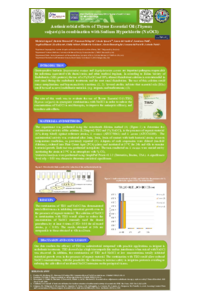
Galgano et al. 2023 - poster.pdf
NATURAL KILLER CELLS IN SARS-COV-2-VACCINATED SUBJECTS WITH INCREASED EFFECTOR CYTOTOXIC CD56DIM CELLS AND MEMORY-LIKE CD57+NKG2C+CD56DIM CELLS.
Genetic characterization of Klebsiella spp. from surface waters in the North of Portugal