Event submissions
Published
This submission belongs to the session S8. Poster Session of the event The 2nd International Electronic Conference on Microbiology
Published date
30 Nov, 2023
Academic Editor
'%3e%3cpath%20d='M12.6657%2010.9104C12.4185%2010.325%2012.0599%209.79327%2011.6097%209.34482C11.1609%208.89508%2010.6293%208.5365%2010.0442%208.28888C10.0389%208.28626%2010.0337%208.28495%2010.0285%208.28233C10.8446%207.69279%2011.3752%206.73249%2011.3752%205.64904C11.3752%203.8542%209.92103%202.39999%208.1262%202.39999C6.33136%202.39999%204.87715%203.8542%204.87715%205.64904C4.87715%206.73249%205.40774%207.69279%206.22393%208.28364C6.21869%208.28626%206.21345%208.28757%206.20821%208.29019C5.62129%208.5378%205.09463%208.89284%204.64265%209.34613C4.1929%209.79493%203.83432%2010.3266%203.58671%2010.9117C3.34345%2011.4845%203.21226%2012.0987%203.20023%2012.7209C3.19988%2012.7349%203.20233%2012.7488%203.20744%2012.7619C3.21255%2012.7749%203.22022%2012.7867%203.22998%2012.7968C3.23975%2012.8068%203.25142%2012.8147%203.26431%2012.8202C3.2772%2012.8256%203.29105%2012.8284%203.30504%2012.8284H4.09109C4.14874%2012.8284%204.19459%2012.7825%204.1959%2012.7262C4.2221%2011.7148%204.62823%2010.7676%205.34617%2010.0497C6.08899%209.30683%207.0755%208.89808%208.1262%208.89808C9.17689%208.89808%2010.1634%209.30683%2010.9062%2010.0497C11.6242%2010.7676%2012.0303%2011.7148%2012.0565%2012.7262C12.0578%2012.7838%2012.1037%2012.8284%2012.1613%2012.8284H12.9474C12.9613%2012.8284%2012.9752%2012.8256%2012.9881%2012.8202C13.001%2012.8147%2013.0126%2012.8068%2013.0224%2012.7968C13.0322%2012.7867%2013.0398%2012.7749%2013.0449%2012.7619C13.0501%2012.7488%2013.0525%2012.7349%2013.0522%2012.7209C13.0391%2012.0947%2012.9094%2011.4855%2012.6657%2010.9104ZM8.1262%207.9024C7.52486%207.9024%206.9589%207.6679%206.53312%207.24211C6.10733%206.81633%205.87283%206.25037%205.87283%205.64904C5.87283%205.0477%206.10733%204.48174%206.53312%204.05596C6.9589%203.63018%207.52486%203.39567%208.1262%203.39567C8.72753%203.39567%209.29349%203.63018%209.71927%204.05596C10.1451%204.48174%2010.3796%205.0477%2010.3796%205.64904C10.3796%206.25037%2010.1451%206.81633%209.71927%207.24211C9.29349%207.6679%208.72753%207.9024%208.1262%207.9024Z'%20fill='%235D1EE1'/%3e%3c/g%3e%3c/svg%3e) Nico Jehmlich
Nico JehmlichCitation
Ângela Pista, Leonor Silveira, Sara Costa, Rute Rosa, Carlota Gonçalves, Margarida Alves, Adriana Belas, Isabel Santos, Ana Lima, Joana Mota, Laurentina Pedroso, Sónia Ramos, Alexandra Nunes, Multidrug-resistant Escherichia coli and Salmonella spp. in pigs slaughtered for human consumption, a potential source for Humans?, in Proceedings of The 2nd International Electronic Conference on Microbiology, 1 December–15 December 2023, MDPI: Basel, Switzerland
Share
Email
Facebook
Twitter
LinkedIn
Multidrug-resistant Escherichia coli and Salmonella spp. in pigs slaughtered for human consumption, a potential source for Humans?
'%3e%3cpath%20d='M12.6647%2010.9104C12.4176%2010.325%2012.0589%209.7933%2011.6088%209.34485C11.16%208.89511%2010.6283%208.53653%2010.0432%208.28891C10.038%208.28629%2010.0327%208.28498%2010.0275%208.28236C10.8437%207.69282%2011.3743%206.73252%2011.3743%205.64907C11.3743%203.85423%209.92005%202.40002%208.12522%202.40002C6.33038%202.40002%204.87618%203.85423%204.87618%205.64907C4.87618%206.73252%205.40677%207.69282%206.22296%208.28367C6.21772%208.28629%206.21248%208.2876%206.20724%208.29022C5.62031%208.53783%205.09365%208.89287%204.64167%209.34616C4.19192%209.79496%203.83334%2010.3266%203.58573%2010.9117C3.34247%2011.4846%203.21128%2012.0987%203.19925%2012.721C3.1989%2012.735%203.20135%2012.7489%203.20646%2012.7619C3.21157%2012.7749%203.21924%2012.7868%203.22901%2012.7968C3.23877%2012.8068%203.25045%2012.8148%203.26334%2012.8202C3.27623%2012.8256%203.29007%2012.8284%203.30406%2012.8284H4.09012C4.14776%2012.8284%204.19362%2012.7825%204.19493%2012.7262C4.22113%2011.7148%204.62726%2010.7676%205.34519%2010.0497C6.08802%209.30686%207.07452%208.89811%208.12522%208.89811C9.17592%208.89811%2010.1624%209.30686%2010.9052%2010.0497C11.6232%2010.7676%2012.0293%2011.7148%2012.0555%2012.7262C12.0568%2012.7839%2012.1027%2012.8284%2012.1603%2012.8284H12.9464C12.9604%2012.8284%2012.9742%2012.8256%2012.9871%2012.8202C13%2012.8148%2013.0117%2012.8068%2013.0214%2012.7968C13.0312%2012.7868%2013.0389%2012.7749%2013.044%2012.7619C13.0491%2012.7489%2013.0515%2012.735%2013.0512%2012.721C13.0381%2012.0947%2012.9084%2011.4856%2012.6647%2010.9104ZM8.12522%207.90243C7.52388%207.90243%206.95792%207.66793%206.53214%207.24215C6.10636%206.81636%205.87185%206.2504%205.87185%205.64907C5.87185%205.04773%206.10636%204.48177%206.53214%204.05599C6.95792%203.63021%207.52388%203.3957%208.12522%203.3957C8.72655%203.3957%209.29252%203.63021%209.7183%204.05599C10.1441%204.48177%2010.3786%205.04773%2010.3786%205.64907C10.3786%206.2504%2010.1441%206.81636%209.7183%207.24215C9.29252%207.66793%208.72655%207.90243%208.12522%207.90243Z'%20fill='%235D1EE1'/%3e%3c/g%3e%3c/svg%3e)
Ângela Pista 1
Leonor Silveira 1
Sara Costa 2
Rute Rosa 3
Carlota Gonçalves 1
Margarida Alves 3

Adriana Belas 3
Isabel Santos 3
Ana Lima 3
Joana Mota 3
Laurentina Pedroso 3
Sónia Ramos 3
Alexandra Nunes 2,3,4
1. Reference Laboratory of Gastrointestinal Infections, Department of Infectious Diseases, Portuguese National Institute of Health
2. School of Psychology and Life Sciences, Lusófona University, Portugal
3. Faculty of Veterinary Medicine, Lusófona University, Portugal
4. Genomics and Bioinformatics Unit, Department of Infectious Diseases, Portuguese National Institute of Health
Abstract
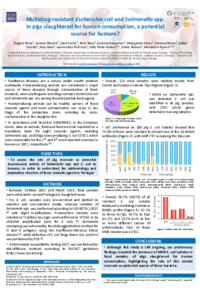
Foodborne diseases are a serious public health problem worldwide. Food‐producing animals are considered a major source of these diseases through contamination of food-products, where pathogenic and drug-resistant Escherichia coli and Salmonella spp. are among the principal bacterial agents. Here, we aimed to assess the role of pig reservoir as potential transmission vehicle to Humans, contributing for the understanding of the epidemiology and population structure of these zoonotic agents in Portugal, since data is still limited.
Fecal samples were collected in different Portuguese slaughterhouses. After bacterial isolation in non- and selective media, serotyping of Salmonella and pathotyping of E. coli isolates were performed. Antimicrobial susceptibility was tested for a sub-set, by the disk diffusion method and interpreted according to EUCAST guidelines.
Overall, 124 stool samples were studied, mostly from Centro and Lisboa e Vale do Tejo Regions. While no Salmonella spp. was detected, E. coli was identified in all pig samples, with Shiga toxin-producing E. coli (STEC) detected in two samples. For a set of 50 E. coli isolates, preliminary antimicrobial resistance results showed that, with exception of one isolate, all were resistant to at least one of the 19 tested antibiotics (mostly erythromycin), where 17 of them displayed a multidrug-resistance profile (MDR). One of these MDR isolates was a STEC.
Although this study is still ongoing, our preliminary findings revealed the presence of MDR E. coli isolates in fecal samples of pigs slaughtered for human consumption, highlighting the role of this animal reservoir as potential source of these bacteria.
Keywords
Foodborne diseases
Zoonose
Foodborne bacterial pathogens
Salmonella spp.
Escherichia coli
Antimicrobial resistance
Pigs
Food safety.
Manuscript
Poster_pigs_ANunes.pdf
Poster
Poster_pigs_ANunes.pdf
Genetic characterization of Klebsiella spp. from surface waters in the North of Portugal
Fiber-Hydrogel Sandwich-Like Composites with Improved Antimicrobial Protection