Event submissions
Published
This submission belongs to the session S2. Foodborne Pathogens and Food Safety of the event The 2nd International Electronic Conference on Microbiology
Published date
30 Nov, 2023
Academic Editor
'%3e%3cpath%20d='M12.6657%2010.9104C12.4185%2010.325%2012.0599%209.79327%2011.6097%209.34482C11.1609%208.89508%2010.6293%208.5365%2010.0442%208.28888C10.0389%208.28626%2010.0337%208.28495%2010.0285%208.28233C10.8446%207.69279%2011.3752%206.73249%2011.3752%205.64904C11.3752%203.8542%209.92103%202.39999%208.1262%202.39999C6.33136%202.39999%204.87715%203.8542%204.87715%205.64904C4.87715%206.73249%205.40774%207.69279%206.22393%208.28364C6.21869%208.28626%206.21345%208.28757%206.20821%208.29019C5.62129%208.5378%205.09463%208.89284%204.64265%209.34613C4.1929%209.79493%203.83432%2010.3266%203.58671%2010.9117C3.34345%2011.4845%203.21226%2012.0987%203.20023%2012.7209C3.19988%2012.7349%203.20233%2012.7488%203.20744%2012.7619C3.21255%2012.7749%203.22022%2012.7867%203.22998%2012.7968C3.23975%2012.8068%203.25142%2012.8147%203.26431%2012.8202C3.2772%2012.8256%203.29105%2012.8284%203.30504%2012.8284H4.09109C4.14874%2012.8284%204.19459%2012.7825%204.1959%2012.7262C4.2221%2011.7148%204.62823%2010.7676%205.34617%2010.0497C6.08899%209.30683%207.0755%208.89808%208.1262%208.89808C9.17689%208.89808%2010.1634%209.30683%2010.9062%2010.0497C11.6242%2010.7676%2012.0303%2011.7148%2012.0565%2012.7262C12.0578%2012.7838%2012.1037%2012.8284%2012.1613%2012.8284H12.9474C12.9613%2012.8284%2012.9752%2012.8256%2012.9881%2012.8202C13.001%2012.8147%2013.0126%2012.8068%2013.0224%2012.7968C13.0322%2012.7867%2013.0398%2012.7749%2013.0449%2012.7619C13.0501%2012.7488%2013.0525%2012.7349%2013.0522%2012.7209C13.0391%2012.0947%2012.9094%2011.4855%2012.6657%2010.9104ZM8.1262%207.9024C7.52486%207.9024%206.9589%207.6679%206.53312%207.24211C6.10733%206.81633%205.87283%206.25037%205.87283%205.64904C5.87283%205.0477%206.10733%204.48174%206.53312%204.05596C6.9589%203.63018%207.52486%203.39567%208.1262%203.39567C8.72753%203.39567%209.29349%203.63018%209.71927%204.05596C10.1451%204.48174%2010.3796%205.0477%2010.3796%205.64904C10.3796%206.25037%2010.1451%206.81633%209.71927%207.24211C9.29349%207.6679%208.72753%207.9024%208.1262%207.9024Z'%20fill='%235D1EE1'/%3e%3c/g%3e%3c/svg%3e) Theodoros Varzakas
Theodoros VarzakasCitation
Nkosinathi Doctor Ndlazi, Maike Claussen, Stefan Schmidt, Microbiological quality of river water used for irrigation of ready-to-eat (RTE) fresh produce by local smallholder farmers in Pietermaritzburg, South Africa, in Proceedings of The 2nd International Electronic Conference on Microbiology, 1 December–15 December 2023, MDPI: Basel, Switzerland
Share
Email
Facebook
Twitter
LinkedIn
Microbiological quality of river water used for irrigation of ready-to-eat (RTE) fresh produce by local smallholder farmers in Pietermaritzburg, South Africa
'%3e%3cpath%20d='M12.6647%2010.9104C12.4176%2010.325%2012.0589%209.7933%2011.6088%209.34485C11.16%208.89511%2010.6283%208.53653%2010.0432%208.28891C10.038%208.28629%2010.0327%208.28498%2010.0275%208.28236C10.8437%207.69282%2011.3743%206.73252%2011.3743%205.64907C11.3743%203.85423%209.92005%202.40002%208.12522%202.40002C6.33038%202.40002%204.87618%203.85423%204.87618%205.64907C4.87618%206.73252%205.40677%207.69282%206.22296%208.28367C6.21772%208.28629%206.21248%208.2876%206.20724%208.29022C5.62031%208.53783%205.09365%208.89287%204.64167%209.34616C4.19192%209.79496%203.83334%2010.3266%203.58573%2010.9117C3.34247%2011.4846%203.21128%2012.0987%203.19925%2012.721C3.1989%2012.735%203.20135%2012.7489%203.20646%2012.7619C3.21157%2012.7749%203.21924%2012.7868%203.22901%2012.7968C3.23877%2012.8068%203.25045%2012.8148%203.26334%2012.8202C3.27623%2012.8256%203.29007%2012.8284%203.30406%2012.8284H4.09012C4.14776%2012.8284%204.19362%2012.7825%204.19493%2012.7262C4.22113%2011.7148%204.62726%2010.7676%205.34519%2010.0497C6.08802%209.30686%207.07452%208.89811%208.12522%208.89811C9.17592%208.89811%2010.1624%209.30686%2010.9052%2010.0497C11.6232%2010.7676%2012.0293%2011.7148%2012.0555%2012.7262C12.0568%2012.7839%2012.1027%2012.8284%2012.1603%2012.8284H12.9464C12.9604%2012.8284%2012.9742%2012.8256%2012.9871%2012.8202C13%2012.8148%2013.0117%2012.8068%2013.0214%2012.7968C13.0312%2012.7868%2013.0389%2012.7749%2013.044%2012.7619C13.0491%2012.7489%2013.0515%2012.735%2013.0512%2012.721C13.0381%2012.0947%2012.9084%2011.4856%2012.6647%2010.9104ZM8.12522%207.90243C7.52388%207.90243%206.95792%207.66793%206.53214%207.24215C6.10636%206.81636%205.87185%206.2504%205.87185%205.64907C5.87185%205.04773%206.10636%204.48177%206.53214%204.05599C6.95792%203.63021%207.52388%203.3957%208.12522%203.3957C8.72655%203.3957%209.29252%203.63021%209.7183%204.05599C10.1441%204.48177%2010.3786%205.04773%2010.3786%205.64907C10.3786%206.2504%2010.1441%206.81636%209.7183%207.24215C9.29252%207.66793%208.72655%207.90243%208.12522%207.90243Z'%20fill='%235D1EE1'/%3e%3c/g%3e%3c/svg%3e)
Nkosinathi Doctor Ndlazi 1
Maike Claussen 1
Stefan Schmidt 1
1. Discipline of Microbiology, University of KwaZulu-Natal, Pietermaritzburg, South Africa
Abstract
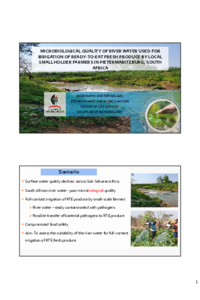
The modern diet emphasizes the consumption of ready-to-eat (RTE) or minimally processed fruits and vegetables essential for a healthy lifestyle. Ensuring the microbiological safety of these produce items is crucial given the highly susceptible Young, Old, Pregnant, and Immuno-compromised (YOPI) citizens. Contamination of fresh produce can occur through various activities from farm to fork, such as using contaminated water for overhead irrigation. This study investigated the suitability of the uMsunduzi River water over the different seasons for overhead irrigation of RTE fresh produce by local smallholder farmers. The microbial burden of river water samples was analyzed, and selected hygiene indicators were determined, including aerobic plate counts, total coliforms, fecal coliforms, Escherichia coli, Enterococcus spp., and the common foodborne pathogen Salmonella spp. The results were concerning, as the river water frequently exceeded the safe irrigation limit of 1000 MPN/100ml E. coli stipulated by the World Health Organization. The river water samples analyzed over the four seasons were generally of unsatisfactory quality, with aerobic plate counts reaching up to 6.18 log10 cfu/ml. In addition, total and fecal coliform and E. coli levels of up to 5.81 log10, 5.66 log10, and 5.23 log10 MPN/100ml were recorded, respectively. Furthermore, high counts of fecal enterococci were regularly present, while presumptive Salmonella spp. were often detected. Based on these findings, it is evident that the uMsunduzi river water is unsuitable for overhead irrigation of produce that is typically consumed raw, highlighting potential risks to food safety when such water is used for overhead irrigation.
Keywords
River water
Irrigation
Fresh produce
Total coliforms
Fecal coliforms
E. coli
Salmonella
Manuscript
Nkosinathi D. Ndlazi_Abstract.pdf
Poster
Nkosinathi D. Ndlazi_Presentation Slides.pdf
Fiber-Hydrogel Sandwich-Like Composites with Improved Antimicrobial Protection
Distribution of antimicrobial resistant lactic acid bacteria along the production of a raw ewe milk-derived cheese