Event submissions
Published
This submission belongs to the session S6. Microbial Characterization and Bioprocess of the event The 2nd International Electronic Conference on Microbiology
Published date
30 Nov, 2023
Academic Editor
'%3e%3cpath%20d='M12.6657%2010.9104C12.4185%2010.325%2012.0599%209.79327%2011.6097%209.34482C11.1609%208.89508%2010.6293%208.5365%2010.0442%208.28888C10.0389%208.28626%2010.0337%208.28495%2010.0285%208.28233C10.8446%207.69279%2011.3752%206.73249%2011.3752%205.64904C11.3752%203.8542%209.92103%202.39999%208.1262%202.39999C6.33136%202.39999%204.87715%203.8542%204.87715%205.64904C4.87715%206.73249%205.40774%207.69279%206.22393%208.28364C6.21869%208.28626%206.21345%208.28757%206.20821%208.29019C5.62129%208.5378%205.09463%208.89284%204.64265%209.34613C4.1929%209.79493%203.83432%2010.3266%203.58671%2010.9117C3.34345%2011.4845%203.21226%2012.0987%203.20023%2012.7209C3.19988%2012.7349%203.20233%2012.7488%203.20744%2012.7619C3.21255%2012.7749%203.22022%2012.7867%203.22998%2012.7968C3.23975%2012.8068%203.25142%2012.8147%203.26431%2012.8202C3.2772%2012.8256%203.29105%2012.8284%203.30504%2012.8284H4.09109C4.14874%2012.8284%204.19459%2012.7825%204.1959%2012.7262C4.2221%2011.7148%204.62823%2010.7676%205.34617%2010.0497C6.08899%209.30683%207.0755%208.89808%208.1262%208.89808C9.17689%208.89808%2010.1634%209.30683%2010.9062%2010.0497C11.6242%2010.7676%2012.0303%2011.7148%2012.0565%2012.7262C12.0578%2012.7838%2012.1037%2012.8284%2012.1613%2012.8284H12.9474C12.9613%2012.8284%2012.9752%2012.8256%2012.9881%2012.8202C13.001%2012.8147%2013.0126%2012.8068%2013.0224%2012.7968C13.0322%2012.7867%2013.0398%2012.7749%2013.0449%2012.7619C13.0501%2012.7488%2013.0525%2012.7349%2013.0522%2012.7209C13.0391%2012.0947%2012.9094%2011.4855%2012.6657%2010.9104ZM8.1262%207.9024C7.52486%207.9024%206.9589%207.6679%206.53312%207.24211C6.10733%206.81633%205.87283%206.25037%205.87283%205.64904C5.87283%205.0477%206.10733%204.48174%206.53312%204.05596C6.9589%203.63018%207.52486%203.39567%208.1262%203.39567C8.72753%203.39567%209.29349%203.63018%209.71927%204.05596C10.1451%204.48174%2010.3796%205.0477%2010.3796%205.64904C10.3796%206.25037%2010.1451%206.81633%209.71927%207.24211C9.29349%207.6679%208.72753%207.9024%208.1262%207.9024Z'%20fill='%235D1EE1'/%3e%3c/g%3e%3c/svg%3e) Maurizio Ciani
Maurizio CianiCitation
Rodrigo Martins, Constança D. F. Bertrand, Francisco Quintas-Nunes, Pedro Reynolds-Brandão, Maria Teresa B. Crespo, Francisco X. Nascimento, Characterization and Biotechnological Potential of Sixteen Marine Bacteria Associated with Algae from the Sado Estuary, in Proceedings of The 2nd International Electronic Conference on Microbiology, 1 December–15 December 2023, MDPI: Basel, Switzerland
Share
Email
Facebook
Twitter
LinkedIn
Characterization and Biotechnological Potential of Sixteen Marine Bacteria Associated with Algae from the Sado Estuary
'%3e%3cpath%20d='M12.6647%2010.9104C12.4176%2010.325%2012.0589%209.7933%2011.6088%209.34485C11.16%208.89511%2010.6283%208.53653%2010.0432%208.28891C10.038%208.28629%2010.0327%208.28498%2010.0275%208.28236C10.8437%207.69282%2011.3743%206.73252%2011.3743%205.64907C11.3743%203.85423%209.92005%202.40002%208.12522%202.40002C6.33038%202.40002%204.87618%203.85423%204.87618%205.64907C4.87618%206.73252%205.40677%207.69282%206.22296%208.28367C6.21772%208.28629%206.21248%208.2876%206.20724%208.29022C5.62031%208.53783%205.09365%208.89287%204.64167%209.34616C4.19192%209.79496%203.83334%2010.3266%203.58573%2010.9117C3.34247%2011.4846%203.21128%2012.0987%203.19925%2012.721C3.1989%2012.735%203.20135%2012.7489%203.20646%2012.7619C3.21157%2012.7749%203.21924%2012.7868%203.22901%2012.7968C3.23877%2012.8068%203.25045%2012.8148%203.26334%2012.8202C3.27623%2012.8256%203.29007%2012.8284%203.30406%2012.8284H4.09012C4.14776%2012.8284%204.19362%2012.7825%204.19493%2012.7262C4.22113%2011.7148%204.62726%2010.7676%205.34519%2010.0497C6.08802%209.30686%207.07452%208.89811%208.12522%208.89811C9.17592%208.89811%2010.1624%209.30686%2010.9052%2010.0497C11.6232%2010.7676%2012.0293%2011.7148%2012.0555%2012.7262C12.0568%2012.7839%2012.1027%2012.8284%2012.1603%2012.8284H12.9464C12.9604%2012.8284%2012.9742%2012.8256%2012.9871%2012.8202C13%2012.8148%2013.0117%2012.8068%2013.0214%2012.7968C13.0312%2012.7868%2013.0389%2012.7749%2013.044%2012.7619C13.0491%2012.7489%2013.0515%2012.735%2013.0512%2012.721C13.0381%2012.0947%2012.9084%2011.4856%2012.6647%2010.9104ZM8.12522%207.90243C7.52388%207.90243%206.95792%207.66793%206.53214%207.24215C6.10636%206.81636%205.87185%206.2504%205.87185%205.64907C5.87185%205.04773%206.10636%204.48177%206.53214%204.05599C6.95792%203.63021%207.52388%203.3957%208.12522%203.3957C8.72655%203.3957%209.29252%203.63021%209.7183%204.05599C10.1441%204.48177%2010.3786%205.04773%2010.3786%205.64907C10.3786%206.2504%2010.1441%206.81636%209.7183%207.24215C9.29252%207.66793%208.72655%207.90243%208.12522%207.90243Z'%20fill='%235D1EE1'/%3e%3c/g%3e%3c/svg%3e)
Rodrigo Martins 1
Constança D. F. Bertrand 1
Francisco Quintas-Nunes 1,2
Pedro Reynolds-Brandão 1
Maria Teresa B. Crespo 1,2

Francisco X. Nascimento 1,2
1. iBET-Instituto de Biologia Experimental e Tecnológica, 2781-901 Oeiras, Portugal.
2. ITQB NOVA, Instituto de Tecnologia Química e Biológica António Xavier, Universidade Nova de Lisboa, Av. da República, 2780-157 Oeiras, Portugal
Abstract
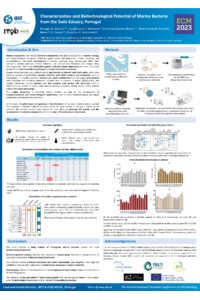
Marine environments harbour diverse and rich microbial communities presenting unique adaptations to this stressful habitat. As a result, marine bacteria developed several stress resistance mechanisms, including the ability to synthesize a wide range of bioactive molecules of biotechnological interest.
In this work, the phenotypic and genotypic characterization of sixteen marine bacteria isolated from seawater collected in diverse locations across the Sado estuary in Portugal is presented. In addition, the isolated bacteria were tested for their ability to promote the growth and the accumulation of valuable compounds in two microalgae, Phaeodactylum tricornutum and Tetraselmis striata.
The obtained results revealed that several bacterial isolates were capable of producing diverse functional and stable extracellular lytic enzymes; showed the ability to synthesize phytohormones such as auxins (indole-3-acetic acid) and produced ammonia, PHAs, as well as carotenoids. Comprehensive genomic analysis revealed the presence of gene clusters involved in the biosynthesis of a wide range of secondary metabolites such as extracellular enzymes, carotenoids, polyunsaturated fatty acids, and polyhydroxy acids in the diverse bacterial isolates.
When co-cultivated with Phaeodactylum tricornutum and Tetraselmis striata, four isolates induced a significant increase in microalgae cell count, cell size, auto-fluorescence, and fucoxanthin content, indicating their microalgae growth-promoting effects.
Ultimately, these findings bring new insights into the untapped potential of marine bacteria and their use in a vast array of biotechnological applications.
Keywords
bacteria
marine
microalgae
secondary metabolites
biotechnology
Manuscript
ECM2023 Abstract - Rodrigo Martins.pdf
Poster
ECM2023 Poster - Rodrigo Martins.pdf
Distribution of antimicrobial resistant lactic acid bacteria along the production of a raw ewe milk-derived cheese
Control of Salmonella Enteritidis on ready-to-eat fresh produce using a lytic bacteriophage