Event submissions
Published
This submission belongs to the session S8. Poster Session of the event The 2nd International Electronic Conference on Microbiology
Published date
30 Nov, 2023
Academic Editor
'%3e%3cpath%20d='M12.6657%2010.9104C12.4185%2010.325%2012.0599%209.79327%2011.6097%209.34482C11.1609%208.89508%2010.6293%208.5365%2010.0442%208.28888C10.0389%208.28626%2010.0337%208.28495%2010.0285%208.28233C10.8446%207.69279%2011.3752%206.73249%2011.3752%205.64904C11.3752%203.8542%209.92103%202.39999%208.1262%202.39999C6.33136%202.39999%204.87715%203.8542%204.87715%205.64904C4.87715%206.73249%205.40774%207.69279%206.22393%208.28364C6.21869%208.28626%206.21345%208.28757%206.20821%208.29019C5.62129%208.5378%205.09463%208.89284%204.64265%209.34613C4.1929%209.79493%203.83432%2010.3266%203.58671%2010.9117C3.34345%2011.4845%203.21226%2012.0987%203.20023%2012.7209C3.19988%2012.7349%203.20233%2012.7488%203.20744%2012.7619C3.21255%2012.7749%203.22022%2012.7867%203.22998%2012.7968C3.23975%2012.8068%203.25142%2012.8147%203.26431%2012.8202C3.2772%2012.8256%203.29105%2012.8284%203.30504%2012.8284H4.09109C4.14874%2012.8284%204.19459%2012.7825%204.1959%2012.7262C4.2221%2011.7148%204.62823%2010.7676%205.34617%2010.0497C6.08899%209.30683%207.0755%208.89808%208.1262%208.89808C9.17689%208.89808%2010.1634%209.30683%2010.9062%2010.0497C11.6242%2010.7676%2012.0303%2011.7148%2012.0565%2012.7262C12.0578%2012.7838%2012.1037%2012.8284%2012.1613%2012.8284H12.9474C12.9613%2012.8284%2012.9752%2012.8256%2012.9881%2012.8202C13.001%2012.8147%2013.0126%2012.8068%2013.0224%2012.7968C13.0322%2012.7867%2013.0398%2012.7749%2013.0449%2012.7619C13.0501%2012.7488%2013.0525%2012.7349%2013.0522%2012.7209C13.0391%2012.0947%2012.9094%2011.4855%2012.6657%2010.9104ZM8.1262%207.9024C7.52486%207.9024%206.9589%207.6679%206.53312%207.24211C6.10733%206.81633%205.87283%206.25037%205.87283%205.64904C5.87283%205.0477%206.10733%204.48174%206.53312%204.05596C6.9589%203.63018%207.52486%203.39567%208.1262%203.39567C8.72753%203.39567%209.29349%203.63018%209.71927%204.05596C10.1451%204.48174%2010.3796%205.0477%2010.3796%205.64904C10.3796%206.25037%2010.1451%206.81633%209.71927%207.24211C9.29349%207.6679%208.72753%207.9024%208.1262%207.9024Z'%20fill='%235D1EE1'/%3e%3c/g%3e%3c/svg%3e) Nico Jehmlich
Nico JehmlichCitation
Oumaima ANACHAD, Wafaa TAHA, Chaimaa SAADOUNE, Amine TAOUIL, Asmae TAHERI, Faiza BENNIS, Fatima CHEGDANI, Predictive study of metabolic pathways and biological processes induced by intestinal dysbiosis in weaned infants, in Proceedings of The 2nd International Electronic Conference on Microbiology, 1 December–15 December 2023, MDPI: Basel, Switzerland
Share
Email
Facebook
Twitter
LinkedIn
Predictive study of metabolic pathways and biological processes induced by intestinal dysbiosis in weaned infants
'%3e%3cpath%20d='M12.6647%2010.9104C12.4176%2010.325%2012.0589%209.7933%2011.6088%209.34485C11.16%208.89511%2010.6283%208.53653%2010.0432%208.28891C10.038%208.28629%2010.0327%208.28498%2010.0275%208.28236C10.8437%207.69282%2011.3743%206.73252%2011.3743%205.64907C11.3743%203.85423%209.92005%202.40002%208.12522%202.40002C6.33038%202.40002%204.87618%203.85423%204.87618%205.64907C4.87618%206.73252%205.40677%207.69282%206.22296%208.28367C6.21772%208.28629%206.21248%208.2876%206.20724%208.29022C5.62031%208.53783%205.09365%208.89287%204.64167%209.34616C4.19192%209.79496%203.83334%2010.3266%203.58573%2010.9117C3.34247%2011.4846%203.21128%2012.0987%203.19925%2012.721C3.1989%2012.735%203.20135%2012.7489%203.20646%2012.7619C3.21157%2012.7749%203.21924%2012.7868%203.22901%2012.7968C3.23877%2012.8068%203.25045%2012.8148%203.26334%2012.8202C3.27623%2012.8256%203.29007%2012.8284%203.30406%2012.8284H4.09012C4.14776%2012.8284%204.19362%2012.7825%204.19493%2012.7262C4.22113%2011.7148%204.62726%2010.7676%205.34519%2010.0497C6.08802%209.30686%207.07452%208.89811%208.12522%208.89811C9.17592%208.89811%2010.1624%209.30686%2010.9052%2010.0497C11.6232%2010.7676%2012.0293%2011.7148%2012.0555%2012.7262C12.0568%2012.7839%2012.1027%2012.8284%2012.1603%2012.8284H12.9464C12.9604%2012.8284%2012.9742%2012.8256%2012.9871%2012.8202C13%2012.8148%2013.0117%2012.8068%2013.0214%2012.7968C13.0312%2012.7868%2013.0389%2012.7749%2013.044%2012.7619C13.0491%2012.7489%2013.0515%2012.735%2013.0512%2012.721C13.0381%2012.0947%2012.9084%2011.4856%2012.6647%2010.9104ZM8.12522%207.90243C7.52388%207.90243%206.95792%207.66793%206.53214%207.24215C6.10636%206.81636%205.87185%206.2504%205.87185%205.64907C5.87185%205.04773%206.10636%204.48177%206.53214%204.05599C6.95792%203.63021%207.52388%203.3957%208.12522%203.3957C8.72655%203.3957%209.29252%203.63021%209.7183%204.05599C10.1441%204.48177%2010.3786%205.04773%2010.3786%205.64907C10.3786%206.2504%2010.1441%206.81636%209.7183%207.24215C9.29252%207.66793%208.72655%207.90243%208.12522%207.90243Z'%20fill='%235D1EE1'/%3e%3c/g%3e%3c/svg%3e)
Oumaima ANACHAD 1
Wafaa TAHA 1
Chaimaa SAADOUNE 1
Amine TAOUIL 1
Asmae TAHERI 1
Faiza BENNIS 1
Fatima CHEGDANI 1
1. Laboratory of Immunology and Biodiversity, Faculty of Sciences Aïn Chock, Hassan II University of Casablanca, Morocco
Abstract
Weaning often leads to gastrointestinal problems, irritation and diarrhea in infants. Weaning influenced by various factors, involves complex interaction axes, in particular the gut-microbiota axis. Better understanding these responses and the underlying pathways may facilitate the development of targeted therapies to attenuate the intensity of dysbiosis and consequently gut inflammation in infants.
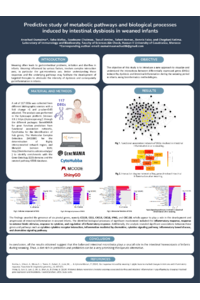
The objective of this study is to introduce a new approach to visualize and understand the interactions between differentially expressed genes (DEGs) induced by dysbiosis and intestinal inflammation during the weaning period in infants, using bioinformatics methodologies.
A set of 117 DEGs was collected from different bibliographic sources with a fold change >1 and p-value<0.05 adjusted. The analysis was performed in the Cytoscape platform (Version: 3.9.1 https://cytoscape.org/) through the different packages: GeneMANIA for gene function prediction from functional association networks, CytoHubba for the identification of hub genes, The Molecular Complex Detection (MCODE) for the determination of highly interconnected network region, and ShinyGO (version 0.65; http://bioinformatics.sdstate.edu/go/) to identify enrichments with the Gene Ontology (GO) domains and the curated pathway KEGG database.
The findings unveiled the presence of six pivotal genes, namely CCL19, CCL5, CXCL9, CXCL8, IFNG, and CXCL10, which appear to play a role in the development and progression of intestinal inflammation in weaned infants. The identified biological processes of significant involvement included the inflammatory response, response to external biotic stimulus, response to cytokine, and regulation of inflammatory response. Additionally, the analysis revealed significant associations between these genes and pathways such as cytokine-cytokine receptor interaction, inflammation mediated by chemokine, cytokine signaling pathway, inflammatory bowel disease, and chemokine signaling pathway.
In conclusion, all the results obtained suggest that the balanced intestinal microbiota plays a crucial role in the intestinal homeostasis of infants during weaning. Thus, a diet rich in prebiotics and probiotics can be a very promising therapeutic alternative.
Keywords
Weaning
Intestinal microbiota
Inflammation
DEGs interactions
prebiotic
probiotic
Manuscript
Abstract ANACHAD.pdf
Poster
Poster.pdf
Control of Salmonella Enteritidis on ready-to-eat fresh produce using a lytic bacteriophage
The influence of essential oils on Staphylococcus spp. isolated from skin microbiota