Event submissions
Published
This submission belongs to the session S8. Poster Session of the event The 2nd International Electronic Conference on Microbiology
Published date
30 Nov, 2023
Academic Editor
'%3e%3cpath%20d='M12.6657%2010.9104C12.4185%2010.325%2012.0599%209.79327%2011.6097%209.34482C11.1609%208.89508%2010.6293%208.5365%2010.0442%208.28888C10.0389%208.28626%2010.0337%208.28495%2010.0285%208.28233C10.8446%207.69279%2011.3752%206.73249%2011.3752%205.64904C11.3752%203.8542%209.92103%202.39999%208.1262%202.39999C6.33136%202.39999%204.87715%203.8542%204.87715%205.64904C4.87715%206.73249%205.40774%207.69279%206.22393%208.28364C6.21869%208.28626%206.21345%208.28757%206.20821%208.29019C5.62129%208.5378%205.09463%208.89284%204.64265%209.34613C4.1929%209.79493%203.83432%2010.3266%203.58671%2010.9117C3.34345%2011.4845%203.21226%2012.0987%203.20023%2012.7209C3.19988%2012.7349%203.20233%2012.7488%203.20744%2012.7619C3.21255%2012.7749%203.22022%2012.7867%203.22998%2012.7968C3.23975%2012.8068%203.25142%2012.8147%203.26431%2012.8202C3.2772%2012.8256%203.29105%2012.8284%203.30504%2012.8284H4.09109C4.14874%2012.8284%204.19459%2012.7825%204.1959%2012.7262C4.2221%2011.7148%204.62823%2010.7676%205.34617%2010.0497C6.08899%209.30683%207.0755%208.89808%208.1262%208.89808C9.17689%208.89808%2010.1634%209.30683%2010.9062%2010.0497C11.6242%2010.7676%2012.0303%2011.7148%2012.0565%2012.7262C12.0578%2012.7838%2012.1037%2012.8284%2012.1613%2012.8284H12.9474C12.9613%2012.8284%2012.9752%2012.8256%2012.9881%2012.8202C13.001%2012.8147%2013.0126%2012.8068%2013.0224%2012.7968C13.0322%2012.7867%2013.0398%2012.7749%2013.0449%2012.7619C13.0501%2012.7488%2013.0525%2012.7349%2013.0522%2012.7209C13.0391%2012.0947%2012.9094%2011.4855%2012.6657%2010.9104ZM8.1262%207.9024C7.52486%207.9024%206.9589%207.6679%206.53312%207.24211C6.10733%206.81633%205.87283%206.25037%205.87283%205.64904C5.87283%205.0477%206.10733%204.48174%206.53312%204.05596C6.9589%203.63018%207.52486%203.39567%208.1262%203.39567C8.72753%203.39567%209.29349%203.63018%209.71927%204.05596C10.1451%204.48174%2010.3796%205.0477%2010.3796%205.64904C10.3796%206.25037%2010.1451%206.81633%209.71927%207.24211C9.29349%207.6679%208.72753%207.9024%208.1262%207.9024Z'%20fill='%235D1EE1'/%3e%3c/g%3e%3c/svg%3e) Nico Jehmlich
Nico JehmlichCitation
Sylwia Andrzejczuk, Martyna Kasela, Dorota Pietras-Ożga, Katarzyna Michalak, Małgorzata Tomczak, Julia Ćwiklak, Urszula Kosikowska, Antistaphylococcal activity of a protein- and peptide-rich aqueous extract of Trametes versicolor, in Proceedings of The 2nd International Electronic Conference on Microbiology, 1 December–15 December 2023, MDPI: Basel, Switzerland
Share
Email
Facebook
Twitter
LinkedIn
Antistaphylococcal activity of a protein- and peptide-rich aqueous extract of Trametes versicolor

Sylwia Andrzejczuk 1
'%3e%3cpath%20d='M12.6647%2010.9104C12.4176%2010.325%2012.0589%209.7933%2011.6088%209.34485C11.16%208.89511%2010.6283%208.53653%2010.0432%208.28891C10.038%208.28629%2010.0327%208.28498%2010.0275%208.28236C10.8437%207.69282%2011.3743%206.73252%2011.3743%205.64907C11.3743%203.85423%209.92005%202.40002%208.12522%202.40002C6.33038%202.40002%204.87618%203.85423%204.87618%205.64907C4.87618%206.73252%205.40677%207.69282%206.22296%208.28367C6.21772%208.28629%206.21248%208.2876%206.20724%208.29022C5.62031%208.53783%205.09365%208.89287%204.64167%209.34616C4.19192%209.79496%203.83334%2010.3266%203.58573%2010.9117C3.34247%2011.4846%203.21128%2012.0987%203.19925%2012.721C3.1989%2012.735%203.20135%2012.7489%203.20646%2012.7619C3.21157%2012.7749%203.21924%2012.7868%203.22901%2012.7968C3.23877%2012.8068%203.25045%2012.8148%203.26334%2012.8202C3.27623%2012.8256%203.29007%2012.8284%203.30406%2012.8284H4.09012C4.14776%2012.8284%204.19362%2012.7825%204.19493%2012.7262C4.22113%2011.7148%204.62726%2010.7676%205.34519%2010.0497C6.08802%209.30686%207.07452%208.89811%208.12522%208.89811C9.17592%208.89811%2010.1624%209.30686%2010.9052%2010.0497C11.6232%2010.7676%2012.0293%2011.7148%2012.0555%2012.7262C12.0568%2012.7839%2012.1027%2012.8284%2012.1603%2012.8284H12.9464C12.9604%2012.8284%2012.9742%2012.8256%2012.9871%2012.8202C13%2012.8148%2013.0117%2012.8068%2013.0214%2012.7968C13.0312%2012.7868%2013.0389%2012.7749%2013.044%2012.7619C13.0491%2012.7489%2013.0515%2012.735%2013.0512%2012.721C13.0381%2012.0947%2012.9084%2011.4856%2012.6647%2010.9104ZM8.12522%207.90243C7.52388%207.90243%206.95792%207.66793%206.53214%207.24215C6.10636%206.81636%205.87185%206.2504%205.87185%205.64907C5.87185%205.04773%206.10636%204.48177%206.53214%204.05599C6.95792%203.63021%207.52388%203.3957%208.12522%203.3957C8.72655%203.3957%209.29252%203.63021%209.7183%204.05599C10.1441%204.48177%2010.3786%205.04773%2010.3786%205.64907C10.3786%206.2504%2010.1441%206.81636%209.7183%207.24215C9.29252%207.66793%208.72655%207.90243%208.12522%207.90243Z'%20fill='%235D1EE1'/%3e%3c/g%3e%3c/svg%3e)
Martyna Kasela 1
Dorota Pietras-Ożga 2
Katarzyna Michalak 2
Małgorzata Tomczak 3
Julia Ćwiklak 3
Urszula Kosikowska 1
1. Department of Pharmaceutical Microbiology, Medical University of Lublin
2. Department of Epizootiology and Infectious Diseases Clinic, University of Life Sciences in Lublin, Poland
3. Students Research Group at the Department of Pharmaceutical Microbiology, Medical University of Lublin
Abstract
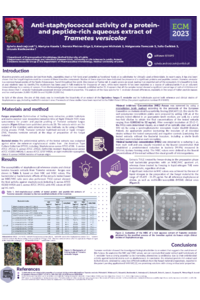
Bioactive proteins and peptides derived from fruits, vegetables, meat or fish have great potential as functional foods or as substitutes for clinically used antimicrobials. In recent years, it has also been shown that the fungal kingdom could be a source of these compounds. This study investigated the bioactivity of an extract of the lignicolous fungus Trametes versicolor and its hydrolysate against reference and clinical strains of Staphylococcus spp. (no. of the patent application: P.445189).
The antimicrobial activity of the tested extract and hydrolysate was evaluated against staphylococcal reference (S. aureus ATCC 6538, methicillin-resistant S. aureus ATCC 1707, S. epidermidis ATCC 12228) and clinical isolates, by using the microdilution broth method according to EUCAST guidelines. In vitro activity of the test compounds (initial concentration 50 mg/mL) was determined on the basis of the minimum inhibitory concentration (MIC) and minimum bactericidal concentration (MBC). The MBC/MIC ratio was also used to assess the bacteriostatic (MBC/MIC ⩾4) or bactericidal (MBC/MIC <4) effect.
We found bactericidal activity of the lignicolous fungus Trametes versicolor extract and its hydrolysate against staphylococcal strains with MIC ranging 62.5 - 500 µg/mL. Extracts obtained from T. versicolor according to the invention show strong antimicrobial activity - extracts obtained from the lyophilisate have species-dependent bactericidal activity against staphylococci, including methicillin-resistant Staphylococcus aureus (MRSA).
The protein-rich T. versicolor extract and its hydrolysate can be used to produce preparations with antimicrobial activity, especially antimicrobial and antioxidant activity, including bioactive ingredients in cosmetics and anti-aging supplements or natural preservatives.
Keywords
Trametes versicolor
extract and hydrolysate
antistaphylococcal activity
bactericidal
Manuscript
Antistaphylococcal activity of a protein_abstract.pdf
Poster
Antistaphylococcal activity of a protein- and peptide-rich aqueous extract of Trametes versicolor-2-1.pdf
Bluetongue virus in the Campania region (southern Italy): high seroprevalence in both SBV exposed and non-exposed ruminants.
Characterization of the archaeal community of colostrum and fecal samples of Mexican mothers and newborns