Event submissions
Published
This submission belongs to the session S8. Poster Session of the event The 2nd International Electronic Conference on Microbiology
Published date
30 Nov, 2023
Academic Editor
'%3e%3cpath%20d='M12.6657%2010.9104C12.4185%2010.325%2012.0599%209.79327%2011.6097%209.34482C11.1609%208.89508%2010.6293%208.5365%2010.0442%208.28888C10.0389%208.28626%2010.0337%208.28495%2010.0285%208.28233C10.8446%207.69279%2011.3752%206.73249%2011.3752%205.64904C11.3752%203.8542%209.92103%202.39999%208.1262%202.39999C6.33136%202.39999%204.87715%203.8542%204.87715%205.64904C4.87715%206.73249%205.40774%207.69279%206.22393%208.28364C6.21869%208.28626%206.21345%208.28757%206.20821%208.29019C5.62129%208.5378%205.09463%208.89284%204.64265%209.34613C4.1929%209.79493%203.83432%2010.3266%203.58671%2010.9117C3.34345%2011.4845%203.21226%2012.0987%203.20023%2012.7209C3.19988%2012.7349%203.20233%2012.7488%203.20744%2012.7619C3.21255%2012.7749%203.22022%2012.7867%203.22998%2012.7968C3.23975%2012.8068%203.25142%2012.8147%203.26431%2012.8202C3.2772%2012.8256%203.29105%2012.8284%203.30504%2012.8284H4.09109C4.14874%2012.8284%204.19459%2012.7825%204.1959%2012.7262C4.2221%2011.7148%204.62823%2010.7676%205.34617%2010.0497C6.08899%209.30683%207.0755%208.89808%208.1262%208.89808C9.17689%208.89808%2010.1634%209.30683%2010.9062%2010.0497C11.6242%2010.7676%2012.0303%2011.7148%2012.0565%2012.7262C12.0578%2012.7838%2012.1037%2012.8284%2012.1613%2012.8284H12.9474C12.9613%2012.8284%2012.9752%2012.8256%2012.9881%2012.8202C13.001%2012.8147%2013.0126%2012.8068%2013.0224%2012.7968C13.0322%2012.7867%2013.0398%2012.7749%2013.0449%2012.7619C13.0501%2012.7488%2013.0525%2012.7349%2013.0522%2012.7209C13.0391%2012.0947%2012.9094%2011.4855%2012.6657%2010.9104ZM8.1262%207.9024C7.52486%207.9024%206.9589%207.6679%206.53312%207.24211C6.10733%206.81633%205.87283%206.25037%205.87283%205.64904C5.87283%205.0477%206.10733%204.48174%206.53312%204.05596C6.9589%203.63018%207.52486%203.39567%208.1262%203.39567C8.72753%203.39567%209.29349%203.63018%209.71927%204.05596C10.1451%204.48174%2010.3796%205.0477%2010.3796%205.64904C10.3796%206.25037%2010.1451%206.81633%209.71927%207.24211C9.29349%207.6679%208.72753%207.9024%208.1262%207.9024Z'%20fill='%235D1EE1'/%3e%3c/g%3e%3c/svg%3e) Nico Jehmlich
Nico JehmlichCitation
Maricarmen Salas López, Carmen Josefina Juárez Castelán, Karina Corona Cervantes, Alberto Piña Escobedo, José Manuel Hernández Hernández, Martín Noé Rangel Calvillo, Claudia Pérez Cruz, Jaime García Mena, Characterization of the archaeal community of colostrum and fecal samples of Mexican mothers and newborns, in Proceedings of The 2nd International Electronic Conference on Microbiology, 1 December–15 December 2023, MDPI: Basel, Switzerland
Share
Email
Facebook
Twitter
LinkedIn
Characterization of the archaeal community of colostrum and fecal samples of Mexican mothers and newborns
'%3e%3cpath%20d='M12.6647%2010.9104C12.4176%2010.325%2012.0589%209.7933%2011.6088%209.34485C11.16%208.89511%2010.6283%208.53653%2010.0432%208.28891C10.038%208.28629%2010.0327%208.28498%2010.0275%208.28236C10.8437%207.69282%2011.3743%206.73252%2011.3743%205.64907C11.3743%203.85423%209.92005%202.40002%208.12522%202.40002C6.33038%202.40002%204.87618%203.85423%204.87618%205.64907C4.87618%206.73252%205.40677%207.69282%206.22296%208.28367C6.21772%208.28629%206.21248%208.2876%206.20724%208.29022C5.62031%208.53783%205.09365%208.89287%204.64167%209.34616C4.19192%209.79496%203.83334%2010.3266%203.58573%2010.9117C3.34247%2011.4846%203.21128%2012.0987%203.19925%2012.721C3.1989%2012.735%203.20135%2012.7489%203.20646%2012.7619C3.21157%2012.7749%203.21924%2012.7868%203.22901%2012.7968C3.23877%2012.8068%203.25045%2012.8148%203.26334%2012.8202C3.27623%2012.8256%203.29007%2012.8284%203.30406%2012.8284H4.09012C4.14776%2012.8284%204.19362%2012.7825%204.19493%2012.7262C4.22113%2011.7148%204.62726%2010.7676%205.34519%2010.0497C6.08802%209.30686%207.07452%208.89811%208.12522%208.89811C9.17592%208.89811%2010.1624%209.30686%2010.9052%2010.0497C11.6232%2010.7676%2012.0293%2011.7148%2012.0555%2012.7262C12.0568%2012.7839%2012.1027%2012.8284%2012.1603%2012.8284H12.9464C12.9604%2012.8284%2012.9742%2012.8256%2012.9871%2012.8202C13%2012.8148%2013.0117%2012.8068%2013.0214%2012.7968C13.0312%2012.7868%2013.0389%2012.7749%2013.044%2012.7619C13.0491%2012.7489%2013.0515%2012.735%2013.0512%2012.721C13.0381%2012.0947%2012.9084%2011.4856%2012.6647%2010.9104ZM8.12522%207.90243C7.52388%207.90243%206.95792%207.66793%206.53214%207.24215C6.10636%206.81636%205.87185%206.2504%205.87185%205.64907C5.87185%205.04773%206.10636%204.48177%206.53214%204.05599C6.95792%203.63021%207.52388%203.3957%208.12522%203.3957C8.72655%203.3957%209.29252%203.63021%209.7183%204.05599C10.1441%204.48177%2010.3786%205.04773%2010.3786%205.64907C10.3786%206.2504%2010.1441%206.81636%209.7183%207.24215C9.29252%207.66793%208.72655%207.90243%208.12522%207.90243Z'%20fill='%235D1EE1'/%3e%3c/g%3e%3c/svg%3e)
Maricarmen Salas López 1
Carmen Josefina Juárez Castelán 1
Karina Corona Cervantes 1
Alberto Piña Escobedo 1
José Manuel Hernández Hernández 2
Martín Noé Rangel Calvillo 3
Claudia Pérez Cruz 4

Jaime García Mena 1
1. Departamento de Genética y Biología Molecular, Cinvestav Unidad Zacatenco. Av. Instituto Politécnico Nacional 2508, Col. San Pedro Zacatenco, CDMX Código Postal 07360. Ciudad de México Tel: +52 (55) 5747 3800.
2. Departamento de Genética y Biología Molecular, Cinvestav Unidad Zacatenco. Av. Instituto Politécnico Nacional 2508, Col. San Pedro Zacatenco, CDMX Código Postal 07360. Ciudad de México Tel: +52 (55) 5747 3800
3. Hospital General “Dr. José María Rodríguez”, Ecatepec de Morelos, Estado de México, México.
4. Departamento de Farmacología, Cinvestav Unidad Zacatenco. Av. Instituto Politécnico Nacional 2508, Col. San Pedro Zacatenco, CDMX Código Postal 07360. Ciudad de México Tel: +52 (55) 5747 3800.
Abstract
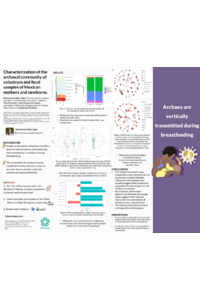
Introduction. Human milk is the perfect food for a newborn. It is composed mainly of water, proteins, lipids, carbohydrates, and biological components, such as bacteria, viruses, and archaea. The central bacteriome of human milk is known. These bacteria are considered to reach human milk via the entero-mammary route and from there, they colonize the intestine of the neonate by vertical transfer during lactation. In recent reports, archaea have been cultivated from human milk; however, their composition is unknown and is unclear if they are vertically transmitted. Also, their role in health remains to be elucidated. Methods. In this study, we sought to characterize the diversity of the archaeal community by V5-V6 16S-rRNA NGS from colostrum and fecal samples of 42 Mexican mothers and neonates. It was hypothesized that the archaeal community diversity present in the colostrum samples would be similar to that in neonate feces, showing a possible vertical transfer during lactation. Results: Our results indicate that alpha diversity differences between groups are significant; this is possibly due to the difference in biomass between samples. The beta diversity analysis featured that the sample types are quite similar. More robust analyzes reveal the absence of differential taxa between both groups, which is consistent with our hypothesis. This result is confirmed by the prediction of metabolic pathways, which indicates that there are no differential metabolic pathways between colostrum and feces. Conclusions: Overall, this gives the idea that these archaea may be specifically selected to fulfil an important role in the newborn intestine. Acknowledgements. Work supported by CONACyT 163235 INFR-2011-01 and CONACyT FORDECYT-PRONACES/6669/2020_Programa Presupuestario F003-Ciencia de Frontera 2019.
Keywords
Archaea
Human Milk Microbiota
Fecal microbiota
High-throughput DNA sequencing.
Manuscript
Abstract ECM 13-oct-23.pdf
Poster
Poster_ECM2023.pdf
Antistaphylococcal activity of a protein- and peptide-rich aqueous extract of Trametes versicolor
Diversity of immunoglobulin-coated archaea in human colostrum and neonatal stool from Mexican individuals