Event submissions
Published
This submission belongs to the session S1. Gut Microbiota and Health Disease of the event The 2nd International Electronic Conference on Microbiology
Published date
30 Nov, 2023
Academic Editor
'%3e%3cpath%20d='M12.6657%2010.9104C12.4185%2010.325%2012.0599%209.79327%2011.6097%209.34482C11.1609%208.89508%2010.6293%208.5365%2010.0442%208.28888C10.0389%208.28626%2010.0337%208.28495%2010.0285%208.28233C10.8446%207.69279%2011.3752%206.73249%2011.3752%205.64904C11.3752%203.8542%209.92103%202.39999%208.1262%202.39999C6.33136%202.39999%204.87715%203.8542%204.87715%205.64904C4.87715%206.73249%205.40774%207.69279%206.22393%208.28364C6.21869%208.28626%206.21345%208.28757%206.20821%208.29019C5.62129%208.5378%205.09463%208.89284%204.64265%209.34613C4.1929%209.79493%203.83432%2010.3266%203.58671%2010.9117C3.34345%2011.4845%203.21226%2012.0987%203.20023%2012.7209C3.19988%2012.7349%203.20233%2012.7488%203.20744%2012.7619C3.21255%2012.7749%203.22022%2012.7867%203.22998%2012.7968C3.23975%2012.8068%203.25142%2012.8147%203.26431%2012.8202C3.2772%2012.8256%203.29105%2012.8284%203.30504%2012.8284H4.09109C4.14874%2012.8284%204.19459%2012.7825%204.1959%2012.7262C4.2221%2011.7148%204.62823%2010.7676%205.34617%2010.0497C6.08899%209.30683%207.0755%208.89808%208.1262%208.89808C9.17689%208.89808%2010.1634%209.30683%2010.9062%2010.0497C11.6242%2010.7676%2012.0303%2011.7148%2012.0565%2012.7262C12.0578%2012.7838%2012.1037%2012.8284%2012.1613%2012.8284H12.9474C12.9613%2012.8284%2012.9752%2012.8256%2012.9881%2012.8202C13.001%2012.8147%2013.0126%2012.8068%2013.0224%2012.7968C13.0322%2012.7867%2013.0398%2012.7749%2013.0449%2012.7619C13.0501%2012.7488%2013.0525%2012.7349%2013.0522%2012.7209C13.0391%2012.0947%2012.9094%2011.4855%2012.6657%2010.9104ZM8.1262%207.9024C7.52486%207.9024%206.9589%207.6679%206.53312%207.24211C6.10733%206.81633%205.87283%206.25037%205.87283%205.64904C5.87283%205.0477%206.10733%204.48174%206.53312%204.05596C6.9589%203.63018%207.52486%203.39567%208.1262%203.39567C8.72753%203.39567%209.29349%203.63018%209.71927%204.05596C10.1451%204.48174%2010.3796%205.0477%2010.3796%205.64904C10.3796%206.25037%2010.1451%206.81633%209.71927%207.24211C9.29349%207.6679%208.72753%207.9024%208.1262%207.9024Z'%20fill='%235D1EE1'/%3e%3c/g%3e%3c/svg%3e) Nico Jehmlich
Nico JehmlichCitation
Diana Laura Rojas Guerrero, Karina Corona-Cervantes, Carmen Josefina Juárez-Castelán, Alberto Piña-Escobedo, Bulmaro Cisneros-Vega, Leopoldo Santos-Argumedo, Tito Ramírez-Lozada, Gustavo Acosta-Altamirano, Mónica Sierra-Martínez, Paola Berenice Zárate-Segura, Jaime García-Mena, Diversity of immunoglobulin-coated archaea in human colostrum and neonatal stool from Mexican individuals, in Proceedings of The 2nd International Electronic Conference on Microbiology, 1 December–15 December 2023, MDPI: Basel, Switzerland
Share
Email
Facebook
Twitter
LinkedIn
Diversity of immunoglobulin-coated archaea in human colostrum and neonatal stool from Mexican individuals
'%3e%3cpath%20d='M12.6647%2010.9104C12.4176%2010.325%2012.0589%209.7933%2011.6088%209.34485C11.16%208.89511%2010.6283%208.53653%2010.0432%208.28891C10.038%208.28629%2010.0327%208.28498%2010.0275%208.28236C10.8437%207.69282%2011.3743%206.73252%2011.3743%205.64907C11.3743%203.85423%209.92005%202.40002%208.12522%202.40002C6.33038%202.40002%204.87618%203.85423%204.87618%205.64907C4.87618%206.73252%205.40677%207.69282%206.22296%208.28367C6.21772%208.28629%206.21248%208.2876%206.20724%208.29022C5.62031%208.53783%205.09365%208.89287%204.64167%209.34616C4.19192%209.79496%203.83334%2010.3266%203.58573%2010.9117C3.34247%2011.4846%203.21128%2012.0987%203.19925%2012.721C3.1989%2012.735%203.20135%2012.7489%203.20646%2012.7619C3.21157%2012.7749%203.21924%2012.7868%203.22901%2012.7968C3.23877%2012.8068%203.25045%2012.8148%203.26334%2012.8202C3.27623%2012.8256%203.29007%2012.8284%203.30406%2012.8284H4.09012C4.14776%2012.8284%204.19362%2012.7825%204.19493%2012.7262C4.22113%2011.7148%204.62726%2010.7676%205.34519%2010.0497C6.08802%209.30686%207.07452%208.89811%208.12522%208.89811C9.17592%208.89811%2010.1624%209.30686%2010.9052%2010.0497C11.6232%2010.7676%2012.0293%2011.7148%2012.0555%2012.7262C12.0568%2012.7839%2012.1027%2012.8284%2012.1603%2012.8284H12.9464C12.9604%2012.8284%2012.9742%2012.8256%2012.9871%2012.8202C13%2012.8148%2013.0117%2012.8068%2013.0214%2012.7968C13.0312%2012.7868%2013.0389%2012.7749%2013.044%2012.7619C13.0491%2012.7489%2013.0515%2012.735%2013.0512%2012.721C13.0381%2012.0947%2012.9084%2011.4856%2012.6647%2010.9104ZM8.12522%207.90243C7.52388%207.90243%206.95792%207.66793%206.53214%207.24215C6.10636%206.81636%205.87185%206.2504%205.87185%205.64907C5.87185%205.04773%206.10636%204.48177%206.53214%204.05599C6.95792%203.63021%207.52388%203.3957%208.12522%203.3957C8.72655%203.3957%209.29252%203.63021%209.7183%204.05599C10.1441%204.48177%2010.3786%205.04773%2010.3786%205.64907C10.3786%206.2504%2010.1441%206.81636%209.7183%207.24215C9.29252%207.66793%208.72655%207.90243%208.12522%207.90243Z'%20fill='%235D1EE1'/%3e%3c/g%3e%3c/svg%3e)
Diana Laura Rojas Guerrero 1
Karina Corona-Cervantes 1
Carmen Josefina Juárez-Castelán 1
Alberto Piña-Escobedo 1
Bulmaro Cisneros-Vega 1
Leopoldo Santos-Argumedo 2
Tito Ramírez-Lozada 3
Gustavo Acosta-Altamirano 4
Mónica Sierra-Martínez 5
Paola Berenice Zárate-Segura 6

Jaime García-Mena 1
1. Departamento de Genética y Biología Molecular, Cinvestav, Av. Instituto Politécnico Nacional 2508, Ciudad de México 07360, México
2. Departamento de Biomedicina Molecular, Cinvestav, Av. Instituto Politécnico Nacional 2508, Ciudad de México 07360, México
3. Unidad de Ginecología y Obstetricia, Hospital Regional de Alta Especialidad de Ixtapaluca, Carretera Federal México-Puebla Km. 34.5, Col. Zoquiapan, Ixtapaluca 56530, México
4. Dirección de Planeación, Enseñanza e Investigación, Hospital Regional de Alta Especialidad de Ixtapaluca, Carretera Federal México-Puebla Km. 34.5, Col. Zoquiapan, Ixtapaluca 56530, México
5. Unidad de Investigación en Salud, Hospital Regional de Alta Especialidad de Ixtapaluca, Carretera Federal México-Puebla Km. 34.5, Col. Zoquiapan, Ixtapaluca 56530, México
6. Laboratorio de Medicina Traslacional, Escuela Superior de Medicina, Instituto Politécnico Nacional, Ciudad de México 11340, México
Abstract
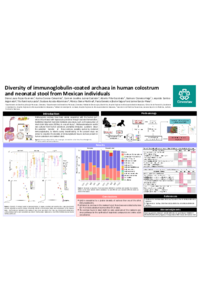
Introduction. Archaea are anaerobic prokaryotes that belong to a lineage independent of Bacteria that were first isolated from human feces in the 80s. Recently, they were detected in feces from adults, breast milk, and meconium of healthy donors, suggesting that they are members of the human microbiota, and potentially, pioneer colonizers of the gut. During breastfeeding, colostrum carries one of the first inoculums of immunoglobulin-coated bacteria that will promote the environmental development of the gut as well as the immune system of the newborn. However, it is unknown if these immunoglobulins coat archaea to mediate their selection in the gut. Objective. We aimed to describe the composition of the archaeal community in colostrum donated by Mexican women and newborn feces to evaluate if these taxa are bound differently. Methods. We selected good-quality DNA isolated from colostrum/feces cells sorted by magnetism using complexes of monoclonal anti- IgA1, IgA2, IgG, and IgM bound to magnetic beads and carried massive 16S amplicon sequencing to determine their taxonomy. Results. Methanosarcina and Methanoculleus are the most abundant genera and they are coated by the four immunoglobulin subtypes, whereas rare genera are bound by IgM in colostrum but by IgG in feces. Interestingly, functional metagenome prediction shows that while archaea in colostrum are associated to anaerobic respiration (i.e. methanogenesis), nucleotide and amino acid biosynthesis are the most abundant pathways in newborn feces. Conclusions. Our results suggest that maternal immunoglobulins bind differentially to archaea that might be pioneer colonizers and that the modeling of the gut environment may start as early as the newborn starts breastfeeding. Acknowledgments. Work supported by CONACyT 163235 INFR-2011-01 and CONACyT FORDECYT-PRONACES/6669/2020_Programa Presupuestario F003-Ciencia de Frontera 2019.
Keywords
Human microbiota
archaea
breastfeeding
Manuscript
Abstract-DLRG.pdf
Poster
Póster-DLRG1.pdf
Characterization of the archaeal community of colostrum and fecal samples of Mexican mothers and newborns
Assessment of contamination on staff hands in veterinary services- The role of multidrug-resistant Staphylococcus epidermidis