Event submissions
Published
This submission belongs to the session S3. Antimicrobial Agents and Resistance of the event The 2nd International Electronic Conference on Microbiology
Published date
01 Dec, 2023
Academic Editor
'%3e%3cpath%20d='M12.6657%2010.9104C12.4185%2010.325%2012.0599%209.79327%2011.6097%209.34482C11.1609%208.89508%2010.6293%208.5365%2010.0442%208.28888C10.0389%208.28626%2010.0337%208.28495%2010.0285%208.28233C10.8446%207.69279%2011.3752%206.73249%2011.3752%205.64904C11.3752%203.8542%209.92103%202.39999%208.1262%202.39999C6.33136%202.39999%204.87715%203.8542%204.87715%205.64904C4.87715%206.73249%205.40774%207.69279%206.22393%208.28364C6.21869%208.28626%206.21345%208.28757%206.20821%208.29019C5.62129%208.5378%205.09463%208.89284%204.64265%209.34613C4.1929%209.79493%203.83432%2010.3266%203.58671%2010.9117C3.34345%2011.4845%203.21226%2012.0987%203.20023%2012.7209C3.19988%2012.7349%203.20233%2012.7488%203.20744%2012.7619C3.21255%2012.7749%203.22022%2012.7867%203.22998%2012.7968C3.23975%2012.8068%203.25142%2012.8147%203.26431%2012.8202C3.2772%2012.8256%203.29105%2012.8284%203.30504%2012.8284H4.09109C4.14874%2012.8284%204.19459%2012.7825%204.1959%2012.7262C4.2221%2011.7148%204.62823%2010.7676%205.34617%2010.0497C6.08899%209.30683%207.0755%208.89808%208.1262%208.89808C9.17689%208.89808%2010.1634%209.30683%2010.9062%2010.0497C11.6242%2010.7676%2012.0303%2011.7148%2012.0565%2012.7262C12.0578%2012.7838%2012.1037%2012.8284%2012.1613%2012.8284H12.9474C12.9613%2012.8284%2012.9752%2012.8256%2012.9881%2012.8202C13.001%2012.8147%2013.0126%2012.8068%2013.0224%2012.7968C13.0322%2012.7867%2013.0398%2012.7749%2013.0449%2012.7619C13.0501%2012.7488%2013.0525%2012.7349%2013.0522%2012.7209C13.0391%2012.0947%2012.9094%2011.4855%2012.6657%2010.9104ZM8.1262%207.9024C7.52486%207.9024%206.9589%207.6679%206.53312%207.24211C6.10733%206.81633%205.87283%206.25037%205.87283%205.64904C5.87283%205.0477%206.10733%204.48174%206.53312%204.05596C6.9589%203.63018%207.52486%203.39567%208.1262%203.39567C8.72753%203.39567%209.29349%203.63018%209.71927%204.05596C10.1451%204.48174%2010.3796%205.0477%2010.3796%205.64904C10.3796%206.25037%2010.1451%206.81633%209.71927%207.24211C9.29349%207.6679%208.72753%207.9024%208.1262%207.9024Z'%20fill='%235D1EE1'/%3e%3c/g%3e%3c/svg%3e) Nico Jehmlich
Nico JehmlichCitation
Isabel Vaz Carvalho, Kamila Soares, Justina Prada, Alexandra Esteves, Isabel Pires, Patrícia Poeta, Filipe Silva, Cristina Saraiva, Assessment of contamination on staff hands in veterinary services- The role of multidrug-resistant Staphylococcus epidermidis, in Proceedings of The 2nd International Electronic Conference on Microbiology, 1 December–15 December 2023, MDPI: Basel, Switzerland
Share
Email
Facebook
Twitter
LinkedIn
Assessment of contamination on staff hands in veterinary services- The role of multidrug-resistant Staphylococcus epidermidis
'%3e%3cpath%20d='M12.6647%2010.9104C12.4176%2010.325%2012.0589%209.7933%2011.6088%209.34485C11.16%208.89511%2010.6283%208.53653%2010.0432%208.28891C10.038%208.28629%2010.0327%208.28498%2010.0275%208.28236C10.8437%207.69282%2011.3743%206.73252%2011.3743%205.64907C11.3743%203.85423%209.92005%202.40002%208.12522%202.40002C6.33038%202.40002%204.87618%203.85423%204.87618%205.64907C4.87618%206.73252%205.40677%207.69282%206.22296%208.28367C6.21772%208.28629%206.21248%208.2876%206.20724%208.29022C5.62031%208.53783%205.09365%208.89287%204.64167%209.34616C4.19192%209.79496%203.83334%2010.3266%203.58573%2010.9117C3.34247%2011.4846%203.21128%2012.0987%203.19925%2012.721C3.1989%2012.735%203.20135%2012.7489%203.20646%2012.7619C3.21157%2012.7749%203.21924%2012.7868%203.22901%2012.7968C3.23877%2012.8068%203.25045%2012.8148%203.26334%2012.8202C3.27623%2012.8256%203.29007%2012.8284%203.30406%2012.8284H4.09012C4.14776%2012.8284%204.19362%2012.7825%204.19493%2012.7262C4.22113%2011.7148%204.62726%2010.7676%205.34519%2010.0497C6.08802%209.30686%207.07452%208.89811%208.12522%208.89811C9.17592%208.89811%2010.1624%209.30686%2010.9052%2010.0497C11.6232%2010.7676%2012.0293%2011.7148%2012.0555%2012.7262C12.0568%2012.7839%2012.1027%2012.8284%2012.1603%2012.8284H12.9464C12.9604%2012.8284%2012.9742%2012.8256%2012.9871%2012.8202C13%2012.8148%2013.0117%2012.8068%2013.0214%2012.7968C13.0312%2012.7868%2013.0389%2012.7749%2013.044%2012.7619C13.0491%2012.7489%2013.0515%2012.735%2013.0512%2012.721C13.0381%2012.0947%2012.9084%2011.4856%2012.6647%2010.9104ZM8.12522%207.90243C7.52388%207.90243%206.95792%207.66793%206.53214%207.24215C6.10636%206.81636%205.87185%206.2504%205.87185%205.64907C5.87185%205.04773%206.10636%204.48177%206.53214%204.05599C6.95792%203.63021%207.52388%203.3957%208.12522%203.3957C8.72655%203.3957%209.29252%203.63021%209.7183%204.05599C10.1441%204.48177%2010.3786%205.04773%2010.3786%205.64907C10.3786%206.2504%2010.1441%206.81636%209.7183%207.24215C9.29252%207.66793%208.72655%207.90243%208.12522%207.90243Z'%20fill='%235D1EE1'/%3e%3c/g%3e%3c/svg%3e)
Isabel Vaz Carvalho 1,2,3
Kamila Soares 1,2,3

Justina Prada 1,2,3
Alexandra Esteves 1,2,3

Isabel Pires 1,2,3

Patrícia Poeta 1,2,3

Filipe Silva 1,2,3

Cristina Saraiva 1,2,3
1. Department of Veterinary Sciences, University of Trás-os-Montes e Alto Douro (UTAD), Vila Real, Portugal
2. Animal and Veterinary Research Centre (CECAV), University of Trás-os-Montes e Alto (UTAD), Vila Real, Portugal
3. AL4AnimalS - Animal and Veterinary Research Centre; Portugal
Abstract
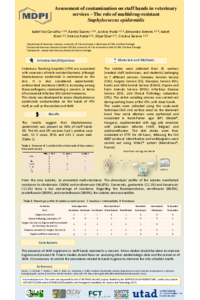
Veterinary Teaching hospitals (VTH) are associated with reservoirs of multi-resistant bacteria. Although Staphylococcus epidermidis is commensal in the skin, is also considered opportunistic, antimicrobial resistance (AMR) is increasing among these pathogens, representing a concern, in terms of nosocomial infection (NI) control measures.
This study was developed to assess Staphylococcus epidermidis contamination on the hands of staff at VTH, plus the existence of AMR.
25 samples were collected of the worker's hands from different services (Companion animals, Surgery, Infectious diseases, Exotic and wild animals, necropsy, Clinical pathology laboratory, and farm animals) of a VTH. The swabs were collected using the swab-wash technique on the dominant hand. Four serial dilutions were performed and inoculated in Baird-Parker agar, supplemented with egg yolk emulsion with potassium tellurite and sulfamethazine. The plates were then incubated at 37ºC for 48 hours, following the ISO 6887 protocol. Identification and antibiograms were carried out using Vitek2® system.
Results suggested that Staphylococcus epidermidis were present in 36% of staff hands (n=9). The necropsy and the laboratory services presented 1 positive each, surgery (n=3), farm animals (n=2), and companion animals (n=2).
From the nine isolates, six presented multi-resistance. The phenotypic profile of the isolates manifested resistance to clindamycin (100%) and erythromycin (66,67%). Conversely, gentamicin (11,1%) and kanamycin (11,1%) show a low percentage of resistance. Regarding the fluoroquinolones, enrofloxacin (88,89%), pradofloxacin (88,89%), and marbofloxacin (88,9%), the isolates were susceptible.
The presence of AMR organisms in staff hands represents a concern. More studies should be performed to improve hygiene and prevent NI.
Keywords
Staphylococcus epidermidis
Staff hands
Veterinary Teaching Hospital
Multi-drug resistance bacteria
Manuscript
MPDI - Assessment of contamination on staff hands in veterinary services _IVC 2023.pdf
Poster
MPDI - Assessment of contamination on staff hands in veterinary services _IVC 2023.pdf
Diversity of immunoglobulin-coated archaea in human colostrum and neonatal stool from Mexican individuals
INTESTINAL MICROBIOTA IN THE CLINICAL RESULTS OF CANCER AND ITS MODULATION AS AUXILIARY THERAPY