Event submissions
Published
This submission belongs to the session S3. Remote sensing applications of the event The 5th International Electronic Conference on Remote Sensing
Published date
01 Dec, 2023
Academic Editor
'%3e%3cpath%20d='M12.6657%2010.9104C12.4185%2010.325%2012.0599%209.79327%2011.6097%209.34482C11.1609%208.89508%2010.6293%208.5365%2010.0442%208.28888C10.0389%208.28626%2010.0337%208.28495%2010.0285%208.28233C10.8446%207.69279%2011.3752%206.73249%2011.3752%205.64904C11.3752%203.8542%209.92103%202.39999%208.1262%202.39999C6.33136%202.39999%204.87715%203.8542%204.87715%205.64904C4.87715%206.73249%205.40774%207.69279%206.22393%208.28364C6.21869%208.28626%206.21345%208.28757%206.20821%208.29019C5.62129%208.5378%205.09463%208.89284%204.64265%209.34613C4.1929%209.79493%203.83432%2010.3266%203.58671%2010.9117C3.34345%2011.4845%203.21226%2012.0987%203.20023%2012.7209C3.19988%2012.7349%203.20233%2012.7488%203.20744%2012.7619C3.21255%2012.7749%203.22022%2012.7867%203.22998%2012.7968C3.23975%2012.8068%203.25142%2012.8147%203.26431%2012.8202C3.2772%2012.8256%203.29105%2012.8284%203.30504%2012.8284H4.09109C4.14874%2012.8284%204.19459%2012.7825%204.1959%2012.7262C4.2221%2011.7148%204.62823%2010.7676%205.34617%2010.0497C6.08899%209.30683%207.0755%208.89808%208.1262%208.89808C9.17689%208.89808%2010.1634%209.30683%2010.9062%2010.0497C11.6242%2010.7676%2012.0303%2011.7148%2012.0565%2012.7262C12.0578%2012.7838%2012.1037%2012.8284%2012.1613%2012.8284H12.9474C12.9613%2012.8284%2012.9752%2012.8256%2012.9881%2012.8202C13.001%2012.8147%2013.0126%2012.8068%2013.0224%2012.7968C13.0322%2012.7867%2013.0398%2012.7749%2013.0449%2012.7619C13.0501%2012.7488%2013.0525%2012.7349%2013.0522%2012.7209C13.0391%2012.0947%2012.9094%2011.4855%2012.6657%2010.9104ZM8.1262%207.9024C7.52486%207.9024%206.9589%207.6679%206.53312%207.24211C6.10733%206.81633%205.87283%206.25037%205.87283%205.64904C5.87283%205.0477%206.10733%204.48174%206.53312%204.05596C6.9589%203.63018%207.52486%203.39567%208.1262%203.39567C8.72753%203.39567%209.29349%203.63018%209.71927%204.05596C10.1451%204.48174%2010.3796%205.0477%2010.3796%205.64904C10.3796%206.25037%2010.1451%206.81633%209.71927%207.24211C9.29349%207.6679%208.72753%207.9024%208.1262%207.9024Z'%20fill='%235D1EE1'/%3e%3c/g%3e%3c/svg%3e) Riccardo Buccolieri
Riccardo BuccolieriCitation
Juan V. Molner, Rebeca Pérez-González, Juan M. Soria, Turbidity and Suspended Matter in Albufera of Valencia (Spain) using Sentinel-2 Images, in Proceedings of The 5th International Electronic Conference on Remote Sensing, 7 November–21 November 2023, MDPI: Basel, Switzerland
Share
Email
Facebook
Twitter
LinkedIn
Turbidity and Suspended Matter in Albufera of Valencia (Spain) using Sentinel-2 Images

Juan V. Molner 1
'%3e%3cpath%20d='M12.6647%2010.9104C12.4176%2010.325%2012.0589%209.7933%2011.6088%209.34485C11.16%208.89511%2010.6283%208.53653%2010.0432%208.28891C10.038%208.28629%2010.0327%208.28498%2010.0275%208.28236C10.8437%207.69282%2011.3743%206.73252%2011.3743%205.64907C11.3743%203.85423%209.92005%202.40002%208.12522%202.40002C6.33038%202.40002%204.87618%203.85423%204.87618%205.64907C4.87618%206.73252%205.40677%207.69282%206.22296%208.28367C6.21772%208.28629%206.21248%208.2876%206.20724%208.29022C5.62031%208.53783%205.09365%208.89287%204.64167%209.34616C4.19192%209.79496%203.83334%2010.3266%203.58573%2010.9117C3.34247%2011.4846%203.21128%2012.0987%203.19925%2012.721C3.1989%2012.735%203.20135%2012.7489%203.20646%2012.7619C3.21157%2012.7749%203.21924%2012.7868%203.22901%2012.7968C3.23877%2012.8068%203.25045%2012.8148%203.26334%2012.8202C3.27623%2012.8256%203.29007%2012.8284%203.30406%2012.8284H4.09012C4.14776%2012.8284%204.19362%2012.7825%204.19493%2012.7262C4.22113%2011.7148%204.62726%2010.7676%205.34519%2010.0497C6.08802%209.30686%207.07452%208.89811%208.12522%208.89811C9.17592%208.89811%2010.1624%209.30686%2010.9052%2010.0497C11.6232%2010.7676%2012.0293%2011.7148%2012.0555%2012.7262C12.0568%2012.7839%2012.1027%2012.8284%2012.1603%2012.8284H12.9464C12.9604%2012.8284%2012.9742%2012.8256%2012.9871%2012.8202C13%2012.8148%2013.0117%2012.8068%2013.0214%2012.7968C13.0312%2012.7868%2013.0389%2012.7749%2013.044%2012.7619C13.0491%2012.7489%2013.0515%2012.735%2013.0512%2012.721C13.0381%2012.0947%2012.9084%2011.4856%2012.6647%2010.9104ZM8.12522%207.90243C7.52388%207.90243%206.95792%207.66793%206.53214%207.24215C6.10636%206.81636%205.87185%206.2504%205.87185%205.64907C5.87185%205.04773%206.10636%204.48177%206.53214%204.05599C6.95792%203.63021%207.52388%203.3957%208.12522%203.3957C8.72655%203.3957%209.29252%203.63021%209.7183%204.05599C10.1441%204.48177%2010.3786%205.04773%2010.3786%205.64907C10.3786%206.2504%2010.1441%206.81636%209.7183%207.24215C9.29252%207.66793%208.72655%207.90243%208.12522%207.90243Z'%20fill='%235D1EE1'/%3e%3c/g%3e%3c/svg%3e)
Rebeca Pérez-González 1

Juan M. Soria 1
1. Instituto Cavanilles de Biodiversidad y Biología Evolutiva, Universidad de Valencia
Abstract
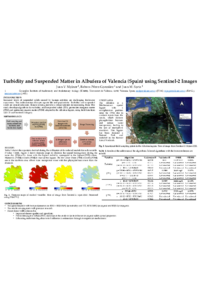
The presence of turbidity and suspended solids in freshwater environments is a natural phenomenon. However, due to human activities, the levels of suspended solids have escalated in numerous habitats. The implications of suspended matter vary depending on its composition, particularly with organic matter's ability to deplete dissolved oxygen within the water column. Excessive sedimentation can have adverse effects on primary productivity and aquatic life by diminishing light penetration and restricting habitat availability. The monitoring of water quality holds immense significance, encompassing vital aspects such as human consumption, agriculture, industry, and overall ecosystem health. Remote sensing techniques, with the utilization of the Sentinel-2 mission, have emerged as valuable tools for monitoring and assessing these critical variables. In the scope of this study, specific algorithms were meticulously calibrated and validated to accurately estimate turbidity and suspended solids in the Albufera de Valencia, leveraging the rich dataset provided by Sentinel-2 satellite imagery. The performance of these algorithms exhibited variability, with the R705 model emerging as the most reliable for estimating both turbidity and suspended solids. However, the validity of its turbidity estimates faced scrutiny. Alternative models, including R705 × R705/R490 and R783 × R705/R490, exhibited less satisfactory outcomes for turbidity estimation but showcased enhanced performance in estimating suspended solids. Further research endeavors are warranted to enhance the precision and robustness of these algorithms, while considering the unique characteristics inherent to the study area. Collaboration between disciplines such as limnology, optics and water chemistry is crucial to advance in water quality estimation models in lakes and lagoons such as Albufera. By integrating expertise and approaches from these diverse fields, new knowledge can be gained and the basis for more effective management and conservation strategies can be laid.
Keywords
water quality
remote sensing
suspended solids
freshwater ecosystems
environmental monitoring
Manuscript
Poster Turbidity and Suspended Matter Albufera.pdf
Poster
Poster Turbidity and Suspended Matter Albufera.pdf
Time series analysis of sea ice production in polynyas in Amery ice shelf region of Antarctica
Trainable Noise Model as an XAI evaluation method: application on Sobol for remote sensing image segmentation