Event submissions
Published
This submission belongs to the session S1. COVID-19 Vaccines and Vaccination of the event The 1st International Electronic Conference on Vaccines
Published date
04 Dec, 2023
Academic Editor
'%3e%3cpath%20d='M12.6657%2010.9104C12.4185%2010.325%2012.0599%209.79327%2011.6097%209.34482C11.1609%208.89508%2010.6293%208.5365%2010.0442%208.28888C10.0389%208.28626%2010.0337%208.28495%2010.0285%208.28233C10.8446%207.69279%2011.3752%206.73249%2011.3752%205.64904C11.3752%203.8542%209.92103%202.39999%208.1262%202.39999C6.33136%202.39999%204.87715%203.8542%204.87715%205.64904C4.87715%206.73249%205.40774%207.69279%206.22393%208.28364C6.21869%208.28626%206.21345%208.28757%206.20821%208.29019C5.62129%208.5378%205.09463%208.89284%204.64265%209.34613C4.1929%209.79493%203.83432%2010.3266%203.58671%2010.9117C3.34345%2011.4845%203.21226%2012.0987%203.20023%2012.7209C3.19988%2012.7349%203.20233%2012.7488%203.20744%2012.7619C3.21255%2012.7749%203.22022%2012.7867%203.22998%2012.7968C3.23975%2012.8068%203.25142%2012.8147%203.26431%2012.8202C3.2772%2012.8256%203.29105%2012.8284%203.30504%2012.8284H4.09109C4.14874%2012.8284%204.19459%2012.7825%204.1959%2012.7262C4.2221%2011.7148%204.62823%2010.7676%205.34617%2010.0497C6.08899%209.30683%207.0755%208.89808%208.1262%208.89808C9.17689%208.89808%2010.1634%209.30683%2010.9062%2010.0497C11.6242%2010.7676%2012.0303%2011.7148%2012.0565%2012.7262C12.0578%2012.7838%2012.1037%2012.8284%2012.1613%2012.8284H12.9474C12.9613%2012.8284%2012.9752%2012.8256%2012.9881%2012.8202C13.001%2012.8147%2013.0126%2012.8068%2013.0224%2012.7968C13.0322%2012.7867%2013.0398%2012.7749%2013.0449%2012.7619C13.0501%2012.7488%2013.0525%2012.7349%2013.0522%2012.7209C13.0391%2012.0947%2012.9094%2011.4855%2012.6657%2010.9104ZM8.1262%207.9024C7.52486%207.9024%206.9589%207.6679%206.53312%207.24211C6.10733%206.81633%205.87283%206.25037%205.87283%205.64904C5.87283%205.0477%206.10733%204.48174%206.53312%204.05596C6.9589%203.63018%207.52486%203.39567%208.1262%203.39567C8.72753%203.39567%209.29349%203.63018%209.71927%204.05596C10.1451%204.48174%2010.3796%205.0477%2010.3796%205.64904C10.3796%206.25037%2010.1451%206.81633%209.71927%207.24211C9.29349%207.6679%208.72753%207.9024%208.1262%207.9024Z'%20fill='%235D1EE1'/%3e%3c/g%3e%3c/svg%3e) François Meurens
François MeurensCitation
Jeffrey Martin, Henry Krasner, Crysty-Ann Olaco, Nicolette Harmon, Kavita Batra, Dale Netski, Community Level Correlates of COVID-19 Booster Vaccine Hesitancy in the United States: A Cross-Sectional Analysis, in Proceedings of The 1st International Electronic Conference on Vaccines, 1 December–15 December 2023, MDPI: Basel, Switzerland
Share
Email
Facebook
Twitter
LinkedIn
Community Level Correlates of COVID-19 Booster Vaccine Hesitancy in the United States: A Cross-Sectional Analysis
'%3e%3cpath%20d='M12.6647%2010.9104C12.4176%2010.325%2012.0589%209.7933%2011.6088%209.34485C11.16%208.89511%2010.6283%208.53653%2010.0432%208.28891C10.038%208.28629%2010.0327%208.28498%2010.0275%208.28236C10.8437%207.69282%2011.3743%206.73252%2011.3743%205.64907C11.3743%203.85423%209.92005%202.40002%208.12522%202.40002C6.33038%202.40002%204.87618%203.85423%204.87618%205.64907C4.87618%206.73252%205.40677%207.69282%206.22296%208.28367C6.21772%208.28629%206.21248%208.2876%206.20724%208.29022C5.62031%208.53783%205.09365%208.89287%204.64167%209.34616C4.19192%209.79496%203.83334%2010.3266%203.58573%2010.9117C3.34247%2011.4846%203.21128%2012.0987%203.19925%2012.721C3.1989%2012.735%203.20135%2012.7489%203.20646%2012.7619C3.21157%2012.7749%203.21924%2012.7868%203.22901%2012.7968C3.23877%2012.8068%203.25045%2012.8148%203.26334%2012.8202C3.27623%2012.8256%203.29007%2012.8284%203.30406%2012.8284H4.09012C4.14776%2012.8284%204.19362%2012.7825%204.19493%2012.7262C4.22113%2011.7148%204.62726%2010.7676%205.34519%2010.0497C6.08802%209.30686%207.07452%208.89811%208.12522%208.89811C9.17592%208.89811%2010.1624%209.30686%2010.9052%2010.0497C11.6232%2010.7676%2012.0293%2011.7148%2012.0555%2012.7262C12.0568%2012.7839%2012.1027%2012.8284%2012.1603%2012.8284H12.9464C12.9604%2012.8284%2012.9742%2012.8256%2012.9871%2012.8202C13%2012.8148%2013.0117%2012.8068%2013.0214%2012.7968C13.0312%2012.7868%2013.0389%2012.7749%2013.044%2012.7619C13.0491%2012.7489%2013.0515%2012.735%2013.0512%2012.721C13.0381%2012.0947%2012.9084%2011.4856%2012.6647%2010.9104ZM8.12522%207.90243C7.52388%207.90243%206.95792%207.66793%206.53214%207.24215C6.10636%206.81636%205.87185%206.2504%205.87185%205.64907C5.87185%205.04773%206.10636%204.48177%206.53214%204.05599C6.95792%203.63021%207.52388%203.3957%208.12522%203.3957C8.72655%203.3957%209.29252%203.63021%209.7183%204.05599C10.1441%204.48177%2010.3786%205.04773%2010.3786%205.64907C10.3786%206.2504%2010.1441%206.81636%209.7183%207.24215C9.29252%207.66793%208.72655%207.90243%208.12522%207.90243Z'%20fill='%235D1EE1'/%3e%3c/g%3e%3c/svg%3e)
Jeffrey Martin 1
Henry Krasner 1
Crysty-Ann Olaco 1
Nicolette Harmon 2

Kavita Batra 2
Dale Netski 1
1. Kirk Kerkorian School of Medicine at UNLV
2. University of Nevada Las Vegas
Abstract
Introduction
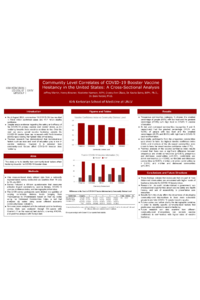
The COVID-19 vaccine was the first mRNA vaccine to receive full FDA approval. It has been shown that the novelty of mRNA vaccines significantly increases vaccine hesitancy, possibly due to the spread of misinformation on this technology. Additionally, previous research has indicated that individual-level socio-demographic factors contribute to vaccine hesitancy. However, it is unknown how community-level factors affect COVID-19 booster dose hesitancy. The current study aims to fill this knowledge gap by comparing data from a nation-wide survey on COVID-19 vaccine hesitancy with a community-level indicator i.e. Distressed Communities Index (DCI).
Methods
This cross-sectional study utilized a 48-item, psychometrically valid and reliable tool to measure attitudes toward vaccinations, vaccine literacy, COVID-19 vaccine confidence index, and trust in July 2021. A total of 2,138 survey participants residing in the United States were divided into quintiles of varying community distress levels (ranging from 1=prosperous to 5=distressed) based on their zip codes using the DCI. Data were analyzed through Chi-square, one-way ANOVA, and post-hoc analysis with Tukey’s test.
Results
A significantly larger proportion of participants from the distressed communities had lower trust as opposed to their prosperous counterparts (26.6% vs. 37.6%, p<0.001). On the contrary, participants from the prosperous communities had the significantly higher mean scores of the vaccine confidence index as opposed to those who were living in distressed communities (2.22±1.13 vs. 1.70±1.01, p<0.001).
Conclusion
These findings affirm the importance of developing community-level interventions in these more vulnerable groups to promote trust in COVID-19 vaccinations, thereby increasing COVID-19 booster dose uptake. From these results, future studies can examine the efficacy of various community-level interventions in promoting vaccine confidence in communities with higher rates of vaccine hesitancy.
Keywords
COVID-19 Booster Hesitancy
COVID-19 Vaccine Hesitancy
community level
vaccine hesitancy
distressed community index
community level indicators
Poster
COVID-19 booster hesitancy poster.pdf
Factors driving the attitudes and hesitancy of Albanian parents toward Covid-19 vaccination of children.
Trajectory of COVID-19 Vaccine Hesitancy Post-Vaccination and Public’s Intention to Take Booster Vaccines: A Cross-Sectional Analysis