Event submissions
Published
This submission belongs to the session S7. Poster Session of the event The 3rd International Electronic Conference on Antibiotics
Published date
15 Dec, 2023
Academic Editor
'%3e%3cpath%20d='M12.6657%2010.9104C12.4185%2010.325%2012.0599%209.79327%2011.6097%209.34482C11.1609%208.89508%2010.6293%208.5365%2010.0442%208.28888C10.0389%208.28626%2010.0337%208.28495%2010.0285%208.28233C10.8446%207.69279%2011.3752%206.73249%2011.3752%205.64904C11.3752%203.8542%209.92103%202.39999%208.1262%202.39999C6.33136%202.39999%204.87715%203.8542%204.87715%205.64904C4.87715%206.73249%205.40774%207.69279%206.22393%208.28364C6.21869%208.28626%206.21345%208.28757%206.20821%208.29019C5.62129%208.5378%205.09463%208.89284%204.64265%209.34613C4.1929%209.79493%203.83432%2010.3266%203.58671%2010.9117C3.34345%2011.4845%203.21226%2012.0987%203.20023%2012.7209C3.19988%2012.7349%203.20233%2012.7488%203.20744%2012.7619C3.21255%2012.7749%203.22022%2012.7867%203.22998%2012.7968C3.23975%2012.8068%203.25142%2012.8147%203.26431%2012.8202C3.2772%2012.8256%203.29105%2012.8284%203.30504%2012.8284H4.09109C4.14874%2012.8284%204.19459%2012.7825%204.1959%2012.7262C4.2221%2011.7148%204.62823%2010.7676%205.34617%2010.0497C6.08899%209.30683%207.0755%208.89808%208.1262%208.89808C9.17689%208.89808%2010.1634%209.30683%2010.9062%2010.0497C11.6242%2010.7676%2012.0303%2011.7148%2012.0565%2012.7262C12.0578%2012.7838%2012.1037%2012.8284%2012.1613%2012.8284H12.9474C12.9613%2012.8284%2012.9752%2012.8256%2012.9881%2012.8202C13.001%2012.8147%2013.0126%2012.8068%2013.0224%2012.7968C13.0322%2012.7867%2013.0398%2012.7749%2013.0449%2012.7619C13.0501%2012.7488%2013.0525%2012.7349%2013.0522%2012.7209C13.0391%2012.0947%2012.9094%2011.4855%2012.6657%2010.9104ZM8.1262%207.9024C7.52486%207.9024%206.9589%207.6679%206.53312%207.24211C6.10733%206.81633%205.87283%206.25037%205.87283%205.64904C5.87283%205.0477%206.10733%204.48174%206.53312%204.05596C6.9589%203.63018%207.52486%203.39567%208.1262%203.39567C8.72753%203.39567%209.29349%203.63018%209.71927%204.05596C10.1451%204.48174%2010.3796%205.0477%2010.3796%205.64904C10.3796%206.25037%2010.1451%206.81633%209.71927%207.24211C9.29349%207.6679%208.72753%207.9024%208.1262%207.9024Z'%20fill='%235D1EE1'/%3e%3c/g%3e%3c/svg%3e) Marc Maresca
Marc MarescaCitation
Ali Aydin, Zhanylbubu Mamatova, Ali Anıl Süleymanoğlu, Mert Sudagidan, Mediha Nur Zafer Yurt, Veli Cengiz Ozalp, Jacob Zornu, Saraya Tavornpanich, Edgar Brun, Antibiotic Susceptibility of Pseudomonas from Sea Bass (Dicentrarchus labrax) in Aegean Sea, Türkiye, in Proceedings of The 3rd International Electronic Conference on Antibiotics, 1 December–15 December 2023, MDPI: Basel, Switzerland
Share
Email
Facebook
Twitter
LinkedIn
Antibiotic Susceptibility of Pseudomonas from Sea Bass (Dicentrarchus labrax) in Aegean Sea, Türkiye
'%3e%3cpath%20d='M12.6647%2010.9104C12.4176%2010.325%2012.0589%209.7933%2011.6088%209.34485C11.16%208.89511%2010.6283%208.53653%2010.0432%208.28891C10.038%208.28629%2010.0327%208.28498%2010.0275%208.28236C10.8437%207.69282%2011.3743%206.73252%2011.3743%205.64907C11.3743%203.85423%209.92005%202.40002%208.12522%202.40002C6.33038%202.40002%204.87618%203.85423%204.87618%205.64907C4.87618%206.73252%205.40677%207.69282%206.22296%208.28367C6.21772%208.28629%206.21248%208.2876%206.20724%208.29022C5.62031%208.53783%205.09365%208.89287%204.64167%209.34616C4.19192%209.79496%203.83334%2010.3266%203.58573%2010.9117C3.34247%2011.4846%203.21128%2012.0987%203.19925%2012.721C3.1989%2012.735%203.20135%2012.7489%203.20646%2012.7619C3.21157%2012.7749%203.21924%2012.7868%203.22901%2012.7968C3.23877%2012.8068%203.25045%2012.8148%203.26334%2012.8202C3.27623%2012.8256%203.29007%2012.8284%203.30406%2012.8284H4.09012C4.14776%2012.8284%204.19362%2012.7825%204.19493%2012.7262C4.22113%2011.7148%204.62726%2010.7676%205.34519%2010.0497C6.08802%209.30686%207.07452%208.89811%208.12522%208.89811C9.17592%208.89811%2010.1624%209.30686%2010.9052%2010.0497C11.6232%2010.7676%2012.0293%2011.7148%2012.0555%2012.7262C12.0568%2012.7839%2012.1027%2012.8284%2012.1603%2012.8284H12.9464C12.9604%2012.8284%2012.9742%2012.8256%2012.9871%2012.8202C13%2012.8148%2013.0117%2012.8068%2013.0214%2012.7968C13.0312%2012.7868%2013.0389%2012.7749%2013.044%2012.7619C13.0491%2012.7489%2013.0515%2012.735%2013.0512%2012.721C13.0381%2012.0947%2012.9084%2011.4856%2012.6647%2010.9104ZM8.12522%207.90243C7.52388%207.90243%206.95792%207.66793%206.53214%207.24215C6.10636%206.81636%205.87185%206.2504%205.87185%205.64907C5.87185%205.04773%206.10636%204.48177%206.53214%204.05599C6.95792%203.63021%207.52388%203.3957%208.12522%203.3957C8.72655%203.3957%209.29252%203.63021%209.7183%204.05599C10.1441%204.48177%2010.3786%205.04773%2010.3786%205.64907C10.3786%206.2504%2010.1441%206.81636%209.7183%207.24215C9.29252%207.66793%208.72655%207.90243%208.12522%207.90243Z'%20fill='%235D1EE1'/%3e%3c/g%3e%3c/svg%3e)
Ali Aydin 1
Zhanylbubu Mamatova 1

Ali Anıl Süleymanoğlu 1

Mert Sudagidan 2
Mediha Nur Zafer Yurt 2

Veli Cengiz Ozalp 3
Jacob Zornu 4
Saraya Tavornpanich 4
Edgar Brun 4
1. Istanbul University-Cerrahpasa, Faculty of Veterinary Medicine, Department of Food Hygiene and Technology
2. KIT-ARGEM R&D Center, Konya Food and Agriculture University
3. Medical School, Department of Medical Biology, Atilim University
4. Norwegian Veterinary Institute
Abstract
Antibiotic resistant bacteria are a global health threat. The increase in the rate of spread of antibiotic resistance in recent years is concerning. Türkiye and Greece are the leading countries in the production of sea bass (Dicentrarchus labrax) in the World. In this study, the microbiota of sea bass (n=96) obtained from 8 fish farms from 12 regions of Türkiye's Aegean Sea borders was examined by Next-Generation Sequencing method and metabarcoding. Pseudomonas spp. was found to be the dominant species (96/96, 100%) and Shewanella spp., Acinetobacter spp., and Flavobacterium spp. were the common species. When Pseudomonas spp. was found in all samples, this species was investigated by classical microbiological method, and Pseudomonas spp. (46/96, 48%) were obtained. Resistance to penicillin, aminoglycosides, carbapenems, fluoroquinolones, and tetracyclines was measured by disc diffusion method according to the European Committee on Antimicrobial Susceptibility Testing (EUCAST) and Clinical and Laboratory Standards Institute (CLSI). According to EUCAST and CLSI, 13 of the strains (28.3%) were resistant to doripenem by the disc diffusion method. The minimum inhibition concentration of resistant strains was measured by E-test. According to EUCAST and CLSI standards, 3 and 2 strains were resistant to doripenem and imipenem, respectively, and the carbapenem resistance observed is concerning. All strains were susceptible to piperacillin-tazobactam, gentamicin, amikacin, levofloxacin, norfloxacin and tetracycline. Next-generation molecular genetic studies and antibiotic resistance in samples obtained from the Aegean Sea provide important information about the epidemiology of carbapenem resistance. This study is the first microbiota analysis study on sea bass (Dicentrarchus labrax) using Next-Generation Sequence method in Türkiye.
Keywords
Sea bass
Next-Generation Sequence
Pseudomonas spp
Carbapenem resistance
Public Health
Manuscript
Antibiotic Susceptibility of Pseudomonas from Sea Bass (Dicentrarchus labrax) in Aegan Sea, Türkiye pdf.pdf
Poster
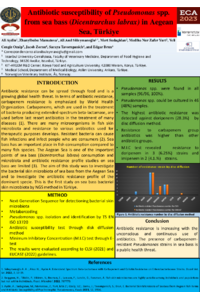
ECA 2023 poster.pdf
Antifungal property of Kadukkai (Terminalia chebula) - An evaluative study.
The orphan regulator Aor1 and its possible histidine kinase in the antibiotic regulation of Streptomyces coelicolor