Event submissions
Published
This submission belongs to the session Session F. Plant Molecular Biology and Plant Genetics, Genomics and Biotechnology of the event The 3rd International Electronic Conference on Plant Sciences
Published date
19 Jan, 2024
Academic Editor
'%3e%3cpath%20d='M12.6657%2010.9104C12.4185%2010.325%2012.0599%209.79327%2011.6097%209.34482C11.1609%208.89508%2010.6293%208.5365%2010.0442%208.28888C10.0389%208.28626%2010.0337%208.28495%2010.0285%208.28233C10.8446%207.69279%2011.3752%206.73249%2011.3752%205.64904C11.3752%203.8542%209.92103%202.39999%208.1262%202.39999C6.33136%202.39999%204.87715%203.8542%204.87715%205.64904C4.87715%206.73249%205.40774%207.69279%206.22393%208.28364C6.21869%208.28626%206.21345%208.28757%206.20821%208.29019C5.62129%208.5378%205.09463%208.89284%204.64265%209.34613C4.1929%209.79493%203.83432%2010.3266%203.58671%2010.9117C3.34345%2011.4845%203.21226%2012.0987%203.20023%2012.7209C3.19988%2012.7349%203.20233%2012.7488%203.20744%2012.7619C3.21255%2012.7749%203.22022%2012.7867%203.22998%2012.7968C3.23975%2012.8068%203.25142%2012.8147%203.26431%2012.8202C3.2772%2012.8256%203.29105%2012.8284%203.30504%2012.8284H4.09109C4.14874%2012.8284%204.19459%2012.7825%204.1959%2012.7262C4.2221%2011.7148%204.62823%2010.7676%205.34617%2010.0497C6.08899%209.30683%207.0755%208.89808%208.1262%208.89808C9.17689%208.89808%2010.1634%209.30683%2010.9062%2010.0497C11.6242%2010.7676%2012.0303%2011.7148%2012.0565%2012.7262C12.0578%2012.7838%2012.1037%2012.8284%2012.1613%2012.8284H12.9474C12.9613%2012.8284%2012.9752%2012.8256%2012.9881%2012.8202C13.001%2012.8147%2013.0126%2012.8068%2013.0224%2012.7968C13.0322%2012.7867%2013.0398%2012.7749%2013.0449%2012.7619C13.0501%2012.7488%2013.0525%2012.7349%2013.0522%2012.7209C13.0391%2012.0947%2012.9094%2011.4855%2012.6657%2010.9104ZM8.1262%207.9024C7.52486%207.9024%206.9589%207.6679%206.53312%207.24211C6.10733%206.81633%205.87283%206.25037%205.87283%205.64904C5.87283%205.0477%206.10733%204.48174%206.53312%204.05596C6.9589%203.63018%207.52486%203.39567%208.1262%203.39567C8.72753%203.39567%209.29349%203.63018%209.71927%204.05596C10.1451%204.48174%2010.3796%205.0477%2010.3796%205.64904C10.3796%206.25037%2010.1451%206.81633%209.71927%207.24211C9.29349%207.6679%208.72753%207.9024%208.1262%207.9024Z'%20fill='%235D1EE1'/%3e%3c/g%3e%3c/svg%3e) Adriano Sofo
Adriano SofoCitation
Lorena Asensio, Carmen Capel, Ricardo Lebrón, Ana Suárez-Alcaraz, Rafael Lozano, Juan Capel, Zucchini TINY4 gene regulates plant development through brassinosteroid signalling pathway, in Proceedings of The 3rd International Electronic Conference on Plant Sciences, 15 January–17 January 2024, MDPI: Basel, Switzerland
Share
Email
Facebook
Twitter
LinkedIn
Zucchini TINY4 gene regulates plant development through brassinosteroid signalling pathway
'%3e%3cpath%20d='M12.6647%2010.9104C12.4176%2010.325%2012.0589%209.7933%2011.6088%209.34485C11.16%208.89511%2010.6283%208.53653%2010.0432%208.28891C10.038%208.28629%2010.0327%208.28498%2010.0275%208.28236C10.8437%207.69282%2011.3743%206.73252%2011.3743%205.64907C11.3743%203.85423%209.92005%202.40002%208.12522%202.40002C6.33038%202.40002%204.87618%203.85423%204.87618%205.64907C4.87618%206.73252%205.40677%207.69282%206.22296%208.28367C6.21772%208.28629%206.21248%208.2876%206.20724%208.29022C5.62031%208.53783%205.09365%208.89287%204.64167%209.34616C4.19192%209.79496%203.83334%2010.3266%203.58573%2010.9117C3.34247%2011.4846%203.21128%2012.0987%203.19925%2012.721C3.1989%2012.735%203.20135%2012.7489%203.20646%2012.7619C3.21157%2012.7749%203.21924%2012.7868%203.22901%2012.7968C3.23877%2012.8068%203.25045%2012.8148%203.26334%2012.8202C3.27623%2012.8256%203.29007%2012.8284%203.30406%2012.8284H4.09012C4.14776%2012.8284%204.19362%2012.7825%204.19493%2012.7262C4.22113%2011.7148%204.62726%2010.7676%205.34519%2010.0497C6.08802%209.30686%207.07452%208.89811%208.12522%208.89811C9.17592%208.89811%2010.1624%209.30686%2010.9052%2010.0497C11.6232%2010.7676%2012.0293%2011.7148%2012.0555%2012.7262C12.0568%2012.7839%2012.1027%2012.8284%2012.1603%2012.8284H12.9464C12.9604%2012.8284%2012.9742%2012.8256%2012.9871%2012.8202C13%2012.8148%2013.0117%2012.8068%2013.0214%2012.7968C13.0312%2012.7868%2013.0389%2012.7749%2013.044%2012.7619C13.0491%2012.7489%2013.0515%2012.735%2013.0512%2012.721C13.0381%2012.0947%2012.9084%2011.4856%2012.6647%2010.9104ZM8.12522%207.90243C7.52388%207.90243%206.95792%207.66793%206.53214%207.24215C6.10636%206.81636%205.87185%206.2504%205.87185%205.64907C5.87185%205.04773%206.10636%204.48177%206.53214%204.05599C6.95792%203.63021%207.52388%203.3957%208.12522%203.3957C8.72655%203.3957%209.29252%203.63021%209.7183%204.05599C10.1441%204.48177%2010.3786%205.04773%2010.3786%205.64907C10.3786%206.2504%2010.1441%206.81636%209.7183%207.24215C9.29252%207.66793%208.72655%207.90243%208.12522%207.90243Z'%20fill='%235D1EE1'/%3e%3c/g%3e%3c/svg%3e)
Lorena Asensio 1
Carmen Capel 1
Ricardo Lebrón 1
Ana Suárez-Alcaraz 1
Rafael Lozano 1
Juan Capel 1
1. Area of Genetics, Dept. of Biology and Geology, University of Almeria
Abstract
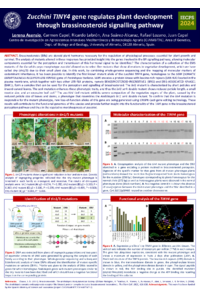
Brassinosteroids (BRs) are steroid plant hormones necessary for the regulation of physiological processes essential for plant growth and survival. The analysis of mutants altered in these responses has provided insight into the genes involved in the BR signalling pathway, allowing molecular components essential for the perception and transmission of this hormonal signal to be identified. The characterization of a collection of the EMS mutants of the Cucurbita pepo morphotype Zucchini allowed us to select five mutants that show alterations in vegetative development, which we have called tiny (tin1/5) due to their small plant size. In this work, by combining whole-genome sequencing and the mapping of molecular markers of codominant inheritance, it has been possible to identify the first known mutant allele of the zucchini TINY4 gene, homologous to the SERK (SOMATIC EMBRYOGENESIS RECEPTOR-LIKE KINASE) gene of Arabidopsis thaliana. SERK encodes a protein kinase with leucine-rich repeats (LRR-RLK) located in the plasma membrane, which together with two other LRR-RLK proteins, namely BRASSINOSTEROID-INSENSITIVE1 (BRI1) and BRI1-ASSOCIATED KINASE1 (BAK1), form a complex that can be used for the perception and signalling of brassinosteroid. The bri1 mutant is characterized by short petioles and inward-curved leaves. The serk mutation enhances these phenotypic traits, and thus the bri1 serk double mutant shows reduced petiole length, a small rosette size, and an excessive leaf curl. The zucchini tin4 mutant exhibits severe compaction of the vegetative organs of the plant, caused by the reduced petiole size of leaves and stems, a phenotype that resembles the Arabidopsis bri1 serk double mutant. To confirm that the tin4 mutation is responsible for the mutant phenotype, new loss-of-function alleles of this gene are being generated using CRISPR-Cas9 gene editing technology. These results will contribute to the functional genomics of this species and provide further insight into the functionality of the TIN4 gene in the brassinosteroid perception pathway and thus in the vegetative morphogenesis of zucchini.
Keywords
chemical mutagenesis
whole-genome sequencing
plant development
dwarf.
Poster
IECPS2024 Póster Lorena_def.pdf
Olive Endochitinase EP3-like gene mediates plant responses against Colletotrichum nymphae infection.
Response of specific leaf area to nutrient addition and competition release in Cistus ladanifer L.