Event submissions
Published
This submission belongs to the session Session D. Phytochemistry, Phytoremediation, and Plants in Urban Ecosystems of the event The 3rd International Electronic Conference on Plant Sciences
Published date
19 Jan, 2024
Academic Editor
'%3e%3cpath%20d='M12.6657%2010.9104C12.4185%2010.325%2012.0599%209.79327%2011.6097%209.34482C11.1609%208.89508%2010.6293%208.5365%2010.0442%208.28888C10.0389%208.28626%2010.0337%208.28495%2010.0285%208.28233C10.8446%207.69279%2011.3752%206.73249%2011.3752%205.64904C11.3752%203.8542%209.92103%202.39999%208.1262%202.39999C6.33136%202.39999%204.87715%203.8542%204.87715%205.64904C4.87715%206.73249%205.40774%207.69279%206.22393%208.28364C6.21869%208.28626%206.21345%208.28757%206.20821%208.29019C5.62129%208.5378%205.09463%208.89284%204.64265%209.34613C4.1929%209.79493%203.83432%2010.3266%203.58671%2010.9117C3.34345%2011.4845%203.21226%2012.0987%203.20023%2012.7209C3.19988%2012.7349%203.20233%2012.7488%203.20744%2012.7619C3.21255%2012.7749%203.22022%2012.7867%203.22998%2012.7968C3.23975%2012.8068%203.25142%2012.8147%203.26431%2012.8202C3.2772%2012.8256%203.29105%2012.8284%203.30504%2012.8284H4.09109C4.14874%2012.8284%204.19459%2012.7825%204.1959%2012.7262C4.2221%2011.7148%204.62823%2010.7676%205.34617%2010.0497C6.08899%209.30683%207.0755%208.89808%208.1262%208.89808C9.17689%208.89808%2010.1634%209.30683%2010.9062%2010.0497C11.6242%2010.7676%2012.0303%2011.7148%2012.0565%2012.7262C12.0578%2012.7838%2012.1037%2012.8284%2012.1613%2012.8284H12.9474C12.9613%2012.8284%2012.9752%2012.8256%2012.9881%2012.8202C13.001%2012.8147%2013.0126%2012.8068%2013.0224%2012.7968C13.0322%2012.7867%2013.0398%2012.7749%2013.0449%2012.7619C13.0501%2012.7488%2013.0525%2012.7349%2013.0522%2012.7209C13.0391%2012.0947%2012.9094%2011.4855%2012.6657%2010.9104ZM8.1262%207.9024C7.52486%207.9024%206.9589%207.6679%206.53312%207.24211C6.10733%206.81633%205.87283%206.25037%205.87283%205.64904C5.87283%205.0477%206.10733%204.48174%206.53312%204.05596C6.9589%203.63018%207.52486%203.39567%208.1262%203.39567C8.72753%203.39567%209.29349%203.63018%209.71927%204.05596C10.1451%204.48174%2010.3796%205.0477%2010.3796%205.64904C10.3796%206.25037%2010.1451%206.81633%209.71927%207.24211C9.29349%207.6679%208.72753%207.9024%208.1262%207.9024Z'%20fill='%235D1EE1'/%3e%3c/g%3e%3c/svg%3e) Suresh Awale
Suresh AwaleCitation
Simrat Kaur, Brad Reddersen, TIM Loncarich, Algae and duckweed offer sustainable solutions to mitigate impacts of water and food insecurity, in Proceedings of The 3rd International Electronic Conference on Plant Sciences, 15 January–17 January 2024, MDPI: Basel, Switzerland
Share
Email
Facebook
Twitter
LinkedIn
Algae and duckweed offer sustainable solutions to mitigate impacts of water and food insecurity
'%3e%3cpath%20d='M12.6647%2010.9104C12.4176%2010.325%2012.0589%209.7933%2011.6088%209.34485C11.16%208.89511%2010.6283%208.53653%2010.0432%208.28891C10.038%208.28629%2010.0327%208.28498%2010.0275%208.28236C10.8437%207.69282%2011.3743%206.73252%2011.3743%205.64907C11.3743%203.85423%209.92005%202.40002%208.12522%202.40002C6.33038%202.40002%204.87618%203.85423%204.87618%205.64907C4.87618%206.73252%205.40677%207.69282%206.22296%208.28367C6.21772%208.28629%206.21248%208.2876%206.20724%208.29022C5.62031%208.53783%205.09365%208.89287%204.64167%209.34616C4.19192%209.79496%203.83334%2010.3266%203.58573%2010.9117C3.34247%2011.4846%203.21128%2012.0987%203.19925%2012.721C3.1989%2012.735%203.20135%2012.7489%203.20646%2012.7619C3.21157%2012.7749%203.21924%2012.7868%203.22901%2012.7968C3.23877%2012.8068%203.25045%2012.8148%203.26334%2012.8202C3.27623%2012.8256%203.29007%2012.8284%203.30406%2012.8284H4.09012C4.14776%2012.8284%204.19362%2012.7825%204.19493%2012.7262C4.22113%2011.7148%204.62726%2010.7676%205.34519%2010.0497C6.08802%209.30686%207.07452%208.89811%208.12522%208.89811C9.17592%208.89811%2010.1624%209.30686%2010.9052%2010.0497C11.6232%2010.7676%2012.0293%2011.7148%2012.0555%2012.7262C12.0568%2012.7839%2012.1027%2012.8284%2012.1603%2012.8284H12.9464C12.9604%2012.8284%2012.9742%2012.8256%2012.9871%2012.8202C13%2012.8148%2013.0117%2012.8068%2013.0214%2012.7968C13.0312%2012.7868%2013.0389%2012.7749%2013.044%2012.7619C13.0491%2012.7489%2013.0515%2012.735%2013.0512%2012.721C13.0381%2012.0947%2012.9084%2011.4856%2012.6647%2010.9104ZM8.12522%207.90243C7.52388%207.90243%206.95792%207.66793%206.53214%207.24215C6.10636%206.81636%205.87185%206.2504%205.87185%205.64907C5.87185%205.04773%206.10636%204.48177%206.53214%204.05599C6.95792%203.63021%207.52388%203.3957%208.12522%203.3957C8.72655%203.3957%209.29252%203.63021%209.7183%204.05599C10.1441%204.48177%2010.3786%205.04773%2010.3786%205.64907C10.3786%206.2504%2010.1441%206.81636%209.7183%207.24215C9.29252%207.66793%208.72655%207.90243%208.12522%207.90243Z'%20fill='%235D1EE1'/%3e%3c/g%3e%3c/svg%3e)
Simrat Kaur 1
Brad Reddersen 2
TIM Loncarich 3
1. Climate Survival Solutions India Private Limited
2. CEO, Climate Survival SOlutions
3. CEO, Climate Survival SOlutions, Inc
Abstract
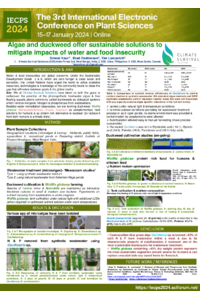
Earth is losing massive chunks of its freshwater reserves at unimaginable scales. Additionally, the conversion of evergreen forests into monoculture farmlands, for feed crops, is eroding soil ecosystems. Therefore, two crucial natural resources, namely water and soil, are being polluted and irreversibly lost, consequently leading to worldwide food and urban water insecurities. In this regard, algae and duckweed play marvelous roles in nutrient recycling and wastewater transformations as well as in directly and indirectly supporting the food pyramid. Due to their cosmopolitan distribution, microalgae can be grown worldwide. Some of the characteristic microalgae, such as mat-forming cyanobacteria or blue-green algae are potential scavengers of inorganic nutrients, which play crucial roles in urban wastewater management. We have isolated mat-forming blue-green algae called Oscillatoria that showed above 90% removal rates for both nitrogen and phosphorous when grown in a synthetic wastewater medium. Other species of microalgae, such as Desmodesmus, Scenedesmus, Ankistrodesmus and Botryococcus, which are also rich sources of lipids and fatty acids, are being tested for their nutrient recovery potential from different types of wastewater. We also cultivate and conduct R&D on various species of duckweed such as Lemna minor, Spirodella sp and Wolffia globosa with particular focus on the latter species. The W globosa grown in indoors under the uncontrolled natural sunlight and temperatures achieved a growth productivity of 33 gm/m2/day. The biomass of W. globosa consists of 30.09%, 41.2% and 6.25%carbohydrates, proteins and fats, respectively. Owing to its high nutritional value, we promote W. globosa as a nutritional alternative to soybean for livestock feed and as a protein-rich non-conventional nutrient source for humans. We have discussed the need to adopt algae and duckweed as two urgent and relevant solutions to mitigate the issues related to water and food insecurity.
Keywords
Algae
Duckweed
Spirodella
Wastewater
Wolffia globosa.
Poster
SimratKaur_CSSI_Rev poster.pdf
Response of specific leaf area to nutrient addition and competition release in Cistus ladanifer L.
Rwanda-native Tetradenia riparia (Hochst.) Codd: Phytochemical Profile, Antioxidant Toxicity, and Anti-Inflammatory and Immunomodulatory Effects