Event submissions
Published
This submission belongs to the session Session E. Plant Nutrition and Plant–Soil–Microorganism Interactions of the event The 3rd International Electronic Conference on Plant Sciences
Published date
19 Jan, 2024
Academic Editor
'%3e%3cpath%20d='M12.6657%2010.9104C12.4185%2010.325%2012.0599%209.79327%2011.6097%209.34482C11.1609%208.89508%2010.6293%208.5365%2010.0442%208.28888C10.0389%208.28626%2010.0337%208.28495%2010.0285%208.28233C10.8446%207.69279%2011.3752%206.73249%2011.3752%205.64904C11.3752%203.8542%209.92103%202.39999%208.1262%202.39999C6.33136%202.39999%204.87715%203.8542%204.87715%205.64904C4.87715%206.73249%205.40774%207.69279%206.22393%208.28364C6.21869%208.28626%206.21345%208.28757%206.20821%208.29019C5.62129%208.5378%205.09463%208.89284%204.64265%209.34613C4.1929%209.79493%203.83432%2010.3266%203.58671%2010.9117C3.34345%2011.4845%203.21226%2012.0987%203.20023%2012.7209C3.19988%2012.7349%203.20233%2012.7488%203.20744%2012.7619C3.21255%2012.7749%203.22022%2012.7867%203.22998%2012.7968C3.23975%2012.8068%203.25142%2012.8147%203.26431%2012.8202C3.2772%2012.8256%203.29105%2012.8284%203.30504%2012.8284H4.09109C4.14874%2012.8284%204.19459%2012.7825%204.1959%2012.7262C4.2221%2011.7148%204.62823%2010.7676%205.34617%2010.0497C6.08899%209.30683%207.0755%208.89808%208.1262%208.89808C9.17689%208.89808%2010.1634%209.30683%2010.9062%2010.0497C11.6242%2010.7676%2012.0303%2011.7148%2012.0565%2012.7262C12.0578%2012.7838%2012.1037%2012.8284%2012.1613%2012.8284H12.9474C12.9613%2012.8284%2012.9752%2012.8256%2012.9881%2012.8202C13.001%2012.8147%2013.0126%2012.8068%2013.0224%2012.7968C13.0322%2012.7867%2013.0398%2012.7749%2013.0449%2012.7619C13.0501%2012.7488%2013.0525%2012.7349%2013.0522%2012.7209C13.0391%2012.0947%2012.9094%2011.4855%2012.6657%2010.9104ZM8.1262%207.9024C7.52486%207.9024%206.9589%207.6679%206.53312%207.24211C6.10733%206.81633%205.87283%206.25037%205.87283%205.64904C5.87283%205.0477%206.10733%204.48174%206.53312%204.05596C6.9589%203.63018%207.52486%203.39567%208.1262%203.39567C8.72753%203.39567%209.29349%203.63018%209.71927%204.05596C10.1451%204.48174%2010.3796%205.0477%2010.3796%205.64904C10.3796%206.25037%2010.1451%206.81633%209.71927%207.24211C9.29349%207.6679%208.72753%207.9024%208.1262%207.9024Z'%20fill='%235D1EE1'/%3e%3c/g%3e%3c/svg%3e) Xinhua He
Xinhua HeCitation
Leonardo Morini, Claudio Ferrari, Marco Bartoli, Mindaugas Zilius, Elias Broman, Giovanna Visioli, Radial oxygen loss by Vallisneria spiralis affects microbial diversity and activity and pore-water chemistry in organic sediments., in Proceedings of The 3rd International Electronic Conference on Plant Sciences, 15 January–17 January 2024, MDPI: Basel, Switzerland
Share
Email
Facebook
Twitter
LinkedIn
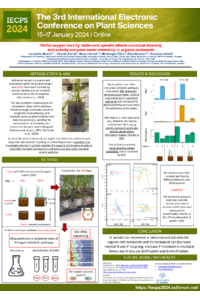
Radial oxygen loss by Vallisneria spiralis affects microbial diversity and activity and pore-water chemistry in organic sediments.
'%3e%3cpath%20d='M12.6647%2010.9104C12.4176%2010.325%2012.0589%209.7933%2011.6088%209.34485C11.16%208.89511%2010.6283%208.53653%2010.0432%208.28891C10.038%208.28629%2010.0327%208.28498%2010.0275%208.28236C10.8437%207.69282%2011.3743%206.73252%2011.3743%205.64907C11.3743%203.85423%209.92005%202.40002%208.12522%202.40002C6.33038%202.40002%204.87618%203.85423%204.87618%205.64907C4.87618%206.73252%205.40677%207.69282%206.22296%208.28367C6.21772%208.28629%206.21248%208.2876%206.20724%208.29022C5.62031%208.53783%205.09365%208.89287%204.64167%209.34616C4.19192%209.79496%203.83334%2010.3266%203.58573%2010.9117C3.34247%2011.4846%203.21128%2012.0987%203.19925%2012.721C3.1989%2012.735%203.20135%2012.7489%203.20646%2012.7619C3.21157%2012.7749%203.21924%2012.7868%203.22901%2012.7968C3.23877%2012.8068%203.25045%2012.8148%203.26334%2012.8202C3.27623%2012.8256%203.29007%2012.8284%203.30406%2012.8284H4.09012C4.14776%2012.8284%204.19362%2012.7825%204.19493%2012.7262C4.22113%2011.7148%204.62726%2010.7676%205.34519%2010.0497C6.08802%209.30686%207.07452%208.89811%208.12522%208.89811C9.17592%208.89811%2010.1624%209.30686%2010.9052%2010.0497C11.6232%2010.7676%2012.0293%2011.7148%2012.0555%2012.7262C12.0568%2012.7839%2012.1027%2012.8284%2012.1603%2012.8284H12.9464C12.9604%2012.8284%2012.9742%2012.8256%2012.9871%2012.8202C13%2012.8148%2013.0117%2012.8068%2013.0214%2012.7968C13.0312%2012.7868%2013.0389%2012.7749%2013.044%2012.7619C13.0491%2012.7489%2013.0515%2012.735%2013.0512%2012.721C13.0381%2012.0947%2012.9084%2011.4856%2012.6647%2010.9104ZM8.12522%207.90243C7.52388%207.90243%206.95792%207.66793%206.53214%207.24215C6.10636%206.81636%205.87185%206.2504%205.87185%205.64907C5.87185%205.04773%206.10636%204.48177%206.53214%204.05599C6.95792%203.63021%207.52388%203.3957%208.12522%203.3957C8.72655%203.3957%209.29252%203.63021%209.7183%204.05599C10.1441%204.48177%2010.3786%205.04773%2010.3786%205.64907C10.3786%206.2504%2010.1441%206.81636%209.7183%207.24215C9.29252%207.66793%208.72655%207.90243%208.12522%207.90243Z'%20fill='%235D1EE1'/%3e%3c/g%3e%3c/svg%3e)
Leonardo Morini 1
Claudio Ferrari 1

Marco Bartoli 1
Mindaugas Zilius 2
Elias Broman 3
Giovanna Visioli 1
1. Università di Parma
2. Klaipeda University
3. Stockholm University
Abstract
Submerged macrophytes provide a wide range of ecosystem services, including sediment retention, the reduction of nutrient recycling, nutrient loss and an improvement of pore water chemistry. The latter depends on the direct uptake of solutes and radial oxygen loss (ROL), increasing the volume of sediments where aerobic microbial metabolism is allowed. ROL is regulated by multiple factors, among which are the organic matter content of sediments and the plasticity of macrophytes, and specifically their response to chemically reduced conditions. By actively increasing aerenchyma macrophytes, we can enhance ROL and contrast potential sediment toxicity. In this work, the effects of ROL by Vallisneria spiralis in organic sediments were tested, focusing on N-related microbial communities, potential nitrification and denitrification and pore-water chemistry. To this end, control and organic-enriched (21% VS 9%) vegetated and unvegetated microcosms were realized, acclimatized under control conditions and then characterized.
Results suggest that ROL by V. spiralis significantly modified the composition of the microbial community and stimulated aerobic nitrification in both control and organic enriched sediments. They also suggest that ROL and the macrophyte uptake significantly decreased the pore-water nutrient concentrations, by at least five-fold. V. spiralis increases the oxic subsurface sediment volume where aerobic microbes can grow, thereby favoring the oxidation of reduced end metabolites and the assimilation of nutrients, decreasing concentration gradients and fluxes to the water column. Due to its easy transplantation, plasticity and adaptive capacity to grow in organic sediments, V. spiralis represents an interesting option as a nature-based solution to contrast eutrophication.
Keywords
Macrophyte
Biogeochemistry
Radial oxygen loss
Nitrogen cycle
Microcosms experiment
Poster
Poster_IECPS_Leonardo_Morini.pdf
Rwanda-native Tetradenia riparia (Hochst.) Codd: Phytochemical Profile, Antioxidant Toxicity, and Anti-Inflammatory and Immunomodulatory Effects
Artemisia herba-alba: A Promising Approach to Combating Arthritis Progression.