Event submissions
Published
This submission belongs to the session Session C. Plant Response to Stresses and Changing Environment of the event The 3rd International Electronic Conference on Plant Sciences
Published date
19 Jan, 2024
Academic Editor
'%3e%3cpath%20d='M12.6657%2010.9104C12.4185%2010.325%2012.0599%209.79327%2011.6097%209.34482C11.1609%208.89508%2010.6293%208.5365%2010.0442%208.28888C10.0389%208.28626%2010.0337%208.28495%2010.0285%208.28233C10.8446%207.69279%2011.3752%206.73249%2011.3752%205.64904C11.3752%203.8542%209.92103%202.39999%208.1262%202.39999C6.33136%202.39999%204.87715%203.8542%204.87715%205.64904C4.87715%206.73249%205.40774%207.69279%206.22393%208.28364C6.21869%208.28626%206.21345%208.28757%206.20821%208.29019C5.62129%208.5378%205.09463%208.89284%204.64265%209.34613C4.1929%209.79493%203.83432%2010.3266%203.58671%2010.9117C3.34345%2011.4845%203.21226%2012.0987%203.20023%2012.7209C3.19988%2012.7349%203.20233%2012.7488%203.20744%2012.7619C3.21255%2012.7749%203.22022%2012.7867%203.22998%2012.7968C3.23975%2012.8068%203.25142%2012.8147%203.26431%2012.8202C3.2772%2012.8256%203.29105%2012.8284%203.30504%2012.8284H4.09109C4.14874%2012.8284%204.19459%2012.7825%204.1959%2012.7262C4.2221%2011.7148%204.62823%2010.7676%205.34617%2010.0497C6.08899%209.30683%207.0755%208.89808%208.1262%208.89808C9.17689%208.89808%2010.1634%209.30683%2010.9062%2010.0497C11.6242%2010.7676%2012.0303%2011.7148%2012.0565%2012.7262C12.0578%2012.7838%2012.1037%2012.8284%2012.1613%2012.8284H12.9474C12.9613%2012.8284%2012.9752%2012.8256%2012.9881%2012.8202C13.001%2012.8147%2013.0126%2012.8068%2013.0224%2012.7968C13.0322%2012.7867%2013.0398%2012.7749%2013.0449%2012.7619C13.0501%2012.7488%2013.0525%2012.7349%2013.0522%2012.7209C13.0391%2012.0947%2012.9094%2011.4855%2012.6657%2010.9104ZM8.1262%207.9024C7.52486%207.9024%206.9589%207.6679%206.53312%207.24211C6.10733%206.81633%205.87283%206.25037%205.87283%205.64904C5.87283%205.0477%206.10733%204.48174%206.53312%204.05596C6.9589%203.63018%207.52486%203.39567%208.1262%203.39567C8.72753%203.39567%209.29349%203.63018%209.71927%204.05596C10.1451%204.48174%2010.3796%205.0477%2010.3796%205.64904C10.3796%206.25037%2010.1451%206.81633%209.71927%207.24211C9.29349%207.6679%208.72753%207.9024%208.1262%207.9024Z'%20fill='%235D1EE1'/%3e%3c/g%3e%3c/svg%3e) Maurizio Badiani
Maurizio BadianiCitation
Olena Bobrova, Alois Bilavčík, Jiri Zamecnik, Milos Faltus, The Cryopreservation of Dormant Buds of Raspberry (Rubus idaeus L.), in Proceedings of The 3rd International Electronic Conference on Plant Sciences, 15 January–17 January 2024, MDPI: Basel, Switzerland
Share
Email
Facebook
Twitter
LinkedIn
The Cryopreservation of Dormant Buds of Raspberry (Rubus idaeus L.)
'%3e%3cpath%20d='M12.6647%2010.9104C12.4176%2010.325%2012.0589%209.7933%2011.6088%209.34485C11.16%208.89511%2010.6283%208.53653%2010.0432%208.28891C10.038%208.28629%2010.0327%208.28498%2010.0275%208.28236C10.8437%207.69282%2011.3743%206.73252%2011.3743%205.64907C11.3743%203.85423%209.92005%202.40002%208.12522%202.40002C6.33038%202.40002%204.87618%203.85423%204.87618%205.64907C4.87618%206.73252%205.40677%207.69282%206.22296%208.28367C6.21772%208.28629%206.21248%208.2876%206.20724%208.29022C5.62031%208.53783%205.09365%208.89287%204.64167%209.34616C4.19192%209.79496%203.83334%2010.3266%203.58573%2010.9117C3.34247%2011.4846%203.21128%2012.0987%203.19925%2012.721C3.1989%2012.735%203.20135%2012.7489%203.20646%2012.7619C3.21157%2012.7749%203.21924%2012.7868%203.22901%2012.7968C3.23877%2012.8068%203.25045%2012.8148%203.26334%2012.8202C3.27623%2012.8256%203.29007%2012.8284%203.30406%2012.8284H4.09012C4.14776%2012.8284%204.19362%2012.7825%204.19493%2012.7262C4.22113%2011.7148%204.62726%2010.7676%205.34519%2010.0497C6.08802%209.30686%207.07452%208.89811%208.12522%208.89811C9.17592%208.89811%2010.1624%209.30686%2010.9052%2010.0497C11.6232%2010.7676%2012.0293%2011.7148%2012.0555%2012.7262C12.0568%2012.7839%2012.1027%2012.8284%2012.1603%2012.8284H12.9464C12.9604%2012.8284%2012.9742%2012.8256%2012.9871%2012.8202C13%2012.8148%2013.0117%2012.8068%2013.0214%2012.7968C13.0312%2012.7868%2013.0389%2012.7749%2013.044%2012.7619C13.0491%2012.7489%2013.0515%2012.735%2013.0512%2012.721C13.0381%2012.0947%2012.9084%2011.4856%2012.6647%2010.9104ZM8.12522%207.90243C7.52388%207.90243%206.95792%207.66793%206.53214%207.24215C6.10636%206.81636%205.87185%206.2504%205.87185%205.64907C5.87185%205.04773%206.10636%204.48177%206.53214%204.05599C6.95792%203.63021%207.52388%203.3957%208.12522%203.3957C8.72655%203.3957%209.29252%203.63021%209.7183%204.05599C10.1441%204.48177%2010.3786%205.04773%2010.3786%205.64907C10.3786%206.2504%2010.1441%206.81636%209.7183%207.24215C9.29252%207.66793%208.72655%207.90243%208.12522%207.90243Z'%20fill='%235D1EE1'/%3e%3c/g%3e%3c/svg%3e)
Olena Bobrova 1
Alois Bilavčík 2
Jiri Zamecnik 3
Milos Faltus 3
1. Plant Physiology and Cryobiology Team, Crop Research Institute, Czech Republic
Cryobiophysics Department, Institute for Problems of Cryobiology and Cryomedicine of the NAS of Ukraine
2. Plant Physiology and Cryobiology Team, Crop Research Institute, Czech Republic
3. Plant Physiology and Cryobiology Team, Crop Research Institute, Czech Republic
Abstract
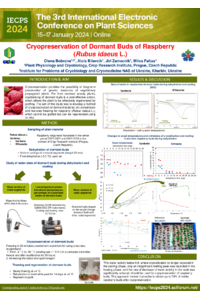
Cryoconservation provides the possibility of the long-term preservation of genetic resources of vegetatively propagated plants. For frost-resistant woody plants, the cryobanking of dormant buds is a cost-effective option which allows the plant to be effectively regenerated by grafting. The aim of this study was to develop a method of cryopreservation of dormant buds by pre-dehydration and two-step freezing for raspberry (Rubus idaeus L.), which cannot be grafted but can be regenerated in vitro. Shoots of raspberry (varieties Sanibelle and Willamette) were harvested in a dormant state in the midwinter season. Uniform cuttings of uninodal segments were dehydrated in a freezer. The low-temperature phase transitions, water state and water content were studied to determine the optimal level of dehydration of raspberry buds. The regeneration of plant material was carried out by rehydration in wet peat and regrowth in perlite. It was revealed that the melting point gradually decreased with dehydration as the concentration of solutes in the bud tissues increased. The crystallization temperature strongly decreased with increasing dehydration time, which indicated a significant increase in the tendency of water to supercool with a decrease in bud moisture. From certain level of dehydration, no crystallization was observed during the cooling phase, and the percentage of crystallized water was less than 1% during the heating phase. Dehydration to water activity below 0.9 significantly changed the dynamics of water activity decline, which correlated with the disappearance of water crystallized during the cooling phase. This water activity below 0.9, where crystallization no longer occurred in the cooling phase, only an insignificant melting peak was recorded in the heating phase, and the rate of decrease in water activity in the buds was significantly reduced, should be used for the cryopreservation of raspberry buds. This approach makes it possible to obtain up to 74% of viable raspberry buds after cryopreservation.
Keywords
raspberry
dormant buds
cryobanking
phase transitions
dehydration
water activity
Poster
Bobrova_poster.pdf
Artemisia herba-alba: A Promising Approach to Combating Arthritis Progression.
Identification and investigation of terrestrial/freshwater algal species with adaptive mechanisms to Cr(VI) stress