Event submissions
Published
This submission belongs to the session Session E. Plant Nutrition and Plant–Soil–Microorganism Interactions of the event The 3rd International Electronic Conference on Plant Sciences
Published date
19 Jan, 2024
Academic Editor
'%3e%3cpath%20d='M12.6657%2010.9104C12.4185%2010.325%2012.0599%209.79327%2011.6097%209.34482C11.1609%208.89508%2010.6293%208.5365%2010.0442%208.28888C10.0389%208.28626%2010.0337%208.28495%2010.0285%208.28233C10.8446%207.69279%2011.3752%206.73249%2011.3752%205.64904C11.3752%203.8542%209.92103%202.39999%208.1262%202.39999C6.33136%202.39999%204.87715%203.8542%204.87715%205.64904C4.87715%206.73249%205.40774%207.69279%206.22393%208.28364C6.21869%208.28626%206.21345%208.28757%206.20821%208.29019C5.62129%208.5378%205.09463%208.89284%204.64265%209.34613C4.1929%209.79493%203.83432%2010.3266%203.58671%2010.9117C3.34345%2011.4845%203.21226%2012.0987%203.20023%2012.7209C3.19988%2012.7349%203.20233%2012.7488%203.20744%2012.7619C3.21255%2012.7749%203.22022%2012.7867%203.22998%2012.7968C3.23975%2012.8068%203.25142%2012.8147%203.26431%2012.8202C3.2772%2012.8256%203.29105%2012.8284%203.30504%2012.8284H4.09109C4.14874%2012.8284%204.19459%2012.7825%204.1959%2012.7262C4.2221%2011.7148%204.62823%2010.7676%205.34617%2010.0497C6.08899%209.30683%207.0755%208.89808%208.1262%208.89808C9.17689%208.89808%2010.1634%209.30683%2010.9062%2010.0497C11.6242%2010.7676%2012.0303%2011.7148%2012.0565%2012.7262C12.0578%2012.7838%2012.1037%2012.8284%2012.1613%2012.8284H12.9474C12.9613%2012.8284%2012.9752%2012.8256%2012.9881%2012.8202C13.001%2012.8147%2013.0126%2012.8068%2013.0224%2012.7968C13.0322%2012.7867%2013.0398%2012.7749%2013.0449%2012.7619C13.0501%2012.7488%2013.0525%2012.7349%2013.0522%2012.7209C13.0391%2012.0947%2012.9094%2011.4855%2012.6657%2010.9104ZM8.1262%207.9024C7.52486%207.9024%206.9589%207.6679%206.53312%207.24211C6.10733%206.81633%205.87283%206.25037%205.87283%205.64904C5.87283%205.0477%206.10733%204.48174%206.53312%204.05596C6.9589%203.63018%207.52486%203.39567%208.1262%203.39567C8.72753%203.39567%209.29349%203.63018%209.71927%204.05596C10.1451%204.48174%2010.3796%205.0477%2010.3796%205.64904C10.3796%206.25037%2010.1451%206.81633%209.71927%207.24211C9.29349%207.6679%208.72753%207.9024%208.1262%207.9024Z'%20fill='%235D1EE1'/%3e%3c/g%3e%3c/svg%3e) Xinhua He
Xinhua HeCitation
Rodrigo Mauricio Ramírez, Pedro Rodriguez-Grados, Jean Piere Quiliche Durán, Sergio Contreras-Liza, José Montemayor Mantilla, Edison Goethe Palomares Anselmo, The use of bacterial consortia improves seed tuber production in potato varieties for frying, in Proceedings of The 3rd International Electronic Conference on Plant Sciences, 15 January–17 January 2024, MDPI: Basel, Switzerland
Share
Email
Facebook
Twitter
LinkedIn
The use of bacterial consortia improves seed tuber production in potato varieties for frying
'%3e%3cpath%20d='M12.6647%2010.9104C12.4176%2010.325%2012.0589%209.7933%2011.6088%209.34485C11.16%208.89511%2010.6283%208.53653%2010.0432%208.28891C10.038%208.28629%2010.0327%208.28498%2010.0275%208.28236C10.8437%207.69282%2011.3743%206.73252%2011.3743%205.64907C11.3743%203.85423%209.92005%202.40002%208.12522%202.40002C6.33038%202.40002%204.87618%203.85423%204.87618%205.64907C4.87618%206.73252%205.40677%207.69282%206.22296%208.28367C6.21772%208.28629%206.21248%208.2876%206.20724%208.29022C5.62031%208.53783%205.09365%208.89287%204.64167%209.34616C4.19192%209.79496%203.83334%2010.3266%203.58573%2010.9117C3.34247%2011.4846%203.21128%2012.0987%203.19925%2012.721C3.1989%2012.735%203.20135%2012.7489%203.20646%2012.7619C3.21157%2012.7749%203.21924%2012.7868%203.22901%2012.7968C3.23877%2012.8068%203.25045%2012.8148%203.26334%2012.8202C3.27623%2012.8256%203.29007%2012.8284%203.30406%2012.8284H4.09012C4.14776%2012.8284%204.19362%2012.7825%204.19493%2012.7262C4.22113%2011.7148%204.62726%2010.7676%205.34519%2010.0497C6.08802%209.30686%207.07452%208.89811%208.12522%208.89811C9.17592%208.89811%2010.1624%209.30686%2010.9052%2010.0497C11.6232%2010.7676%2012.0293%2011.7148%2012.0555%2012.7262C12.0568%2012.7839%2012.1027%2012.8284%2012.1603%2012.8284H12.9464C12.9604%2012.8284%2012.9742%2012.8256%2012.9871%2012.8202C13%2012.8148%2013.0117%2012.8068%2013.0214%2012.7968C13.0312%2012.7868%2013.0389%2012.7749%2013.044%2012.7619C13.0491%2012.7489%2013.0515%2012.735%2013.0512%2012.721C13.0381%2012.0947%2012.9084%2011.4856%2012.6647%2010.9104ZM8.12522%207.90243C7.52388%207.90243%206.95792%207.66793%206.53214%207.24215C6.10636%206.81636%205.87185%206.2504%205.87185%205.64907C5.87185%205.04773%206.10636%204.48177%206.53214%204.05599C6.95792%203.63021%207.52388%203.3957%208.12522%203.3957C8.72655%203.3957%209.29252%203.63021%209.7183%204.05599C10.1441%204.48177%2010.3786%205.04773%2010.3786%205.64907C10.3786%206.2504%2010.1441%206.81636%209.7183%207.24215C9.29252%207.66793%208.72655%207.90243%208.12522%207.90243Z'%20fill='%235D1EE1'/%3e%3c/g%3e%3c/svg%3e)
Rodrigo Mauricio Ramírez 1

Pedro Rodriguez-Grados 1
Jean Piere Quiliche Durán 2

Sergio Contreras-Liza 1
José Montemayor Mantilla 1
Edison Goethe Palomares Anselmo 1
1. Universidad Nacional Jose Faustino Sanchez Carrion
2. Universidade São Paulo
Abstract
Objective: To determine the effect of a consortium of growth-promoting rhizobacteria on potato varieties for frying under controlled conditions. Methodology: The research was conducted at the Universidad Nacional José Faustino Sánchez Carrión, Huacho, Peru. The experiment was carried out in pots in a greenhouse using a completely randomized design with six replications, under a factorial arrangement. Four potato genotypes were used for frying (cv. Bicentenaria, advanced clones UH-9, CIP 396311.1, and CIP 399101.1), and four inoculant treatments (Azotobacter sp. (T1), Azotobacter sp.+ Bacillus simplex (T2), Azotobacter sp.+ B. subtilis (T3), and Azotobacter sp.+ B. subtilis+ B. simplex (T4)) and an uninoculated control (T0) were also used. The variables studied were vegetative vigor, plant height, the number of stems per plant, the number of leaves per plant, fresh and dry weight per plant, tuber diameter, and the number and weight of tubers per plant. Data were statistically processed and analyzed by performing Scott—Knott's comparison of treatments and principal component analysis. Results: The inoculation alone with Azotobacter sp. (T1) or with the consortium Azotobacter sp.+ B. simplex+ B. subtilis (T4) significantly promoted potato growth with respect to the number of stems and the number of leaves per plant, as well as the weight and number of tubers per plant; for vegetative vigor, the control treatment (T0) obtained differences in comparison with the inoculated treatments. Plant height, the number of shoots, the fresh and dry weight of foliage, and tuber diameter did not show significant differences due to the effect of the inoculation. Interactions between varieties and treatments were found for vegetative vigor, and the number of leaves and tubers per plant was positive for the inoculation with some bacterial consortia. Conclusion: Bacterial consortia with Azotobacter sp. were found to promote the growth and productivity of potato varieties for processing under greenhouse conditions.
Keywords
Rhizobacteria
potato clones
inoculation
plant-microbe interaction
greenhouse
Poster
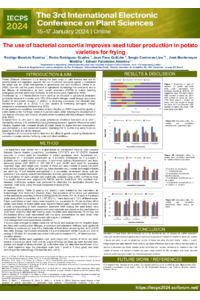
Poster Contreras et al. 2024.pptx.pdf
Identification and investigation of terrestrial/freshwater algal species with adaptive mechanisms to Cr(VI) stress
Pharmacognostic study of the rare Saponaria sicula Raf. in relation to different pedo-climatic conditions.