Event submissions
Published
This submission belongs to the session Session A. Plant Physiology Signaling and Communication of the event The 3rd International Electronic Conference on Plant Sciences
Published date
19 Jan, 2024
Academic Editor
'%3e%3cpath%20d='M12.6657%2010.9104C12.4185%2010.325%2012.0599%209.79327%2011.6097%209.34482C11.1609%208.89508%2010.6293%208.5365%2010.0442%208.28888C10.0389%208.28626%2010.0337%208.28495%2010.0285%208.28233C10.8446%207.69279%2011.3752%206.73249%2011.3752%205.64904C11.3752%203.8542%209.92103%202.39999%208.1262%202.39999C6.33136%202.39999%204.87715%203.8542%204.87715%205.64904C4.87715%206.73249%205.40774%207.69279%206.22393%208.28364C6.21869%208.28626%206.21345%208.28757%206.20821%208.29019C5.62129%208.5378%205.09463%208.89284%204.64265%209.34613C4.1929%209.79493%203.83432%2010.3266%203.58671%2010.9117C3.34345%2011.4845%203.21226%2012.0987%203.20023%2012.7209C3.19988%2012.7349%203.20233%2012.7488%203.20744%2012.7619C3.21255%2012.7749%203.22022%2012.7867%203.22998%2012.7968C3.23975%2012.8068%203.25142%2012.8147%203.26431%2012.8202C3.2772%2012.8256%203.29105%2012.8284%203.30504%2012.8284H4.09109C4.14874%2012.8284%204.19459%2012.7825%204.1959%2012.7262C4.2221%2011.7148%204.62823%2010.7676%205.34617%2010.0497C6.08899%209.30683%207.0755%208.89808%208.1262%208.89808C9.17689%208.89808%2010.1634%209.30683%2010.9062%2010.0497C11.6242%2010.7676%2012.0303%2011.7148%2012.0565%2012.7262C12.0578%2012.7838%2012.1037%2012.8284%2012.1613%2012.8284H12.9474C12.9613%2012.8284%2012.9752%2012.8256%2012.9881%2012.8202C13.001%2012.8147%2013.0126%2012.8068%2013.0224%2012.7968C13.0322%2012.7867%2013.0398%2012.7749%2013.0449%2012.7619C13.0501%2012.7488%2013.0525%2012.7349%2013.0522%2012.7209C13.0391%2012.0947%2012.9094%2011.4855%2012.6657%2010.9104ZM8.1262%207.9024C7.52486%207.9024%206.9589%207.6679%206.53312%207.24211C6.10733%206.81633%205.87283%206.25037%205.87283%205.64904C5.87283%205.0477%206.10733%204.48174%206.53312%204.05596C6.9589%203.63018%207.52486%203.39567%208.1262%203.39567C8.72753%203.39567%209.29349%203.63018%209.71927%204.05596C10.1451%204.48174%2010.3796%205.0477%2010.3796%205.64904C10.3796%206.25037%2010.1451%206.81633%209.71927%207.24211C9.29349%207.6679%208.72753%207.9024%208.1262%207.9024Z'%20fill='%235D1EE1'/%3e%3c/g%3e%3c/svg%3e) Luigi De Bellis
Luigi De BellisCitation
Giulia Giovanna Salerno, Eugenia Polverini, Stefano Bruno, Ada Ricci, Does an auxin-adjuvant urea derivative interfere with the vascular pattern formation? Preliminary results, in Proceedings of The 3rd International Electronic Conference on Plant Sciences, 15 January–17 January 2024, MDPI: Basel, Switzerland
Share
Email
Facebook
Twitter
LinkedIn
Does an auxin-adjuvant urea derivative interfere with the vascular pattern formation? Preliminary results
'%3e%3cpath%20d='M12.6647%2010.9104C12.4176%2010.325%2012.0589%209.7933%2011.6088%209.34485C11.16%208.89511%2010.6283%208.53653%2010.0432%208.28891C10.038%208.28629%2010.0327%208.28498%2010.0275%208.28236C10.8437%207.69282%2011.3743%206.73252%2011.3743%205.64907C11.3743%203.85423%209.92005%202.40002%208.12522%202.40002C6.33038%202.40002%204.87618%203.85423%204.87618%205.64907C4.87618%206.73252%205.40677%207.69282%206.22296%208.28367C6.21772%208.28629%206.21248%208.2876%206.20724%208.29022C5.62031%208.53783%205.09365%208.89287%204.64167%209.34616C4.19192%209.79496%203.83334%2010.3266%203.58573%2010.9117C3.34247%2011.4846%203.21128%2012.0987%203.19925%2012.721C3.1989%2012.735%203.20135%2012.7489%203.20646%2012.7619C3.21157%2012.7749%203.21924%2012.7868%203.22901%2012.7968C3.23877%2012.8068%203.25045%2012.8148%203.26334%2012.8202C3.27623%2012.8256%203.29007%2012.8284%203.30406%2012.8284H4.09012C4.14776%2012.8284%204.19362%2012.7825%204.19493%2012.7262C4.22113%2011.7148%204.62726%2010.7676%205.34519%2010.0497C6.08802%209.30686%207.07452%208.89811%208.12522%208.89811C9.17592%208.89811%2010.1624%209.30686%2010.9052%2010.0497C11.6232%2010.7676%2012.0293%2011.7148%2012.0555%2012.7262C12.0568%2012.7839%2012.1027%2012.8284%2012.1603%2012.8284H12.9464C12.9604%2012.8284%2012.9742%2012.8256%2012.9871%2012.8202C13%2012.8148%2013.0117%2012.8068%2013.0214%2012.7968C13.0312%2012.7868%2013.0389%2012.7749%2013.044%2012.7619C13.0491%2012.7489%2013.0515%2012.735%2013.0512%2012.721C13.0381%2012.0947%2012.9084%2011.4856%2012.6647%2010.9104ZM8.12522%207.90243C7.52388%207.90243%206.95792%207.66793%206.53214%207.24215C6.10636%206.81636%205.87185%206.2504%205.87185%205.64907C5.87185%205.04773%206.10636%204.48177%206.53214%204.05599C6.95792%203.63021%207.52388%203.3957%208.12522%203.3957C8.72655%203.3957%209.29252%203.63021%209.7183%204.05599C10.1441%204.48177%2010.3786%205.04773%2010.3786%205.64907C10.3786%206.2504%2010.1441%206.81636%209.7183%207.24215C9.29252%207.66793%208.72655%207.90243%208.12522%207.90243Z'%20fill='%235D1EE1'/%3e%3c/g%3e%3c/svg%3e)
Giulia Giovanna Salerno 1
Eugenia Polverini 2
Stefano Bruno 3
Ada Ricci 4
1. Dipartimento di Scienze Chimiche, della Vita e della Sostenibilità Ambientale, Università di Parma. Parma, Italy
2. Dipartimento di Scienze Matematiche, Fisiche e Informatiche, Università di Parma, Parma, Italy
3. Dipartimento di Scienze degli Alimenti e del Farmaco, Università di Parma, Parma, Italy
4. Department of Chemistry, Life Sciences and Environmental Sustainability
Abstract
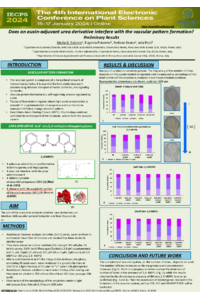
The vascular system is essential for land plants by providing long-distance transportation for water, nutrients, and signaling molecules. Our knowledge about its structure comes from the study of the continuous conductive system of Arabidopsis leaves, composed of interconnected veins organized in a hierarchical network: single primary veins, loops of secondary veins, lateral veins, marginal veins, and tertiary-connected veins. Auxin is a key factor guiding the vascular network differentiation in all organs, and continuous polar auxin transportation reflects the continuity of conductive tissues. Indeed, auxin cell-to-cell movement involves at least influx and efflux carriers located at the plasma membrane (AUX1/LIKE AUX1 family and PIN-FORMED family, respectively) and receptor/receptors through which an auxin signaling mechanism operates. According to the canalization hypothesis, auxin induces the formation of self-organizing channels via a feedback regulation of its own transport.
Auxin-binding protein 1 (ABP1) is the first auxin-binding protein identified, predominantly located in the endoplasmic reticulum, while a small fraction remains in the apoplast. In this acidic region, it binds with auxin by acting as a receptor that mediates auxin canalization.
Here, we report preliminary results based on the interference between ABP1 and an auxin-adjuvant urea derivative, the N,N'-bis(2,3-methylenedioxyphenyl)urea (2,3-MDPU).
The simple and regular vein patterns of Arabidopsis cotyledons will be used to study the effects of this urea derivative on vascular development.
Keywords
Vasculature
ABP1 receptor
urea derivative
Poster
Poster 2024 ABP1.pdf
Mycorrhizal inoculation affects oxidative stress response in wheat plants under manganese stress.
ANTI-PHYTOVIRAL AND CYTOTOXIC ACTIVITY OF HYDROSOL AND METHANOLIC EXTRACT OF THE SPECIES Seseli tomentosum Vis.