Event submissions
Published
This submission belongs to the session Session C. Plant Response to Stresses and Changing Environment of the event The 3rd International Electronic Conference on Plant Sciences
Published date
19 Jan, 2024
Academic Editor
'%3e%3cpath%20d='M12.6657%2010.9104C12.4185%2010.325%2012.0599%209.79327%2011.6097%209.34482C11.1609%208.89508%2010.6293%208.5365%2010.0442%208.28888C10.0389%208.28626%2010.0337%208.28495%2010.0285%208.28233C10.8446%207.69279%2011.3752%206.73249%2011.3752%205.64904C11.3752%203.8542%209.92103%202.39999%208.1262%202.39999C6.33136%202.39999%204.87715%203.8542%204.87715%205.64904C4.87715%206.73249%205.40774%207.69279%206.22393%208.28364C6.21869%208.28626%206.21345%208.28757%206.20821%208.29019C5.62129%208.5378%205.09463%208.89284%204.64265%209.34613C4.1929%209.79493%203.83432%2010.3266%203.58671%2010.9117C3.34345%2011.4845%203.21226%2012.0987%203.20023%2012.7209C3.19988%2012.7349%203.20233%2012.7488%203.20744%2012.7619C3.21255%2012.7749%203.22022%2012.7867%203.22998%2012.7968C3.23975%2012.8068%203.25142%2012.8147%203.26431%2012.8202C3.2772%2012.8256%203.29105%2012.8284%203.30504%2012.8284H4.09109C4.14874%2012.8284%204.19459%2012.7825%204.1959%2012.7262C4.2221%2011.7148%204.62823%2010.7676%205.34617%2010.0497C6.08899%209.30683%207.0755%208.89808%208.1262%208.89808C9.17689%208.89808%2010.1634%209.30683%2010.9062%2010.0497C11.6242%2010.7676%2012.0303%2011.7148%2012.0565%2012.7262C12.0578%2012.7838%2012.1037%2012.8284%2012.1613%2012.8284H12.9474C12.9613%2012.8284%2012.9752%2012.8256%2012.9881%2012.8202C13.001%2012.8147%2013.0126%2012.8068%2013.0224%2012.7968C13.0322%2012.7867%2013.0398%2012.7749%2013.0449%2012.7619C13.0501%2012.7488%2013.0525%2012.7349%2013.0522%2012.7209C13.0391%2012.0947%2012.9094%2011.4855%2012.6657%2010.9104ZM8.1262%207.9024C7.52486%207.9024%206.9589%207.6679%206.53312%207.24211C6.10733%206.81633%205.87283%206.25037%205.87283%205.64904C5.87283%205.0477%206.10733%204.48174%206.53312%204.05596C6.9589%203.63018%207.52486%203.39567%208.1262%203.39567C8.72753%203.39567%209.29349%203.63018%209.71927%204.05596C10.1451%204.48174%2010.3796%205.0477%2010.3796%205.64904C10.3796%206.25037%2010.1451%206.81633%209.71927%207.24211C9.29349%207.6679%208.72753%207.9024%208.1262%207.9024Z'%20fill='%235D1EE1'/%3e%3c/g%3e%3c/svg%3e) Giovanna Visioli
Giovanna VisioliCitation
Leonardo Coviello, Antonella Vitti, Antonio Franco, Giovanni Lomonaco, Antonio Dolce, Patrizia Falabella, Maria Nuzzaci, Exploring frass deriving from Hermetia illucens as a new sustainable tool for inducing biostimulant and antifungal activities in wheat and tomato against Fusarium spp., in Proceedings of The 3rd International Electronic Conference on Plant Sciences, 15 January–17 January 2024, MDPI: Basel, Switzerland
Share
Email
Facebook
Twitter
LinkedIn
Exploring frass deriving from Hermetia illucens as a new sustainable tool for inducing biostimulant and antifungal activities in wheat and tomato against Fusarium spp.
'%3e%3cpath%20d='M12.6647%2010.9104C12.4176%2010.325%2012.0589%209.7933%2011.6088%209.34485C11.16%208.89511%2010.6283%208.53653%2010.0432%208.28891C10.038%208.28629%2010.0327%208.28498%2010.0275%208.28236C10.8437%207.69282%2011.3743%206.73252%2011.3743%205.64907C11.3743%203.85423%209.92005%202.40002%208.12522%202.40002C6.33038%202.40002%204.87618%203.85423%204.87618%205.64907C4.87618%206.73252%205.40677%207.69282%206.22296%208.28367C6.21772%208.28629%206.21248%208.2876%206.20724%208.29022C5.62031%208.53783%205.09365%208.89287%204.64167%209.34616C4.19192%209.79496%203.83334%2010.3266%203.58573%2010.9117C3.34247%2011.4846%203.21128%2012.0987%203.19925%2012.721C3.1989%2012.735%203.20135%2012.7489%203.20646%2012.7619C3.21157%2012.7749%203.21924%2012.7868%203.22901%2012.7968C3.23877%2012.8068%203.25045%2012.8148%203.26334%2012.8202C3.27623%2012.8256%203.29007%2012.8284%203.30406%2012.8284H4.09012C4.14776%2012.8284%204.19362%2012.7825%204.19493%2012.7262C4.22113%2011.7148%204.62726%2010.7676%205.34519%2010.0497C6.08802%209.30686%207.07452%208.89811%208.12522%208.89811C9.17592%208.89811%2010.1624%209.30686%2010.9052%2010.0497C11.6232%2010.7676%2012.0293%2011.7148%2012.0555%2012.7262C12.0568%2012.7839%2012.1027%2012.8284%2012.1603%2012.8284H12.9464C12.9604%2012.8284%2012.9742%2012.8256%2012.9871%2012.8202C13%2012.8148%2013.0117%2012.8068%2013.0214%2012.7968C13.0312%2012.7868%2013.0389%2012.7749%2013.044%2012.7619C13.0491%2012.7489%2013.0515%2012.735%2013.0512%2012.721C13.0381%2012.0947%2012.9084%2011.4856%2012.6647%2010.9104ZM8.12522%207.90243C7.52388%207.90243%206.95792%207.66793%206.53214%207.24215C6.10636%206.81636%205.87185%206.2504%205.87185%205.64907C5.87185%205.04773%206.10636%204.48177%206.53214%204.05599C6.95792%203.63021%207.52388%203.3957%208.12522%203.3957C8.72655%203.3957%209.29252%203.63021%209.7183%204.05599C10.1441%204.48177%2010.3786%205.04773%2010.3786%205.64907C10.3786%206.2504%2010.1441%206.81636%209.7183%207.24215C9.29252%207.66793%208.72655%207.90243%208.12522%207.90243Z'%20fill='%235D1EE1'/%3e%3c/g%3e%3c/svg%3e)
Leonardo Coviello 1

Antonella Vitti 1
Antonio Franco 2
Giovanni Lomonaco 2
Antonio Dolce 2

Patrizia Falabella 2
Maria Nuzzaci 1
1. School of Agricultural, Forestry, Food and Environmental Sciences, University of Basilicata, 85100 Potenza, Italy
2. Department of Science, University of Basilicata, 85100 Potenza, Italy
Abstract
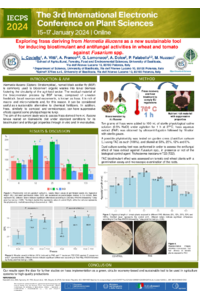
Hermetia illucens (Diptera: Stratiomyidae) is commonly used as a bioconverter insect of organic wastes during its larval stage in order to obtain chitin (and its derivatives) and foster the circularity of the agri-food sector. The residual material of this bioconversion process using black soldier fly larvae, composed of larval excreta, exuviate and uneaten feedstock, is known as frass. It is rich in macro- and micro-nutrients and, for this reason, can be considered a secondary by-product usable as a sustainable alternative to chemical fertilizers. In addition, frass, similarly to compost and vermicompost, can exhibit suppressive effects against some phytopathogenic fungi. In this study, frass from H. illucens pupae reared on the Gainesville diet under standard conditions was investigated with in vitro and in vivo studies to assess its biostimulant and antifungal properties. The in vitro assay demonstrated that the frass aqueous extract (FAE) added in the media was able to stimulate the germination of seeds of the test plant cress (Lepidium sativum L.), never being phytotoxic. In addition, FAE inhibited the mycelial growth of soil-borne pathogens Fusarium oxysporum f.sp. lycopersici and F. sporotrichioides (by 30% and 49%, respectively). Moreover, when synergistically used with other antagonists, such as Trichoderma harzianum, FAE did not disturb their effectiveness in controlling phytopathogenic fungi. Germination tests on tomato (Solanum lycopersicum L. var cerasiforme) and durum wheat (Triticum durum Desf. var Simeto) seeds infected with the same above-mentioned fungi indicated that FAE was able to induce antifungal and biostimulant effects, especially with regard to lateral root branching and radicle length in tomato and wheat, respectively. In conclusion, our results open the door for further studies that use frass as a green, circular-economy-based, and sustainable tool in agriculture systems.
Keywords
Black soldier fly
Fusarium oxysporum f.sp. lycopersici
Fusarium sporotrichioides
fungal disease control
Poster
Coviello et al._poster_IECPS 2024.pdf
ANTI-PHYTOVIRAL AND CYTOTOXIC ACTIVITY OF HYDROSOL AND METHANOLIC EXTRACT OF THE SPECIES Seseli tomentosum Vis.
Salinity stress-mediated phenotypic, biochemical and microscopic assessment of two flaxseed cultivars having contrasting lignan content