Event submissions
Published
This submission belongs to the session Session F. Plant Molecular Biology and Plant Genetics, Genomics and Biotechnology of the event The 3rd International Electronic Conference on Plant Sciences
Published date
19 Jan, 2024
Academic Editor
'%3e%3cpath%20d='M12.6657%2010.9104C12.4185%2010.325%2012.0599%209.79327%2011.6097%209.34482C11.1609%208.89508%2010.6293%208.5365%2010.0442%208.28888C10.0389%208.28626%2010.0337%208.28495%2010.0285%208.28233C10.8446%207.69279%2011.3752%206.73249%2011.3752%205.64904C11.3752%203.8542%209.92103%202.39999%208.1262%202.39999C6.33136%202.39999%204.87715%203.8542%204.87715%205.64904C4.87715%206.73249%205.40774%207.69279%206.22393%208.28364C6.21869%208.28626%206.21345%208.28757%206.20821%208.29019C5.62129%208.5378%205.09463%208.89284%204.64265%209.34613C4.1929%209.79493%203.83432%2010.3266%203.58671%2010.9117C3.34345%2011.4845%203.21226%2012.0987%203.20023%2012.7209C3.19988%2012.7349%203.20233%2012.7488%203.20744%2012.7619C3.21255%2012.7749%203.22022%2012.7867%203.22998%2012.7968C3.23975%2012.8068%203.25142%2012.8147%203.26431%2012.8202C3.2772%2012.8256%203.29105%2012.8284%203.30504%2012.8284H4.09109C4.14874%2012.8284%204.19459%2012.7825%204.1959%2012.7262C4.2221%2011.7148%204.62823%2010.7676%205.34617%2010.0497C6.08899%209.30683%207.0755%208.89808%208.1262%208.89808C9.17689%208.89808%2010.1634%209.30683%2010.9062%2010.0497C11.6242%2010.7676%2012.0303%2011.7148%2012.0565%2012.7262C12.0578%2012.7838%2012.1037%2012.8284%2012.1613%2012.8284H12.9474C12.9613%2012.8284%2012.9752%2012.8256%2012.9881%2012.8202C13.001%2012.8147%2013.0126%2012.8068%2013.0224%2012.7968C13.0322%2012.7867%2013.0398%2012.7749%2013.0449%2012.7619C13.0501%2012.7488%2013.0525%2012.7349%2013.0522%2012.7209C13.0391%2012.0947%2012.9094%2011.4855%2012.6657%2010.9104ZM8.1262%207.9024C7.52486%207.9024%206.9589%207.6679%206.53312%207.24211C6.10733%206.81633%205.87283%206.25037%205.87283%205.64904C5.87283%205.0477%206.10733%204.48174%206.53312%204.05596C6.9589%203.63018%207.52486%203.39567%208.1262%203.39567C8.72753%203.39567%209.29349%203.63018%209.71927%204.05596C10.1451%204.48174%2010.3796%205.0477%2010.3796%205.64904C10.3796%206.25037%2010.1451%206.81633%209.71927%207.24211C9.29349%207.6679%208.72753%207.9024%208.1262%207.9024Z'%20fill='%235D1EE1'/%3e%3c/g%3e%3c/svg%3e) Pandiyan Muthuramalingam
Pandiyan MuthuramalingamCitation
Julieta Andrea Silva de Almeida, Maria Bernadete Silvarolla, Julio César Mistro, Paulo Sérgio da Silva Coelho, Elaine Mantovani Satorres, The effect of sucrose and a gelling agent on the direct somatic embryogenesis capacity of decaffeinated genotypes of Coffea arabica L., in Proceedings of The 3rd International Electronic Conference on Plant Sciences, 15 January–17 January 2024, MDPI: Basel, Switzerland
Share
Email
Facebook
Twitter
LinkedIn
The effect of sucrose and a gelling agent on the direct somatic embryogenesis capacity of decaffeinated genotypes of Coffea arabica L.
'%3e%3cpath%20d='M12.6647%2010.9104C12.4176%2010.325%2012.0589%209.7933%2011.6088%209.34485C11.16%208.89511%2010.6283%208.53653%2010.0432%208.28891C10.038%208.28629%2010.0327%208.28498%2010.0275%208.28236C10.8437%207.69282%2011.3743%206.73252%2011.3743%205.64907C11.3743%203.85423%209.92005%202.40002%208.12522%202.40002C6.33038%202.40002%204.87618%203.85423%204.87618%205.64907C4.87618%206.73252%205.40677%207.69282%206.22296%208.28367C6.21772%208.28629%206.21248%208.2876%206.20724%208.29022C5.62031%208.53783%205.09365%208.89287%204.64167%209.34616C4.19192%209.79496%203.83334%2010.3266%203.58573%2010.9117C3.34247%2011.4846%203.21128%2012.0987%203.19925%2012.721C3.1989%2012.735%203.20135%2012.7489%203.20646%2012.7619C3.21157%2012.7749%203.21924%2012.7868%203.22901%2012.7968C3.23877%2012.8068%203.25045%2012.8148%203.26334%2012.8202C3.27623%2012.8256%203.29007%2012.8284%203.30406%2012.8284H4.09012C4.14776%2012.8284%204.19362%2012.7825%204.19493%2012.7262C4.22113%2011.7148%204.62726%2010.7676%205.34519%2010.0497C6.08802%209.30686%207.07452%208.89811%208.12522%208.89811C9.17592%208.89811%2010.1624%209.30686%2010.9052%2010.0497C11.6232%2010.7676%2012.0293%2011.7148%2012.0555%2012.7262C12.0568%2012.7839%2012.1027%2012.8284%2012.1603%2012.8284H12.9464C12.9604%2012.8284%2012.9742%2012.8256%2012.9871%2012.8202C13%2012.8148%2013.0117%2012.8068%2013.0214%2012.7968C13.0312%2012.7868%2013.0389%2012.7749%2013.044%2012.7619C13.0491%2012.7489%2013.0515%2012.735%2013.0512%2012.721C13.0381%2012.0947%2012.9084%2011.4856%2012.6647%2010.9104ZM8.12522%207.90243C7.52388%207.90243%206.95792%207.66793%206.53214%207.24215C6.10636%206.81636%205.87185%206.2504%205.87185%205.64907C5.87185%205.04773%206.10636%204.48177%206.53214%204.05599C6.95792%203.63021%207.52388%203.3957%208.12522%203.3957C8.72655%203.3957%209.29252%203.63021%209.7183%204.05599C10.1441%204.48177%2010.3786%205.04773%2010.3786%205.64907C10.3786%206.2504%2010.1441%206.81636%209.7183%207.24215C9.29252%207.66793%208.72655%207.90243%208.12522%207.90243Z'%20fill='%235D1EE1'/%3e%3c/g%3e%3c/svg%3e)
Julieta Andrea Silva de Almeida 1
Maria Bernadete Silvarolla 1
Julio César Mistro 1
Paulo Sérgio da Silva Coelho 2
Elaine Mantovani Satorres 1
1. Centro de Café “Alcides Carvalho”, Instituto Agronômico de Campinas, Campinas, São Paulo, Brasil
2. Centro de Horticultura, Instituto Agronômico de Campinas, Campinas, São Paulo, Brasil
Abstract
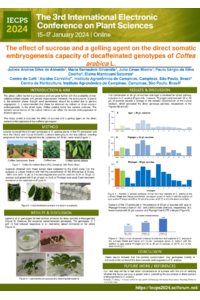
The global coffee market is prosperous and can grow further with the availability of low-caffeine coffees created with genetic improvement. However, the multiplication of these plants by seed germination is avoided due to genetic segregation, and indirect or direct somatic embryogenesis is recommended. In the direct route, Coffea arabica forms few somatic embryos. The osmotic concentration of the culture medium can affect the somatic embryogenesis of different species. This study aimed to evaluate the effect of sucrose and a gelling agent on the direct somatic embryogenesis of low-caffeine genotypes. Leaves collected from thirteen genotypes of C. arabica plants in the F3 generation and from the Obatã and Catuaí Vermelho cultivars belonging to the low-caffeine breeding program of the Instituto Agronômico de Campinas, SP, were used. Explants obtained from these leaves were subjected to the direct route. For this purpose, a culture medium with half the concentration of MS salts with 10 µM of 2-Isopentenyladenine and the addition of 20 or 30 g/L of sucrose and gelled with 5 g/L of agar or 2 g/L of Phytagel was used. Each treatment consisted of ten replications. Explants of all genotypes formed somatic embryos, but 2, 7 and 14 had lower responses. Explants of the 13 genotypes in the presence of 20 g/L of sucrose with agar or Phytagel formed a total of 1,821 and 2,645 somatic embryos, respectively. However, those treated with 30 g/L sucrose and Phytagel had 3775 embryos. The combination of 20 g/L of sucrose and agar is standard for direct pathway induction in C. arabica. However, Phytagel combined (or not) with 30 g/L of sucrose caused a change in the osmotic concentration of the culture medium, which promoted the direct genotype pathway. These results indicate that the osmotic concentration may participate directly or indirectly in the control of the direct somatic embryogenesis of C. arabica.
Keywords
Coffea
osmotic concentration
somatic embryo
Poster
sciforum-084684 - Julieta Almeida x 17 01 24.pdf
Elicitation by Organic Compounds for Inducing Defenses in Alstroemeria sp. against Frankliniella occidentalis (Pergande)
Synthesis of acibenzolar-S-methyl analogs derived from salicylic acid and 4-hydroxybenzaldehyde: DFT B3LYP computational study and molecular docking against enzymatic targets of biological interest